Categories
STARTERS/SIDES

Chicken liver parfait


Serve with figs, grapes and herb salad and whole-wheat bread

Make this silky and rich parfait at least a day in advance if possible so the flavors can fully develop and mature.  Go to the extra trouble with the sieving by pushing the mixture through twice.  This will guarantee the parfait’s smooth and delicate texture.
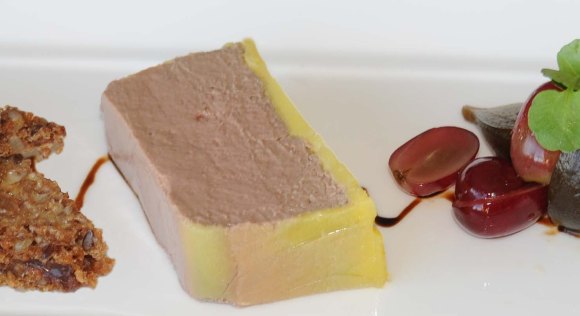
Chicken liver pave

For the parfait:
1¾ cup milk
400 g/14 oz chicken livers, trimmed
2 tablespoons olive oil
1 medium shallot, finely chopped
1 garlic clove, finely chopped
1 sprig of thyme
3 tablespoons brandy
3 tablespoons port
3 tablespoons of Madeira
50 g/1.8 oz clarified butter*, melted
3 eggs
1 egg yolk
salt and freshly ground black pepper
300 g/10.5 oz butter, melted (to seal the parfait)
balsamic glaze for drizzling


Clarified butter
This is butter that has had the whey and the milk solids removed which allows the butter to be heated to a higher temperature without burning.
To make clarified butter:
Heat the butter in a saucepan over medium heat.  As it melts, the butter will start sizzling as the water evaporates and the butter breaks up in three layers.  A sediment will form in the base of the pan, a froth will form on top and the clear butter in the middle. The sediment on the bottom should not go brown in the process and the froth on top has to be skimmed. Pour the butter through a sieve lined with cheesecloth to trap the milk solids. Store the clarified butter covered in the refrigerator for up to 3 weeks or freeze it for 3 months.
When the recipe calls for foaming butter, do not use clarified butter because the impurities that you remove when clarifying, is in fact, what encourages the foaming.

For the garnish:
4 ripe figs
a few pitted grapes
micro herbs

whole wheat bread, thinly sliced

To make the parfait:

  • Soak the livers in the milk for at least four hours, then drain, rinse and pat dry. Discard the milk.
  • Heat the oven to 120°C/248°F. Grease a terrine mold and line with plastic film.
  • Heat the oil in a frying pan and add the shallot and garlic. Fry until translucent, then add the thyme.
  • Add the brandy and flambé, and when the flames have died down, add the port, Madeira and reduce by two-thirds.
  • Leave to cool slightly, then add the butter, eggs and the cleaned livers and season with salt and pepper.
  • Do not bring to a boil again, this is just to get all the ingredients up to the same temperature.
  • Discard the thyme.
  • Transfer the liver mixture to a food processor and blend until smooth.
  • Pour the blended mixture through a fine sieve, rubbing the mixture with the back of a ladle into a bowl.
  • Discard any solids left behind.
  • Pour the liver mixture into the mold, put a piece of tin foil over the top of the dish (it must not touch the liver mixture) and place the lid on top.
  • Put the dish into a roasting tin, fill it halfway with hot water, place on the middle shelf of the oven and bake for 45 minutes.
  • Test the internal temperature and if it has not reached 65°C/149°F, place it back into the oven for another 10 minutes and check it again.
  • When the parfait is cooked, remove it from the oven and leave to cool in the dish until it has reached room temperature.
  • Spoon the clarified butter over the parfait and decorate with herbs to your liking, pressing them lightly into the butter to adhere.
  • Place the mold in the fridge to set overnight.
  • The next day, place a large enough plate over the parfait and tip the board and plate over to leave the parfait on the plate with the decorated surface facing up.
  • Peel off the plastic film and discard.
  • Return the terrine to the fridge until ready to serve. This will keep for up to 3 days.

The flavors improve tremendously if you leave the parfait to rest for at least 24 hours.

For the garnish:

  • Heat the grill to medium hot.
  • Cut the figs in half and drizzle a few drops of olive oil over the cut side of the fig halves and briefly put under the grill (cut side up). Remove and let cool.
  • Gently toss the micro herbs and grapes with olive oil, a pinch of salt, and a few grinds of pepper.
  • Divide into four servings.

To serve:
Dip a large sharp knife into hot water and carefully slice the parfait to the thickness desired. Plate each slice on suitable serving plates with the fig and grapes and the whole-wheat bread on the side. Drizzle with the balsamic glaze all round.
Categories
SOUPS/SAUCES/CONDIMENTS

STARTERS/LIGHT LUNCHES


PASTA SPIRAL


Pasta spiral with a mushroom filling, a light cheese sauce and truffle vinaigrette


DEEPFRIED BRIEDeep-fried brie on toast with figs, crispy glass noodles and a port vinaigrette


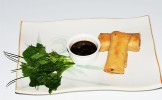
PORK SPRING ROLLSPork spring rolls with Oriental dipping sauce


MUSHROOM SOUP

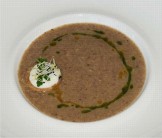
Mixed  mushroom soup with cream, chives and truffle oil vinaigrette


THAI  SPICED CHICKEN SOUP

Thai spiced chicken and coconut soup


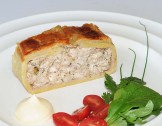
CHICKEN PATEChicken pate in pastry with tomato salad and a creamy salad dressing


TERRINE OF FISH AND CUCUMBER

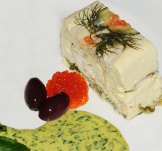
Terrine of fish and cucumber with watercress mayonnaise


SEAFOOD CAKES

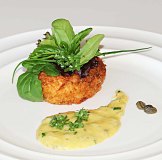
Seafood cakes with a caper sauce and mixed herbs


STUFFED SQUID

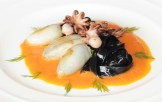
Prawn and mushroom stuffed squid with squid ink pasta and a spicy tomato sauce


PRAWN AND VEGETABLE COCKTAIL

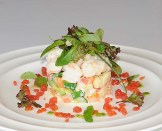
Prawn and vegetable cocktail with a creamy saffron and dill dressing


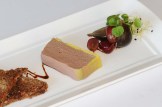
CHICKEN LIVER PAFEChicken liver parfait with figs, grapes and herb salad and whole-wheat bread


Spicy salmon mousse in filo pastry cups

Spicy salmon mousse in filo pastry cups served with balsamic vinegar dressing


SMOKED TROUT MOUSSE Smoked trout mousse with micro salad leaves and tomato and tarragon


SEAFOOD TEMPURA

Fish and prawn tempura with an Oriental dipping sauce


Categories
MAIN COURSE

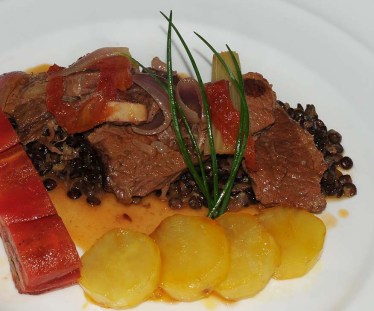
BEEF BRISKET POACHED IN SPICY BEEF STOCK


Serve with Puy lentils, candied sweet potatoes and tomato and basil terrine.

LINE

Serves 4

Brisket is an inexpensive cut of beef that requires long, slow cooking to break down the collagen in the connective muscle tissues which results in succulence and  tenderness.  The Tomato and basil terrine is a refreshing addition to the rich brisket dish.

BEEF BRISKET

The brisket:
2 tablespoons/30 ml olive oil
1 kg/2 lbs brisket with the bone on
3 cloves garlic, crushed
1 red onion, roughly chopped
1 cup/250 ml dry red wine
2 cups spicy/500 ml beef stock, heated
1 teaspoon/5 ml fresh ginger, grated
juice of ½ lemon
2 teaspoons/10 ml palm sugar
1 star anise
salt and freshly ground pepper
1 red chili, rib and seeds removed, finely chopped (optional)

The Puy lentils:
200 g/7 oz Puy lentils
1½/375 ml cup chicken stock
salt and freshly ground black pepper
1 medium red onion, finely sliced
1 tablespoon/15 ml lemon juice
1 tablespoon/15 ml olive oil
salt and freshly ground black pepper

The sweet potatoes:
4 large sweet potatoes, peeled and cut across into 1 cm (0.4 in) thick slices
¼ cup/60 ml butter
¼ cup/60 ml sugar
juice of one orange

The tomato and basil terrine:
1 cup/250 ml olive oil
½ cup/125 ml balsamic vinegar
4 shallots, peeled and finely sliced
4 garlic cloves, minced
salt and freshly ground black pepper
1.5 kg/3.3 lbs very ripe tomatoes, peeled, sliced into petals and seeded
1 bunch basil
baby rocket leaves

Start with the terrine:
For the marinade, combine the olive oil, vinegar, shallots, garlic and seasoning. Add the tomatoes to the marinade and refrigerate for 24 hours.

For the terrine, line four individual molds with plastic film, then push in each mold a layer of the tomato petals, then a basil leave, then salt and pepper and a drizzle of the marinade. Repeat until all the ingredients are used and pour the rest of the marinade over. Press down firmly and fit a piece of board cut to the size of the mold on top. Put small weights on top and leave for at least 8 hours to set before serving.  When ready to serve, invert the terrines on each of the serving plates with the brisket, Puy lentils and sweet potatoes.

For the brisket, heat the oil in a large saucepan and brown the brisket all over. Add the garlic and onion and stir until heated through, then add the red wine and allow to boil until almost evaporated. Add the beef stock and bring to a boil, then add the rest of the ingredients and cook, covered, for about ½ hour. Remove the star anise and continue cooking for another hour or until the meat is very tender. Check periodically to see that there is enough liquid to cover the meat. If necessary add a little bit of boiling water from time to time.

When the brisket is tender, remove from the saucepan and keep in a warm place. Add the chili (optional) to the saucepan and reduce the liquid in the pan until it is thick and syrupy.

Shred the brisket into smaller pieces, discard the bones (if any) and return the meat to the saucepan. Gently mix with the sauce in the pan and check the seasoning. Keep warm.

Cook the lentils in simmering unsalted chicken stock for 20 minutes or until tender. Drain and season with salt and freshly ground black pepper.

Meanwhile, soak the red onion in the lemon juice for 5 minutes. Once the lentils are cooked, add the drained onion, olive oil and stir through.

In a saucepan, put the sweet potatoes and cover with water, salt and half the butter. Bring to the boil and cook until nearly all the water has evaporated. Pour in the orange juice, the rest of the butter and the sugar. Turn the heat down low and let the juices slowly caramelize.

Assemble the dish:
Serve the brisket on top of the Puy lentils with the Sweet potatoes and the Tomato and basil terrine around it.

Categories
MAIN COURSE

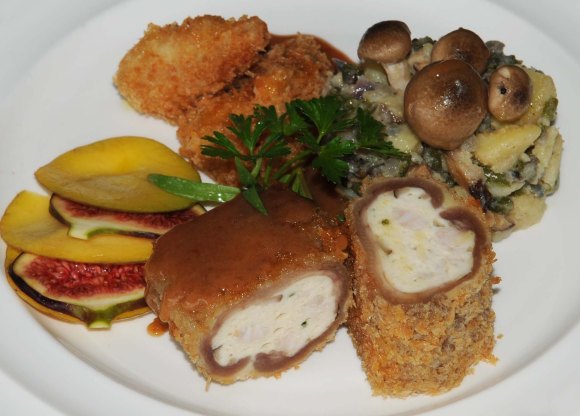
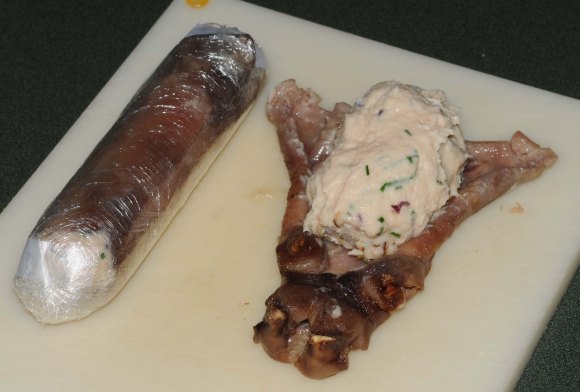
Pork trotter stuffed with chicken and sweetbread mousse


The humble pig’s trotter does not possess much meat, but what it has is flavor, and the cylindrical shape ideal to be stuffed like a sausage.  It’s the intelligent way to approach this part of the nose to tail philosophy, I think.  Its flavor is simple but elegant, earthy but seriously delicious. How to get there is a totally different story.  It is a commitment and a secure few hours of dedication to make the best of it.  My very first time.

PIG'S TROTTERS STUFFED WITH CHICK MOUSSE.jpg


After careful research and You Tube education, and armed with a very sharp knife and chopping board, I started with my most amazing journey — deboning and stuffing pig’s trotters. First the singing with the blow torch to remove any hair that might still be around. Then scrubbing between the toes and singe once more if necessary, and voilá — ready for the deboning action.  Not for the squeamish though…

  • Start with the deboning of the trotters.  You will need 4 trotters.
  • Make an incision down the middle of the underside and carefully ease the skin away from the bone, starting from the open end (the end opposite the toes).
  • At all times try not to cut through the skin because the stuffing will leak out during the cooking process.
  • Peel the skin back as you cut it away from the bone.
  • You will reach the toes and quite a few tough tendons.
  • Cut the tendons and maneuver the knife into the first joint to disconnect the largest bone in the trotter.  (You will need to use some extra force.)
  • Then tackle the next joints which are smaller and easier to remove.
  • The good news is that the bones right inside the toes stay intact to keep them firm.
  • There will still be fat and unidentifiable bits and pieces on the inside of the skin which should be scraped off carefully without tearing the skin.

PIG'S TROTTER DEBONED

Lightly sprinkle the skins with some salt, and spices (I used ground clove and cinnamon) of your choice, and set aside.

The recipe for the whole process:
4 pigs trotters
flour for coating
3 eggs with a dash of water
4 cups/1 liter panko breadcrumbs
oil for deep-frying

2 tablespoons/30 ml oil
2 large carrots, diced
1 large onion, diced
¼ cup/60 ml white wine
1 tablespoon/15 ml Madeira
½ cup/125 ml veal or pork stock
2 teaspoons/10 ml champagne vinegar
herbs such as thyme, sage, tarragon, etc.

For the stuffing:
25 g calf’s sweetbreads
50 g/1.7 oz butter
1 small onion
20 mushrooms of your choice
1 chicken breast (very cold), skinned and diced
1 egg white
200 ml / 7 fl oz double cream, very cold
salt and freshly ground pepper


The chicken meat, egg white and cream must be very cold, otherwise it might split when processed.

  • Heat the oil in an oven-proof pan and lightly brown the chopped vegetables and the bones.
  • Deglaze the pan with the wine and as soon as the wine has evaporated, add the Madeira and the stock and bring back to a boil.
  • Place the trotter skins on top of the bones. Cover the pan tightly and place in the oven at 160°C/325°F for 3 hours.
  • Meanwhile, prepare the stuffing:
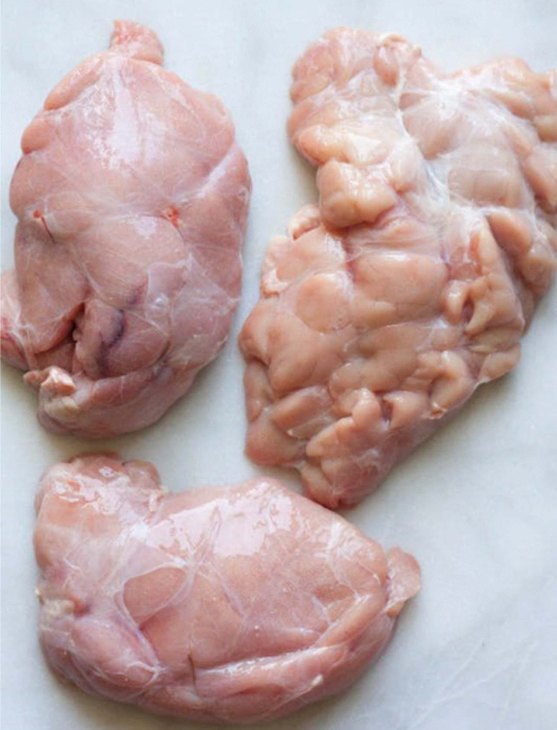
CALF'S SWEETBREADS
Calf’s sweetbreads
  • Blanch the sweetbreads for 5 minutes, remove with a slotted spoon and plunge in iced water.
  • Drain and carefully remove the skin and membranes around the sweetbreads, then roughly chop them.
  • In a pan heat some butter over medium heat and fry the sweetbreads and chopped onion for 5 minutes then add the mushrooms and cook for a further 5 minutes. Season lightly.  Set aside to cool.
  • To finish the stuffing:  In a processor, puree the chicken breast with the egg white and cream and season with salt and pepper.
  • Stir in the sweetbread mixture and mix well.  Take a small amount of the stuffing and fry it for tasting to adjust the seasoning if necessary.
  • To stuff the trotters:  Place each lukewarm trotter skin (if it gets too cold it loses its elasticity and makes it difficult to roll) on a square of plastic wrap and start filling it, starting at the end of the foot.
  • Pack the stuffing in well but not so much that the trotter loses its shape. The exact amount of mixture will depend on the size of your trotters.
  • Once stuffed, it will take its original shape of the bone-in pig’s foot.
  • Tightly roll up the stuffed trotters in plastic wrap and refrigerate for an hour or two.  (Leftover mousse can be frozen to fill tortellini, etc.)

PORK TROTTERS BEING STUFFED.jpg

  • Meanwhile strain the cooking stock and discard the solids.
  • Reduce the stock to a thick consistency, skimming the fat from the surface of the braising liquid all the time, then whisk in a of champagne vinegar.
  • Add the herbs, adjust the seasoning and keep warm.
  • For the frying of the crumbed trotters, get ready three shallow bowls, one with flour, the other with an egg and water mixture and a third with panko breadcrumbs.
  • Remove the plastic wrap from the trotters.  Cover them with flour, shaking off the excess, then dip into the egg and finally roll in the breadcrumbs, making sure that the crumbs adhere all over.
  • Put back in the refrigerator for 30 minutes.
  • Heat a large pan on medium heat filled with enough vegetable oil to cover the trotters when deep-frying.
  • Once the oil is hot (about 160ºC/325ºF), add the breaded pig’s trotter to the pan and slowly fry it until all sides are golden brown all round.
  • Transfer to a heated pan and place in the oven (160°C/325°F) for 15 minutes.
  • When ready to serve, slice the trotter like a sausage and and arrange on the plate with the  sauce and Crushed potatoes, green beans and shiittaki .


Categories
SOUPS/SAUCES/CONDIMENTS

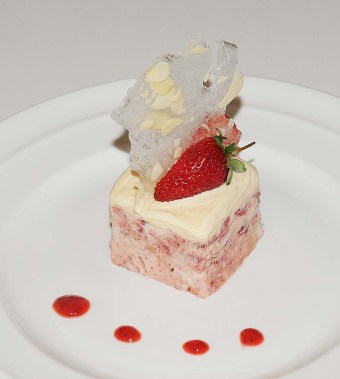
White chocolate and strawberry terrine


Serve with strawberry sauce and crispy sugar almonds

LINE

White chocolate and strawberry terrine

The terrine:
3 cups/750 ml fresh strawberries, hulled and cut in half
240 g/8.5 oz good-quality white chocolate, chopped
127 g/4.5 oz sugar
2 tablespoons/30 ml water
1 tablespoon/15 ml light corn syrup
4 large free-range egg whites
½ teaspoon/3 ml cream of tartar
1½ cups/375 ml chilled fresh cream
seeds from one vanilla pod
1 tablespoon/15 ml Grand Marnier liqueur

The crispy sugary almonds:
100 g/3.5 oz sugar
2 tablespoons/30 ml liquid glucose
1 tablespoon/15 ml water
3 tablespoons/45 ml almonds, flaked and roasted

Extra garnish:
glazed fruit, such as green fig and orange, finely sliced (optional)
reserved strawberry puree

Make the terrine:
♦  Line the bottom of a 22 x 12 x 7 cm/8½ x 4.7 x 2.7 in terrine dish (7-8-cup capacity) with cling-film, extending the foil over the shorter ends.
♦  Puree the strawberries and measure out 1¼ cups/312.5 ml of the puree and set aside. Reserve the remaining puree for garnishing.
♦  Stir the white chocolate in the top of a double boiler set over barely simmering water until melted. Remove from the heat.
♦  In a small saucepan, heat the sugar, water and corn syrup until the sugar dissolves, then increase the heat. Boil for about 4 minutes (120°C/248°F on a sugar thermometer), periodically brushing down the sides of the pan with a wet pastry brush.
♦  Meanwhile, whisk the egg whites and cream of tartar in a large bowl until it forms soft peaks. Gradually add the boiling syrup to the whites, beating until the meringue is cool, about 5 minutes; then fold the melted white chocolate into the meringue.
♦  Beat the cream and vanilla in a large bowl until medium-firm, then add to the white chocolate mixture to form the chocolate mousse.
♦ Transfer 4 cups/1 liter of the white chocolate mousse to a medium bowl and fold the 1¼ cups strawberry puree and Grand Marnier into the mousse.
♦ Spread half the strawberry mousse in the prepared terrine dish, and freeze until almost firm, about 15 minutes. Keep the remaining white chocolate mousse and remaining strawberry mousse in the refrigerator.
♦  After 15 minutes, spread the white chocolate mousse over the half frozen strawberry mousse layer and freeze for about 25 minutes.
♦  Spread the remaining strawberry mousse over the white chocolate layer. Cover the terrine with plastic and freeze overnight. (Can be prepared and kept frozen for 4 days ahead).
♦  Uncover the terrine and carefully invert the terrine onto a platter. Carefully peel off the cling-film.

The crispy sugary almonds:
Bring the sugar, glucose and water to a boil over medium heat until it turns golden and lightly caramelizes. Remove from the heat and leave to cool slightly.

Glucose is very sticky and an easy way to measure it is with either a heated spoon or a spoon dipped in oil. The glucose will simply slip off the spoon. Do the same with honey and corn syrup.

Lightly grease some parchment paper, or use silicone paper, and with a teaspoon drizzle the sugar syrup into patterns of your choice. Immediately scatter the almonds over the sugar patterns, then leave to cool totally and become crispy.

To serve:
Brush a wide stripe of the reserved strawberry puree over the center of each serving plate, place a slice of the terrine in the middle of the stripe, and decorate with sugary almonds and glazed fruit (if using).

Categories
STARTERS/SIDES

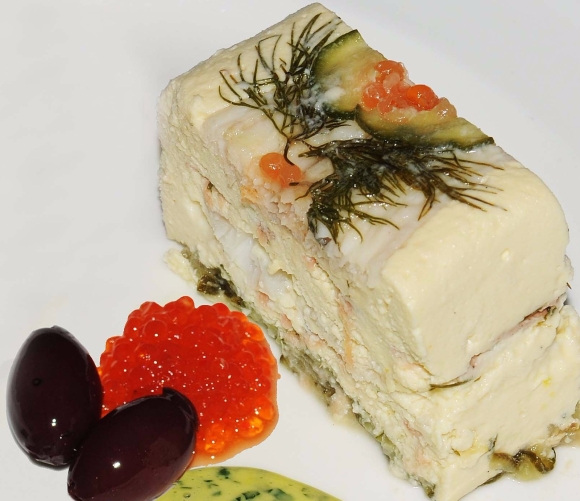
Terrine of fish and cucumber with watercress mayonnaise


To give time for the flavors to develop, this dish needs to be made at least 24 hours ahead, therefore it is ideal for entertaining. This is perfect as a starter to a dinner as well as for a lunch — even as a main course for dinner on a hot summers evening.

terrine-of-fish-and-cucumber-e1513152159747.jpg

The terrine:
500 g/18 oz firm white fish fillets, half in fillets and the rest cut into small pieces
whites of 2 eggs, lightly beaten (reserve the yolks for the mayonnaise)
1 egg
salt and freshly ground white pepper
a pinch of cayenne pepper
2 cups/500 ml crème fraîche (make your own)
250 g/9 oz smoked salmon, thinly sliced
3 tablespoons/45 ml dill, chopped
freshly ground black pepper

The vegetable mixture:
30 g/1 oz butter
1 large onion, finely chopped
English cucumber, thinly sliced

The watercress mayonnaise:
basic mayonnaise recipe using 2 egg yolks
½ cup/125 ml watercress leaves, chopped, tightly packed
1 teaspoon/5 ml dill, finely chopped
½ onion, finely chopped
1 teaspoon/5 ml lemon juice

The garnish:
a selection of herbs
carrots, pickled cucumber, etc, cut into decorative patterns
50 g/1.7 oz red lumpfish roe

The fish mixture:

  • In a processor, mince the cubed white fish, add the egg whites, whole egg, salt and cayenne pepper and blend well.
  • Cover with plastic film, and refrigerate for 30 minutes.
  • Process the fish mixture again, slowly adding half the crème fraîche, scraping down the sides of the bowl, then slowly add the remaining crème fraîche.
  • Place in the refrigerator on a bowl of ice for at least half and hour.
  • Season the whole white fish fillets with salt.
  • Season the smoked salmon with black pepper and dill.

The vegetable mixture:

  • In the meantime, in a saucepan melt the butter, add the onion and cook over low heat for a few minutes.
  • Add the cucumber, stirring until the moisture has evaporated.
  • Spoon into a dish, allow to cool, then refrigerate.

The mayonnaise:

  • Process the watercress, dill and onion and stir into the mayonnaise.
  • Taste and adjust the seasoning, then stir in the lemon juice.

This mayonnrecipe contains raw eggs and is not suitable for pregnant women, the elderly or very young children.

The terrine layering:

  • Preheat the oven to 160°C/320°F.
  • Paint the inside of a terrine dish with a little olive oil, and on the bottom place the herbs, the small vegetable pieces and the lump fish roe decoratively (use your imagination), and press down into the oil to secure it.
  • Now, carefully place half the white fish fillets over the decorations, covering the whole bottom part of the terrine dish — the “good” side of the fish facing downwards.
  • Spoon half of the fish mixture over the fish fillets and evenly spread it around.
  • Then cover the fish mixture with half the salmon.
  • Spread the rest of the fish mixture over the salmon, and add the rest of the white fish fillets.
  • Cover with the rest of the fish mixture, the rest of the salmon, and finally the vegetable mixture.
  • Lightly knock the terrine on the worktop to force out any air and cover with buttered foil. Secure the lid on top of the terrine.
  • Fill a large baking dish with warm water and place the terrine dish in it. Bake at 160°C/320°F for 1½ hours, then remove from the oven.
  • Remove the lid, then place a piece of board cut big enough the cover the terrine directly.
  • Place a weight on top and let the terrine cool to room temperature. Refrigerate for 24 – 48 hours.

To serve:
When ready to serve, turn the terrine out onto a plate and drain carefully before turning it out onto a cutting board. Cut the terrine into slices with a serrated knife and serve with the watercress mayonnaise and some extra lumpfish roe scattered over.

Categories
SOUPS/SAUCES/CONDIMENTS

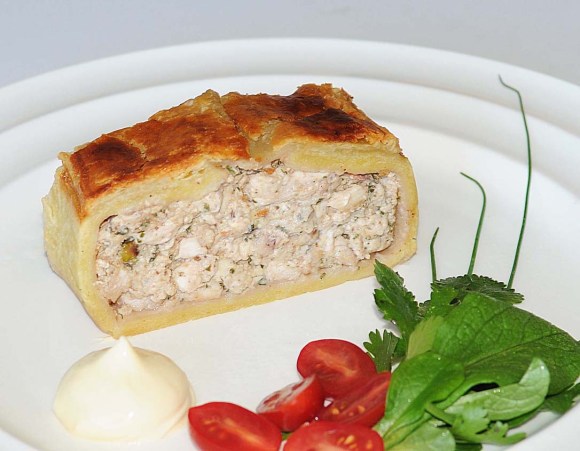
Chicken pate in pastry with tomato salad and a creamy salad dressing


Serve with tomato salad and a creamy salad dressing.

BLOCK HORIZONTAL LINE

This pate tastes better when it has cooled down. Leave it uncovered for the pastry to stay crisp, until it gets to room temperature.

CHICKEN PATE

The filling:
1.5 kg/3.3 lbs free-range chicken
1 teaspoon/5 ml salt
a pinch each of ground black pepper, ground cloves, ground ginger, ground nutmeg
4 tablespoons/60 ml parsley, finely chopped
6 cloves of garlic, finely chopped
2 free-range eggs, lightly beaten
2 cups/500 ml white wine

The pastry:
500 g/17.6 oz short crust pastry
150 g/5.2 oz puff pastry
1 free-range egg yolk

The jelly:
20 g/0.7 oz powdered gelatin
1¼ cup/310 ml chicken stock
1 tablespoon/30 l Madeira
season to taste

The salad:
2 cherry tomatoes, peeled, cut in half
1 spring onion, shredded
a mixture of herb leaves

The dressing:
4 tablespoons/60 ml Japanese mayonnaise
2 teaspoons/10 ml rice wine vinegar
2 teaspoons/10 ml caster sugar
5 tablespoons/75 ml chive oil
balsamic vinegar glaze (optional)

Debone chicken and cut into thin strips then mix with the rest of the ingredients. Place in the refrigerator overnight to marinate.

Preheat the oven to 190°C/374°F.
Roll out the short crust pastry to a thickness of just over 3 mm/0.1 in and line a greased terrine dish. Spoon in the meat filling to the top of the dish and coat the pastry around the top edges with the egg yolk.

Cover the filling with the puff pastry, rolled out to 4 mm/0.2 in thickness, and press the edges firmly on to the edges of the short crust pastry.  Coat the puff pastry with the egg yolk and cut two holes in the center of the pastry (to allow the steam to escape). Insert two pastry funnels or two pieces of foil rolled-up. Bake in the preheated oven for 50 minutes.

Meanwhile, heat a little of the chicken stock and add the gelatin powder, stirring until dissolved. Add the rest of the chicken stock and the Madeira and heat through. Season to taste and strain the liquid. When the pate is cooked, remove from the oven then evenly pour the liquid through both the openings into the pate.

For the salad, mix together all the ingredients and season well.
For the dressing, combine all the ingredients. It should be like stiff cream. If not, add more mayonnaise.

To serve:
Allow the pate to cool to room temperature and remove from the terrine mold. Slice into 4 cm/1.5 in slices and place in the center of four serving plates. Spoon the salad on the side with the mayonnaise.