Categories
MAIN COURSE

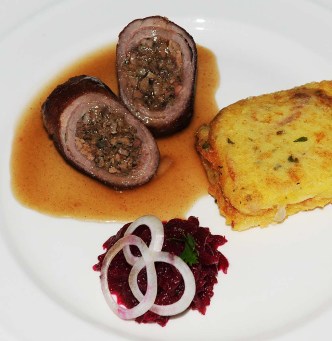
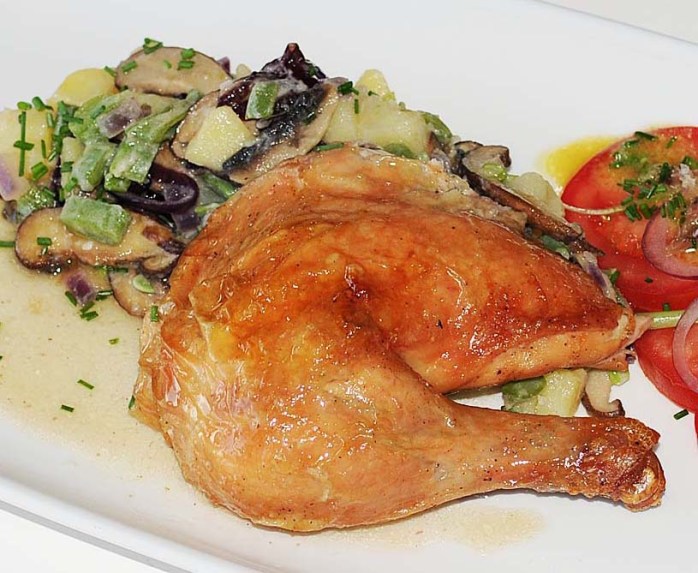
Veal rolls stuffed with chicken liver and prosciuto in a Marsala and white wine sauce


Serve it with polenta cakes and pickled beetroot.

LINE

Serves 4

The rolls can be prepared the previous day and cooked just before serving.VEAL ROLLS

The filling for the veal rolls:
15 ml/1 tablespoon oil
15 ml/1 tablespoon onion, finely chopped
2 rashers of bacon, finely diced
2 free-range chicken livers
5 ml/1 teaspoon rosemary, finely chopped
30 ml/2 tablespoons fresh white breadcrumbs
30 ml/2 tablespoons Parmesan cheese, freshly grated
5 ml/1 teaspoon parsley, finely chopped
1 free-range egg, beaten
pinch nutmeg, freshly grated
5ml/1 teaspoon lemon juice
salt and freshly ground black pepper

The veal:
12 thin slices of veal
12 slices of prosciuto
50 g/1.7 oz butter

The sauce:
30 ml/1 tablespoons olive oil 125ml/½ cup shallots, thinly sliced
5 ml/1 teaspoon garlic, minced
80ml/⅓ cup beef stock
80ml/⅓ cup Marsala wine
salt
10 ml/2 teaspoons fresh rosemary, finely chopped
10 ml/2 teaspoons parsley, finely chopped

If Marsala wine is not available, use port or sherry.

The polenta:
2 liters/4.3 pts milk
300 g/10.5 oz polenta
50 g/1.7 oz Parmesan cheese, grated
50 g/1.7 oz butter
1125 ml/½ cup chopped fresh chives
salt
150 g/5.2 oz butter for frying the mushrooms
500 g/1 lb mixed mushrooms
freshly ground black pepper
60 ml/¼ cup vegetable oil

Heat the oil and fry the onion and bacon until crisp, remove from the pan and drain on paper towel. Add the chicken liver to the same pan and fry for 1 minute, remove and drain, then chop the liver fine and mix well with the bacon and the rest of the filling ingredients. Divide up into twelve portions.

Between two sheets of cling-film, beat the slices of veal flat with a mallet. Put a portion of filling on top of each of the veal slices and carefully roll up the veal with the filling, taking care no to let the filling push out on the sides. Put each roll on top of a slice of prosciuto and roll up again. Secure with toothpicks. Cover and place in the refrigerator for one hour.
In a heavy based saucepan and over medium heat, melt the butter and fry the veal rolls until they are evenly cooked and golden brown – about 3 minutes on each side. Remove from the pan and keep aside in a warm place for 10 minutes.

Add the olive oil to the saucepan in which the veal rolls were cooked, add the shallots and over low heat saute for about 2 minutes, then add the garlic. Turn the heat up and deglaze the pan with the Marsala wine, then add the chicken stock, parsley and rosemary and cook until the liquid is reduced by half. Season to taste and return the veal rolls and any accumulated juices to the pan. Spoon the sauce over the veal rolls and simmer for about 1 minute.

Meanwhile, bring 2 liters/4.3 pts milk to the boil in a large saucepan, add the polenta gradually in a thin, steady stream, stirring all the time. Add salt and cook over low heat for about 45 minutes, stirring frequently.

Remove the polenta from the heat and gently stir in the Parmesan cheese and chives. In a frying pan, heat the butter then fry the mushrooms until cooked and mix in with to the polenta which should be quite soft.  Pour the hot polenta into a square dish about 2 cm/0.7 in thick. Leave to set then slice into squares of about 8 x 8 cm/3 x 3 in.
Heat a frying pan with the oil until quite hot. Gently lower the polenta squares one by one into the hot pan and fry until golden on both sides. Drain on kitchen towel.

Serve the veal rolls sliced at a slant across with the polenta and Pickled beetroot salad. Drizzle the sauce around and serve immediately.

Categories
MAIN COURSE METHODS

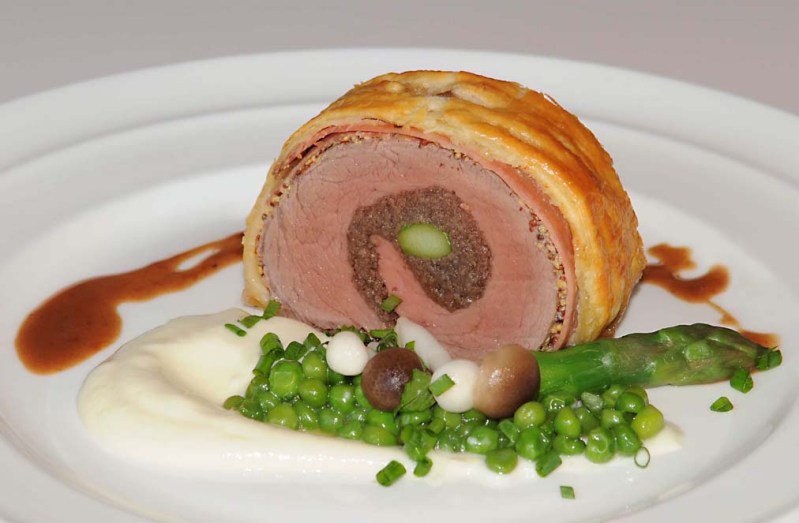
Stuffed beef fillet rolled in pastry and served with cauliflower cream and sweet peas


This dish is a variation of the Beef Wellington in a way.  It is, however, fabulous for dinner parties and is always enjoyed by all.

BEEF WELLINGTON

Serves 4

The beef roll:
450 g/1 lb mixed mushrooms
salt
8 green asparagus, trimmed and blanched in salted water
8-10 slices prosciutto
2 tablespoons/30 ml olive oil
700 g/1.6 lbs beef fillet, trimmed
2 tablespoons/30 ml wholegrain mustard
450 g/1 lb puff pastry
1 eggs, whisked, for glazing

The sauce:
1 cup/250 ml red wine
1½ cup/375 ml beef stock, heated
the reserved mushroom paste
½ cup/125 ml full cream

The cauliflower cream:
1 tablespoon/15 ml butter
1 medium size cauliflower, cut into small pieces
1 cup/250 ml full cream
1 tablespoon/15 ml crème fraîche
¼ teaspoon nutmeg, grated
2 teaspoons/10 ml lemon juice
salt and freshly ground black pepper to taste

The peas:
2 cups/500 ml peas (fresh or frozen and defrosted)
1 tablespoon/15 ml butter
1 tablespoon/15 ml sugar
salt
2 teaspoons/10 ml mint, finely chopped

  • In a food processor, chop the mushrooms until a rough paste forms. Transform to a non-stick frying pan and dry fry the mushrooms until all its natural moisture has evaporated. Season and put aside to cool.
  • Cut the beef horizontally but not right through. Stop about 3 cm/1¼ in away from the edge.
  • Fold the fillet open like a book and place between two sheets of plastic film.
  • With a mallet, lightly bash the meat all over to get an even thickness.
  • Sprinkle with salt on the cut side then spread the cooked mushrooms evenly all over (reserving 2 tablespoons/30 ml for the sauce) , leaving a small space on the edges all round.
  • Cut the asparagus tips off and set aside.
  • Place the stems in the center horizontally, then roll up the beef. Secure with a skewer or toothpicks.
  • Heat the olive oil in a frying pan until very hot and quickly sear the steak all round.
  • Set aside to cool.
  • When the meat has cooled almost completely, roll out a large piece of plastic film and place the prosciutto alongside each other to more or less the size you will need to cover the fillet all round.
  • Remove the skewers or toothpicks from the meat, then spread mustard all over the outside.
  • Place the meat in the center of the prosciutto and with the help of the plastic film, roll the fillet with the prosciutto into a neat roll.
  • Twist the ends of the plastic film to prevent it from splitting open and refrigerate for at least 20 minutes.
  • Preheat the oven to 200°C/390°F and grease a baking tray.
  • When ready to cook, roll out the pastry into a rectangle, unwrap the beef carefully and place in the center of the puff pastry.
  • Brush the pastry edges all round with the egg wash then fold it over the beef and seal.
  • Trim the ends of the pastry and with the help of the egg wash, seal the ends neatly.
  • Paint the pastry all over with the egg wash and lift the roll onto the baking tray.
  • Refrigerate for about 15 minutes.
  • Remove the roll from the refrigerator and brush again with the egg wash.
  • Lightly score the top of the pastry and place in the oven to bake for 15 minutes.
  • Turn the baking pan around and lower the heat to 180°C/356°F. Bake for 10 minutes more.
  • Remove from the oven and let it rest for at least 15 minutes before slicing.
  • Heat the pan in which you seared the beef and deglaze it with the red wine.
  • When all the alcohol has evaporated and the pan is nearly dry, add the stock and reduce to half.
  • Add the mushroom paste and cook until the sauce has reduced to a half.
  • Stir in the cream and let it cook until it thickens.
  • Strain, season with salt and freshly ground black pepper and pour back into the pan to keep warm.
  • After the beef roll has rested and you are ready to cut it, pour the juices that leaked out of the roll into the sauce and mix.
  • Meanwhile, for the cauliflower, bring water in a saucepan to the boil and add the butter and cauliflower. (The water should only come halfway up the cauliflower).
  • Cook until the cauliflower is tender. (The water should have reduced down to about half).
  • Pour all the content of the saucepan (and the water) into a food processor and blend until smooth. (It should be the consistency of thick whipped cream).
  • Add the cream, crème fraîche, nutmeg, salt and pepper and blend until smooth.
  • Add 1 teaspoon/5 ml of lemon juice and taste, then add more if required.
  • Pour back into the saucepan and keep warm until ready to serve.
  • Melt the butter in a saucepan and add the peas, a pinch of salt and 1 teaspoon/5 ml of sugar.
  • Let it heat through over low heat until the sugar has melted.
  • Add the chopped mint and set aside in a warm place until ready to serve.
Categories
MAIN COURSE

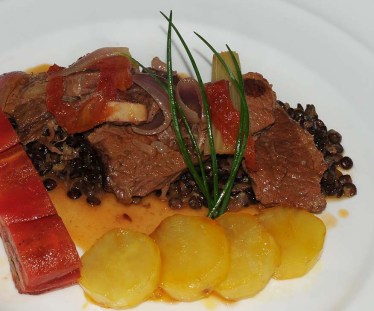
Beef brisket poached in spicy beef stock


Serve with Puy lentils, candied sweet potatoes and tomato and basil terrine.

BLOCK HORIZONTAL LINE

Serves 4

Brisket is an inexpensive cut of beef that requires long, slow cooking to break down the collagen in the connective muscle tissues which results in succulence and  tenderness.  The Tomato and basil terrine is a refreshing addition to the rich brisket dish.

BEEF BRISKET

The brisket:
2 tablespoons/30 ml olive oil
1 kg/2 lbs brisket with the bone on
3 cloves garlic, crushed
1 red onion, roughly chopped
1 cup/250 ml dry red wine
2 cups spicy beef stock, heated
1 teaspoon/5 ml fresh ginger, grated
juice of ½ lemon
2 teaspoons/10 ml palm sugar
1 star anise
salt and freshly ground pepper
1 red chili, rib and seeds removed, finely chopped (optional)

The Puy lentils:
200 g/7 oz Puy lentils
1½ cup chicken stock
salt and freshly ground black pepper
1 medium red onion, finely sliced
1 tablespoon/15 ml lemon juice
1 tablespoon/15 ml olive oil
salt and freshly ground black pepper

The sweet potatoes:
4 large sweet potatoes, peeled and cut across into 1 cm (0.4 in) thick slices
¼ cup/60 ml butter
¼ cup/60 ml sugar
juice of one orange

The tomato and basil terrine:  (Optional)
1 cup/250 ml olive oil
½ cup/125 ml balsamic vinegar
4 shallots, peeled and finely sliced
4 garlic cloves, minced
salt and freshly ground black pepper
1.5 kg (3.3 lbs) very ripe tomatoes, peeled, sliced into petals and seeded
1 bunch basil
baby rocket leaves

Start with the terrine:  (If making)
For the marinade, combine the olive oil, vinegar, shallots, garlic and seasoning. Add the tomatoes to the marinade and refrigerate for 24 hours.
For the terrine, line four individual molds with plastic film, then push in each mold a layer of the tomato petals, then a basil leave, then salt and pepper and a drizzle of the marinade. Repeat until all the ingredients are used and pour the rest of the marinade over. Press down firmly and fit a piece of board cut to the size of the mold on top. Put small weights on top and leave for at least 8 hours to set before serving.
When ready to serve, invert the terrines on each of the serving plates with the brisket, Puy lentils and sweet potatoes.

For the brisket, heat the oil in a large saucepan and brown the brisket all over. Add the garlic and onion and stir until heated through, then add the red wine and allow to boil until almost evaporated. Add the beef stock and bring to a boil, then add the rest of the ingredients and cook, covered, for about ½ hour. Remove the star anise and continue cooking for another hour or until the meat is very tender. Check periodically to see that there is enough liquid to cover the meat. If necessary add a little bit of boiling water from time to time.

When the brisket is tender, remove from the saucepan and keep in a warm place. Add the chili (optional) to the saucepan and reduce the liquid in the pan until it is thick and syrupy.
Shred the brisket into smaller pieces, discard the bones (if any) and return the meat to the saucepan. Gently mix with the sauce in the pan and check the seasoning. Keep warm.

Cook the lentils in simmering unsalted chicken stock for 20 minutes or until tender. Drain and season with salt and freshly ground black pepper.

Meanwhile, soak the red onion in the lemon juice for 5 minutes. Once the lentils are cooked, add the drained onion, olive oil and stir through.

In a saucepan, put the sweet potatoes and cover with water, salt and half the butter. Bring to the boil and cook until nearly all the water has evaporated. Pour in the orange juice, the rest of the butter and the sugar. Turn the heat down low and let the juices slowly caramelize.

Assemble the dish:
Serve the brisket on top of the Puy lentils with the Sweet potatoes and the Tomato and basil terrine (if using) around it.


Categories
METHODS

BEEF STOCK


2 kg/4.4 lbs beef bones, cut into small pieces
2 pig’s trotters, cleaned thoroughly and split in half (ask your butcher to do it for you)
2 tablespoons/30 ml oil
2 small brown onions, skin on, roughly chopped
3 cm/1.2 in piece of ginger, bruised and chopped
1 teaspoon black peppercorns
star anise
6 cloves
1 cinnamon stick
2 whole nutmeg
2 tablespoons/30 ml Asian fish sauce

Preheat the oven to 200°C/400°F.
Place the beef bones and the trotters on an oven tray and roast in the preheated oven until browned all over.  In a large stockpot, heat the oil and lightly fry the onions and ginger, then add the beef bones and trotters and the rest of the ingredients.  Add 4 liters/8.5 pts cold water, and bring to the boil.  Simmer gently over low-medium heat and regularly skim the brown foam that forms on the surface.  Simmer for 4 hours, adding enough water to keep the contents submerged, then remove from the heat.

Cool to room temperature, then strain, do not press down on the solids as this will cause the stock to become cloudy.  Cover and refrigerate until cold, then remove the fat from the surface. Refrigerate for up to 2 days or freeze in smaller containers for up to 3 months.  Discard the solids.

Categories
MAIN COURSE

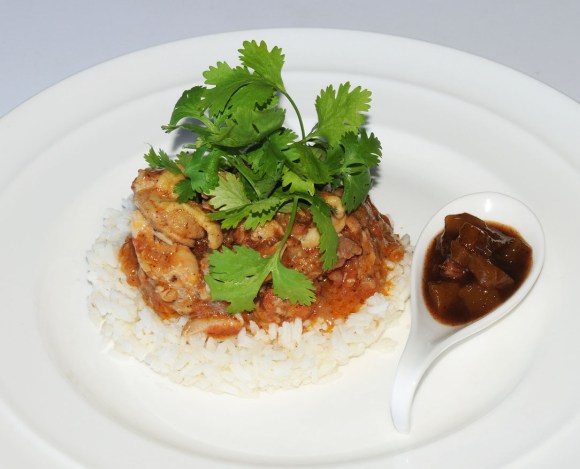
An Indian chicken dish delicately flavored with a selection of spices


Serve with Basmati rice, Poppadoms and a variety of sambals

BLOCK HORIZONTAL LINE

Serves 4

This is a wonderful dish to make a day ahead as the flavor becomes more intense overnight, therefore making it ideal for entertaining. 

INDIAN CHICKEN DISH

The chicken:
6 free-range chicken thighs
6 free-range drumsticks
3 tablespoons/45 ml oil
1 ℓ/4 cups chicken stock
4 tablespoons/60 ml plain yogurt
¼ cup/60 ml lemon juice
4 fresh green chilies, ribs and seeds removed, finely sliced
1 tablespoon/15 ml garam masala

 The spicy onion and tomato and mixture:
2.5 cm/1 in cinnamon stick
seeds of 2 large cardamom pods
8 black peppercorns
1 teaspoon/5 ml black cumin seeds, ground
1 teaspoon/5 ml chili powder
2 tablespoons/30 ml oil
3 medium onions, finely chopped
1 tablespoon/15 ml fresh ginger, finely chopped
3 garlic cloves, finely chopped
6 medium tomatoes, peeled, seeded and chopped
salt to taste
250 ml/1 cup chicken stock

The rice:
(Adding the spices are optional.  Use plain Basmati rice if you wish otherwise make the Fruit, spice and nut rice)
450 g/16 oz Basmati rice
75 g/2.6 oz unsalted butter
1 tablespoon/15 ml corn oil
1 bay leaf
3 black peppercorns, crushed
4 green cardamom pods, crushed and husks removed
1 teaspoon/5 ml salt
75 g/2.6 oz sultanas
50 g almonds, flaked (slivered)
4 cups/1 liter water

The garnish:
2 tablespoons/30 ml fresh coriander, chopped
2 fresh green chilies, chopped (optional)

In a heavy-based saucepan, heat the oil and fry the chicken pieces until golden brown. Add the chicken stock and salt to taste, bring to the boil then  turn the heat down, cover and let it simmer gently for 30 minutes.

Meanwhile prepare the onion and tomato mixture.
In a coffee grinder or pestle and mortar, grind the cinnamon, cardamom seeds, peppercorns, cumin seeds and chili powder.
In a saucepan heat the oil and over low heat fry the onions, ginger and garlic gently until golden brown.  Add the ground spices and fry a little longer,  then add the tomatoes and cook slowly until the tomatoes break up and a thick sauce is formed.  Keep on cooking whilst stirring regularly. When all is thoroughly coated (take care that it does not stick to the bottom of the pan), season to taste.  If it becomes too thick before the tomatoes are cooked, add the chicken stock.  

Add the cooked onion and tomato spice mixture (recipe above) to the chicken, mix through and let it simmer, covered, over low heat for another 15 minutes.  Check constantly that it does not cook dry.  Add a little boiling hot water if necessary.   When cooked,  check the seasoning and remove the pan from the heat.  Add the yogurt, lemon, fresh chilies and garam masala to the chicken and gently mix to heat through.  Do not cook again.

Meanwhile, wash the rice twice, drain in a colander and set aside.  If making the spicy rice, heat the butter and oil in a medium saucepan, over low heat, and add the bay leaf, peppercorns and cardamoms, and fry for about 30 seconds. Add the rice, salt, sultanas and flaked almonds, and stir-fry for about 1 minute, then pour in the water. Bring to the boil, lower the heat, then cover with a tightly-fitting lid. Cook for 15-20 minutes then turn off the heat and leave the rice to stand, still covered, for about 5 minutes before serving.  When ready to serve, remove the bay leaf and fluff up the rice with a fork.

To serve:
Place a 10 cm (2 in) diameter pastry ring on the plate and fill it with the Fruit, spice and nut rice.  Arrange the chicken pieces around it with a generous helping of the sauce.  Lift the pastry rings off the rice and place some coriander and whole chili on top of the rice.  Serve the Sambals in small individual bowls for each guest and Naan bread and /or Poppadoms (available at upmarket super markets) on the side.

Categories
SOUPS/SAUCES/CONDIMENTS

Baked aubergine and mushroom stacks with tomato and balsamic vinegar


Serves 4

BAKED AUBERGINE AND MUSHROOM STACKS

The aubergine stacks:
2 tablespoons/30 ml olive oil
2-3 large aubergines, sliced across in 2 cm/0.8 in wide slices (you
should have 16 slices)
8 large black mushrooms, wiped clean
salt and freshly ground black pepper
4 tablespoons/60 ml soft goat’s cheese
4 slices of brie, medium flavored
8 basil leaves

The tomato sauce
1 tablespoon/15 ml olive oil
1 medium onion, finely chopped
1 garlic clove, finely chopped
3 large very ripe tomatoes, skinned and deseeded, roughly chopped
3 sprigs fresh rosemary, finely chopped
few sprigs of fresh thyme, leaves picked
salt and freshly ground black pepper
vegetable stock (optional), if needed

The dressing:
3 tablespoons/45 ml balsamic vinegar (not an expensive grade)
2 tablespoons/30 ml caster sugar
2 tablespoons/30 l water
zest of one lemon, finely chopped
2 tablespoons/30 ml chives, finely sliced

Heat the olive oil in a large frying pan and fry the aubergine slices until golden brown on both sides. Remove with a slotted spoon and drain on kitchen paper. In the same pan, fry the mushrooms, until they have released all their moisture. Remove from the heat and set aside.

For the tomatoes, heat the olive oil and over medium heat, fry the onion and garlic for about 1 minute. Turn up the heat, add the tomato and cook for about 10 minutes – nothing more. It must still retain the freshness. Add the herbs and season well. Reserve about 1 cup/250 ml for drizzling at the end.

For the dressing, bring the balsamic vinegar and sugar to the boil and remove from the heat immediately. (By the time you need to use the balsamic vinegar it might have turned too sticky to use. Just add a little water and reheat, stirring well.) Add the lemon zest and set aside.

Preheat the oven to 220°C/422°F.

To assemble:
In a heatproof dish make four “towers” starting at the bottom with one layer of aubergine, followed by a mushroom, a spoon full of tomato sauce and a layer of the soft goat’s cheese crumbled. Repeat this procedure until all the vegetables have been used, finishing with tomato. Put a slice of brie on top, scatter the crumb mixture over and drizzle a little bit of olive oil over. Put in the oven for about 10 minutes or until the brie starts bubbling. Remove from the oven and put a ”tower” on each plate. Drizzle the reserved tomato sauce around and a swirl of the balsamic vinegar glaze. Sprinkle the chopped chives and spring onions around, and serve immediately. If you have sufficient size ovenproof dishes, each “tower” can be baked and served individually.

Categories
MAIN COURSE

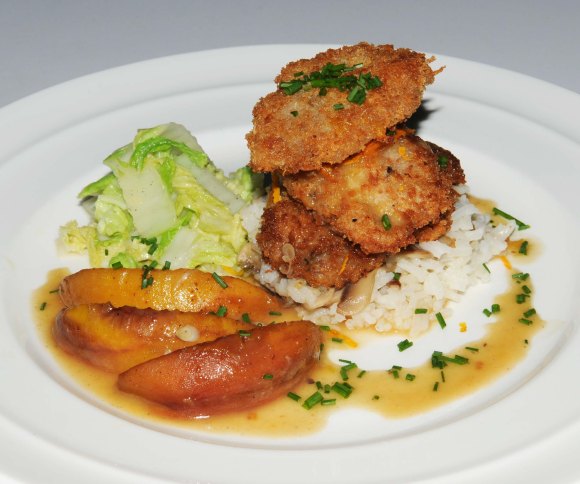
Duck breast fritters with Basmati rice and roast peaches


If you wish to serve another vegetable,  cabbage, lightly poached in butter and seasoned with nutmeg, goes very well with this dish.

Serves 4

DUCK BREAST FRITTERS

The duck:
4 free-range duck breasts
2 tablespoons/30 ml shoa xing rice wine (available at Asian supermarkets)
1 tablespoon/15 ml szechuan pepper, ground (available at Asian supermarkets)
1 clove garlic, minced
salt
flour for sprinkling
2 free-range eggs, whisked
Japanese breadcrumbs (Panko breadcrumbs)
oil for deep-frying

The peaches:
1 tablespoon/15 ml sugar
1 tablespoon/15 ml butter
4 ripe peaches, stoned and quartered (use canned peaches if fresh ones are unavailable but cut down on the sugar)
2 cloves, ground
2 tablespoons/30 ml Peach Schnapps

The rice:
450 g/15.8 oz Basmati rice
4 cups/1 liter chicken stock
75 g/2.6 oz butter
salt

The garnish:
2 tablespoons/30 ml orange zest, grated
2 tablespoons/30 ml fresh chives, chopped

Score the breasts on the fat side with 2 cm/0.8 in space between each cut. Mix the rice wine, pepper, garlic and salt and rub onto the breasts on both sides. Set aside in the refrigerator for at least 2 hours.

When ready to cook, wipe most of the marinade of the breasts, heat a non-stick pan and sear the breasts on the fat side only, until crispy (about 3 minutes). Remove the breasts from the pan and set aside to cool. Store the rendered fat in a container for another time to fry potatoes, etc.

When the meat has rested for at least ½ hour (it will be quite raw still), slice the meat into 4 thick slices across. Place each slice of breast between two pieces of cling film and with a mallet, flatten the meat until about 15 mm/1 in) thick.

Sprinkle each slice with flour, then dip it in the egg and finally coat with the breadcrumbs. Heat the oil in a large saucepan,  fry the crumbed slices in the hot oil until crispy — not longer than 30 seconds on each side. Remove from the pan and let drain on kitchen paper.

Meanwhile, in a saucepan, melt the sugar and butter and saute the peach quarters in it for about 1 minute on each side, de-glaze with the schnapps, sprinkle over the ground cloves and let simmer for another 2 minutes or until just tender.

Add the rice, salt and chicken stock to a medium saucepan. Bring to the boil, lower the heat, then cover with a tightly-fitting lid. Cook for 15-20 minutes then turn off the heat and leave the rice to stand, still covered, until about 5 minutes before serving. When ready to serve,add the butter and fluff up the rice with a fork.

To serve:
On each heated serving plate, spoon some rice and stack four duck breast fritters on top.  Divide the peaches and place around the rice and drizzle some of the peach juices over.

Categories
MAIN COURSE

Thyme smoked chicken (Done on a Weber)


Served with a creamy white wine and thyme sauce, served rice and any vegetables. 


To smoke food, means to slowly cook over indirect heat and a low fire with smoldering flavorings such as herbs or special wood. For this recipe however it is a combination of smoking and roasting. Here we serve the chicken with a Bulgur wheat salad with fennel, egg, grapes and sun-dried tomatoes and a Roast potato with rosemary.

THYME SMOKED CHICKEN

Serves 4

The chicken:
1 large free-range chicken, washed inside and out, and dried
3 tablespoons/45 ml olive oil
salt and freshly ground black pepper
juice of ½ lemon
20 sprigs of fresh thyme, tied in two bundles
2 cups/500 ml chicken stock

The sauce:
1 teaspoon garlic, minced
1 shallot, finely chopped
1 cup/250 ml chicken stock
the pan drippings
1cup/250 ml fresh cream (optional)
salt and freshly ground black pepper

The bulgur wheat salad:
250 g/9 oz bulgur wheat
4 small free-range eggs (small hen’s eggs or quail eggs)
1 fennel bulb, halved and finely sliced
1 bunch spring onions, chopped
25 g/0.8 oz sun-dried tomatoes in oil, drained and sliced
a handful of green seedless grapes, cut in half
3 tablespoons/45 ml chopped fresh parsley
2 tablespoons/30 ml chopped fresh mint
75 g (2.6 oz) black olives, stoned
¼ cup/60 ml olive oil
1 small garlic clove, minced
2 tablespoons/30 ml lemon juice
salt and ground black pepper


For the smoking, we strongly recommend using the indirect cooking method in a kettle barbecue. Set up your grill for indirect heat by building a 2 zone fire, one on each side – drip pan goes in the middle under the meat. Make a charcoal fire and let burn until the coals are coated lightly with white ash.

  • Rub the oil over the skin of the chicken and season inside and out with salt and pepper.
  • Prepare the fire with two side fires and a central position for a drip try.
  • Generously rub with olive oil all over, then place the chicken, breasts up, on top of the wire racks of the barbeque, over the hot coals (with the dripping tray directly underneath), then position the sprigs of thyme on each side of the chicken.
  • Place the lid firmly on but keep the grill vents open, and cook for about 20 minutes. Then remove and discard the burnt thyme.
  • Tip the carcass to let the juice in the cavity run into the dripping tray (do this every 10 minutes from now on), pour the chicken stock in the dripping tray, and place the chicken back on the grid with the breasts facing down.
  • Replace the lid firmly again and continue cooking for another 20 minutes.
  • Then make a small incision in the inside of each leg. If the juices run clear it is cooked, otherwise leave it for 5-10 minutes longer.
  • Another way of seeing whether the chicken is cooked, tip it again to see whether the juices in the cavity is clear. If you are satisfied that the juices are clear, remove the chicken from the grill and leave to rest in a warm place, breasts side down, for at least 25 minutes.
  • While the chicken is cooking, heat the oil in a saucepan and gently fry the garlic and shallot until golden.
  • Turn up the heat then add the chicken stock and reduce until syrupy. Put aside until the chicken is cooked.
  • When the chicken is cooked and while resting it, remove the dripping tray from the barbeque and drain off the excess oil.
  • Pour the contents of the dripping through a strainer (scraping off all the bits that are stuck to the tray) into the reduced chicken stock and over medium heat, bring to the boil then add the cream (if using).
  • Pour through a fine sift again into a clean pan and simmer gently until the sauce has thickened, stirring continuously. Check the seasoning.

To serve:

  • Joint the chicken and place a serving of joints on warm serving plates.
  • Spoon the sauce around and garnish with a sprig of fresh thyme.
  • Serve with the rice and other side dishes of your choice.
  • If you wish, cut the chicken in easy serving pieces the Chinese way. A description of this method is in the Glossary.
Categories
METHODS

Vegetable stock


3 onions, coarsely chopped
1 leek, coarsely chopped
2 celery sticks, coarsely chopped
6 carrots, coarsely chopped
1 whole head garlic, split in half
1 lemon, cut into 6 wedges
4 white peppercorns
4 pink peppercorns
½ bay leaf
4 star anise
8 cups/1 liter cold water
1 sprig each of tarragon, basil, coriander, thyme, parsley and chervil
½ cup/125 ml dry white wine

Place the prepared vegetables, the lemon wedges, peppercorns, bay leaf and star anise in a large pot.  Add the water and bring to the boil.  Reduce the heat and simmer for about 10 minutes.  Remove the pot from the heat and add the herbs and submerge it.  Set aside to cool and to allow the herbs to infuse the stock. Pass the stock through a double layer of muslin and leave to cool. Pour small amounts in suitable containers and freeze for up to 2-3 months.

Categories
METHODS

Lamb stock


5 kg/11 lbs lamb bones
2 pig’s trotters, cleaned thoroughly and split in half (ask your butcher to do it for you)
50 ml olive oil
2 medium onions, roughly chopped
4 carrots, roughly chopped
1 celery stalk, roughly chopped
6 liters/12.5 pts/ cold water
5 medium size ripe tomatoes, cut in quarters

Preheat the oven to 200°C/400°F.
Place the lamb bones and the trotters on an oven tray and cook in the preheated oven until browned all over.  In a large stockpot, heat the oil and lightly fry the onions, carrots and celery, then add the lamb bones and trotters. Add the water, and bring to the boil.  Turn down the heat and simmer gently over low-medium heat, regularly skimming the brown foam that forms on the surface.  Simmer for 5 hours, then remove from the heat. Cool to room temperature, then strain, do not press down on the solids as this will cause the stock to become cloudy.  Cover and refrigerate until cold, then remove the fat from the  surface.  Refrigerate for up to 2 days or frozen in smaller containers for up to 3 months.  Discard the solids.