Categories
MAIN COURSE

Marinated belly pork “sous vide”


“Sous-vide”-cooking is a method used to cook food sealed in airtight plastic bags in a water bath for longer than normal cooking times, sometimes as long as 72 hours, at a regulated temperature much lower than normally used for cooking. The intention is to cook the item (mostly tough cuts of meat) evenly, preventing the food from overcooking whilst keeping it juicy, succulent and tender.

PORK BELLY

For the pork:
1 kg/2 lb pork belly, without bone
300 ml pork stock
2 tablespoons/30 ml vegetable oil

The marinade:
1 stalk lemongrass, hard outside removed, the core finely chopped
1 teaspoon/5 ml white pepper, freshly ground
2 teaspoons/10 ml Chinese five-spice powder (mix your own)
4 cloves garlic, crushed
2 teaspoons/10 ml fresh ginger, peeled and finely chopped
Kosher salt
1-2 red chilies, seeds removed, finely chopped

  • For the marinade, mix the lemongrass, spices, garlic, ginger, salt and red chilies together in a small bowl, then rub the marinade into the pork belly all round.  Cover with cling film and marinate for at least two hours, or up to 12 hours, in the fridge.
  • Preheat the oven to 100ºC/212ºF.
  • Place the marinated pork in a food grade plastic bag and pour in the stock.
  • Seal the bag in the vacuum packing machine.
  • Meanwhile heat water in the ovenproof  basking dish to the same temperature as you have set the oven.
  • Carefully lower the sealed bag into the hot water and make sure the bag is totally covered with the water.

A good idea is to put a circle of greaseproof paper with a small hole in the middle, on top of the meat before you secure the lid on.

  • Place the baking dish in the oven and set your timer for 3 hours.
  • When the cooking time is up, carefully remove the bag from the hot water with tongs and place in a deep dish.
  • Cut the bag open and let the meat and juices slide out of the bag into the dish.
  • Pour out the sauce in a saucepan.
  • Press the meat between two baking trays with a weight on top to flatten the skin and place in the fridge to chill for 1-2 hours.
  • Just before serving set the oven to grill and place the pork belly, skin side up, about 30 cm/12 in from the grill.

Keep an eye on the skin as it can burn in an instant.


The sauce will have all the flavors of the marinade as well as the meat. 
 

Categories
METHODS

CHINESE FIVE SPICE


Five-spice powder is a spice mixture of five spices, used primarily in Chinese cuisine but also used in other Asian and Arabic cookery.

1 teaspoon/5 ml Szechwan peppercorns
2 whole star anise
1 teaspoon/5 ml fennel seeds
1 teaspoon/5 ml whole cloves
1 stick cinnamon 

In a dry pan over medium heat, toast all the spices until fragrant, stirring regularly to prevent the seeds from burning. Allow to cool.  In a spice grinder grind all the spices until a fine powder is formed.  Store the powder in an airtight container away from direct light. The spice blend will stay good for several months.

Categories
SOUPS/SAUCES/CONDIMENTS

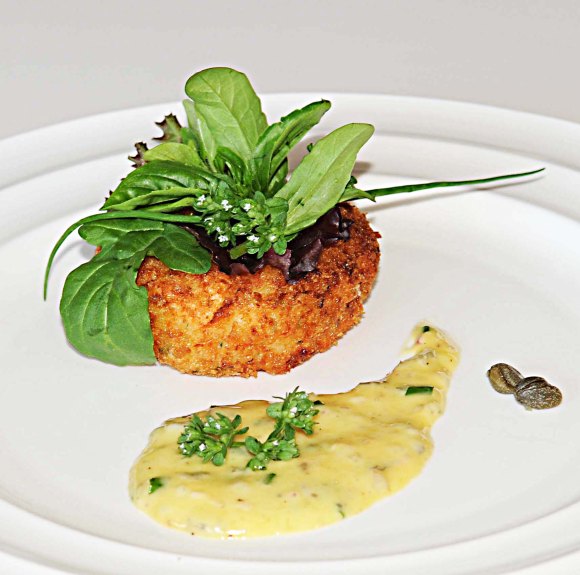
Seafood cakes with a caper sauce and mixed herbs


The fishcakes can be made with any leftover fish from a previous meal.

Serves 4
SEAFOOD CAKES

The mashed potatoes:
300 g/0.5 oz potatoes, peeled
2 tablespoons/30 ml créme fraîsche (make your own)
2 tablespoons/30 ml milk, heated
salt and freshly ground white pepper

The seafood:
1 tablespoon/15 ml olive oil
8 medium prawns, shelled, deveined
200 g/7 oz firm white fish OR 100 g/3.5 oz  salmon and 100 g/3.5 oz
firm white fish
100 g/3.5 oz smoked salmon
1 medium shallot, finely chopped
1 small mild red chili, finely chopped
1 tablespoon/15 ml lemon juice
1 egg lightly beaten
1 tablespoon/15 ml parsley, finely chopped
1 tablespoon fresh coriander, finely chopped
salt and fresh ground black pepper
Japanese breadcrumbs (Panko)
oil for deep-frying

The sauce:
2 hard-boiled egg
½ teaspoon/3 ml Dijon mustard
salt and freshly ground black pepper
½ cup/125 ml peanut oil
2 teaspoons/10 ml white wine vinegar
1 tablespoon/15 ml capers, drained, rinsed and roughly chopped
2 tablespoons/30 ml gherkins (cornichons), finely chopped
1 tablespoon/15 ml of each of parsley, tarragon, chives and chervil, finely chopped

The garnish:
a mixture of fresh herb leaves
paprika for sprinkling

Cut the potatoes into even chunks and boil in salted water until tender (about 15 minutes). Drain and return to the pan and over gentle heat, reheat the potatoes until any excess moisture has evaporated.  Push the potato chunks through a potato ricer.  In the meantime, slowly add the heated milk to the potatoes whilst whisking it with a fork. Mix in the créme fraîsche, salt and pepper to taste, then cover and set aside in a warm place.

To get the potato mash even smoother, push it through a drum sieve.

In a frying pan, heat the oil and lightly fry the prawns for 1 minute.  Remove with a slotted spoon and drain on kitchen towel.  Then fry the fish until just cooked – about 2 minutes.  Remove with a slotted spoon and drain on kitchen towel.  When the prawns and fish have cooled completely, roughly chop all of it and put in a bowl.  Cut the smoked salmon into small pieces and add to the fish and prawns.  Add the rest of the ingredients and the mashed potatoes, except the crumbs and oil, and mix well.  Put in the refrigerator for about 15 minutes to set, then remove and form the cakes.  Divide the mixture into 8 equal sized cakes.  (If you find that the cakes are too big, make smaller ones to get 12 cakes.)

To make sure that all the cakes are the same size, weigh them!

Heat the oil to about 170°C/335°F. (See safety tips for deep frying.)

Roll each cake in the crumbs, making sure the crumbs stick well, then fry in the oil – about 1-2 minutes on each side until they are golden brown.  Drain on kitchen towel and keep warm until ready to serve.

Put the yolks of the boiled eggs with the mustard and salt and pepper in a blender and blend well until a smooth paste forms.  While mixing, add half the oil, drop for drop, until all the ingredients amalgamated well.  Carry on mixing and add the vinegar, then slowly add the rest of the oil.  Transfer the mixture to a bowl and mix in the rest of the ingredients except the paprika.  Check the seasoning and adjust if necessary.  The paprika will be sprinkled over the sauce once it has be spooned onto the serving plates. Keep the sauce refrigerated until ready to serve.

To serve:
Place two or three fishcakes in the center of each serving plate, then put a posy of herb leaves on top or next to the cakes, and drizzle the sauce around.  Lightly sprinkle some paprika onto the sauce.

Categories
METHODS

Vegetable stock


3 onions, coarsely chopped
1 leek, coarsely chopped
2 celery sticks, coarsely chopped
6 carrots, coarsely chopped
1 whole head garlic, split in half
1 lemon, cut into 6 wedges
4 white peppercorns
4 pink peppercorns
½ bay leaf
4 star anise
8 cups/1 liter cold water
1 sprig each of tarragon, basil, coriander, thyme, parsley and chervil
½ cup/125 ml dry white wine

Place the prepared vegetables, the lemon wedges, peppercorns, bay leaf and star anise in a large pot.  Add the water and bring to the boil.  Reduce the heat and simmer for about 10 minutes.  Remove the pot from the heat and add the herbs and submerge it.  Set aside to cool and to allow the herbs to infuse the stock. Pass the stock through a double layer of muslin and leave to cool. Pour small amounts in suitable containers and freeze for up to 2-3 months.

Categories
MAIN COURSE

Lamb shanks poached in a spicy broth


Served with harissa yogurt,  couscous and roast vegetables and spicy aubergine and shiitaki mushrooms

BLOCK HORIZONTAL LINE
Serves 4

LAMB SHANKS WITH HARISSA

The shanks:
olive oil
4 lamb shanks
1 carrot, diced
1 leek, diced
1 celery stick, diced
4 garlic cloves
1 bay leaf
1 rosemary sprig
1 star anise
4 cardamom pods
1½ cup/375 ml dry white wine
7 cups/1¾ liter lamb stock, heated
sea salt and freshly ground black pepper

The couscous:
2 tablespoons/30 ml butter
3 spring onions, thinly sliced
½ cup/250 ml raisins
cinnamon stick
salt and freshly ground black pepper
3 cups/740 ml chicken stock
2 cups/250 ml couscous
¼ cup/60 ml almonds, slithered
¼ cup/60 ml fresh mint, chopped

The aubergines:
olive oil
4 medium aubergines, sliced in thin sliced
12 shiittaki mushrooms, sliced
salt and freshly ground black pepper
½ teaspoon/3 ml sesame oil
½ teaspoon/3 ml oyster sauce
½ tablespoon/7 ml balsamic vinegar
½ tablespoon/7 ml lemon juice
1 tablespoon.15 ml soy sauce
2 teaspoons/10 ml mirin

The yoghurt and harissa sauce:
2 tablespoons/30 ml fresh cream
4 tablespoons/60 ml plain yoghurt
2 teaspoons/20 ml lemon juice
salt and pepper to taste
harissa paste

Preheat the oven to 120°C/250ºF.
Heat a little olive oil in a large ovenproof pan and brown the shanks all over. Remove and set aside. Add some more olive oil to the same pan, then saute the carrot, leek, celery and garlic until light golden. Add the herbs and spices, pour in the wine and cook until the alcohol has evaporated.
Place the lamb shanks back into the pan with the vegetables, then pour in the stock. Season well, then cover and put in the preheated oven. Cook for about 3 hours, then remove from the oven and leave in the liquid for 30 minutes. Remove the meat and keep in a warm place. Strain the liquid, discard the solids, then skim of the fat that rises to the top. Reduce the liquid over high heat until thick and glossy. Check the seasoning and add more salt and pepper if necessary.

In a saucepan, melt the butter then add the spring onions, raisins, cinnamon stick, salt and pepper and stir until everything is well coated with the butter. Add the stock and bring to a boil. Put the couscous in a heatproof bowl and pour the spiced stock over. Cover and allow to sit for 5-10 minutes. Uncover, fluff the couscous with a fork, and stir in the almonds. Serve warm at room temperature with the mint sprinkled over.

Preheat the oven to 180°C/356°F.
Sprinkle the aubergines with salt and set aside for 30 minutes, then rinse the aubergines and pat dry. Heat some oil and fry the aubergine slices until golden brown on both sides. Drain on kitchen towel and set aside.

In the same pan heat some more oil and fry the mushrooms until tender. Remove from the pan and drain on kitchen towel. Set aside.
Mix together the rest of the ingredients for the dressing and season to taste. Mix the dressing with the fried mushrooms and aubergines and gently stir through to coat all the vegetables. Set aside until ready to serve warm at room temperature.

Whisk the cream until stiff, then fold in the yoghurt, lemon juice and salt and pepper. Taste and adjust the seasoning to your liking. Set aside until ready to use.
Just before serving, add some of the harissa paste to the yoghurt and mix through. Taste and add more paste if you wish.

Categories
MAIN COURSE

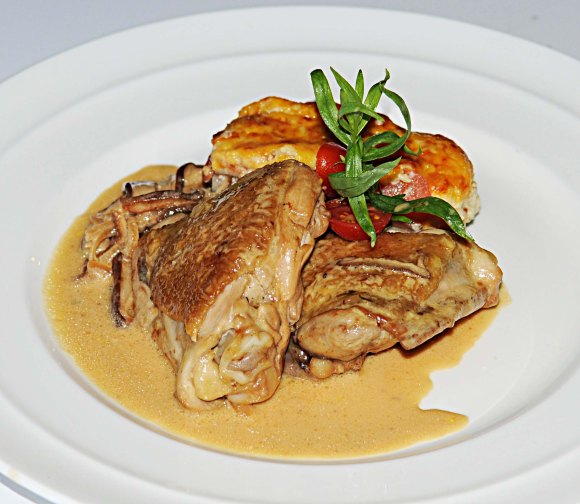
Chicken and mushroom casserole with a creamy champagne and tarragon sauce


Served with  Peccorino Swiss chard, and Macaroni and cheese

CHICKEN CASSEROLEServes 4

The casserole:
2 tablespoons olive oil
12 free-range chicken thighs, deboned (reserve the bones)
1 shallot, finely chopped
12 fresh tarragon leaves
salt and freshly ground black pepper
½ cup brut Champagne
½ cup fresh cream
1 teaspoon Dijon mustard
500 g/1 lb fresh mushrooms, stems removed and sliced
fresh tarragon leaves


Fresh shiitake mushrooms can be replaced with dried ones, but use about half the quantity.

The Peccorino Swiss chard:
1 kg/2 lbs Swiss chard
2 tablespoons butter
2 tablespoons olive oil
1 tablespoon garlic, minced
½ small red onion, diced
2 tablespoons Parmesan cheese
2 tablespoons Peccorino cheese
10 cherry tomatoes, skinned
salt and freshly ground black pepper

The macaroni and cheese:
4 cups milk
40 g butter
50 g/1.7 oz flour, sifted
½ cup Fontina
½ cup mature cheddar cheese
1 teaspoon mustard
400 g/14 oz Riggatoni pasta
15 g/0.5 oz butter
4 large tomatoes, skinned and sliced in 3 mm/0.2 thick slices
1 tablespoon red onion, finely sliced
1 cup Gruyère cheese, freshly grated
½ cup Parmesan


Any leftover Macaroni and cheese is ideal for a light lunch with salad the next day. It will keep, covered and refrigerated, for up to four days, but well wrapped, it also freezes well.

The salsa:
2 ripe pears, julienned
2 teaspoons, finely chopped
1 tablespoon pickled ginger, finely sliced
1½ tablespoon chive oil
1 teaspoon Dijon mustard
2 teaspoons lemon juice
pinch of sugar

The chicken:

  • Heat the oil in a saucepan and lightly sauté the chicken and bones until golden brown all over. Add the shallot and sauté until translucent, then add the tarragon and season with salt and pepper.
  • Add the Champagne and bring to a boil over medium heat. Cover and cook for ±20 minutes, remove the bones, then add the mushrooms and cook for another 15 minutes.
  • Mix the cream and mustard and pour over the chicken. Stir and bring to the boil, then cover and cook for 10 more minutes over low heat, stirring often. Serve immediately.

If you prefer to use reduced fat cream and to avoid it curdling, turn the heat right down at the end of the cooking time and only then pour the cream and mustard over the chicken. Stir gently to heat through, not longer than 15 seconds, then remove from the heat. Do not let it boil again – it will curdle.

  • Serve with some fresh tarragon leaves scattered over.

The Swiss chard:

  • Separate the ribs and leaves. Finely chop the ribs and shred the leaves, keeping them separate as the ribs take longer to cook.
  • Heat the butter and olive oil together in a large saucepan over medium-high heat.
  • Stir in the garlic and onion, and cook for 30 seconds. Remove with a slotted spoon and set aside.
  • Add the ribs and cook for about 5 minutes then add the chard leaves and cook until the leaves are wilted. Drain and squeeze out as much liquid as possible.
  • Put the chard, fried garlic and onions in a processor and pulse until it looks like large breadcrumbs.
  • Remove from the processor to a bowl, add the freshly grated Parmesan cheese and Peccorino. Mix well and tomatoes. Season to taste and keep warm.

The macaroni and cheese:

  • Preheat the oven to 200°C/392°F.
  • For the cheese sauce, bring the milk to a boil in a small saucepan, then remove from the heat.
  • Meanwhile, in a separate saucepan and over a medium heat, melt the butter. Stir in the flour and cook for 3-4 minutes, then gradually stir in the milk and cook gently, stirring constantly, until the sauce is smooth.
  • Reduce the heat and simmer for 3-4 minutes or until thickened. Remove from the heat and add the freshly grated Fontina and cheddar cheese and mustard, then season to taste with salt and freshly ground black pepper.
  • For the macaroni, cook the Riggatoni until tender, drain and set aside.
  • In a large ovenproof dish, start the layering: First a layer of a third of the pasta, followed by a layer of a third of the tomatoes and onions.
  • Spoon over a third of the sauce and sprinkle over a third of the freshly gated Gruyère cheese, then repeat with the rest of the ingredients.
  • Finally sprinkle over the freshly grated Parmesan. Bake in the oven for 20 minutes or until the top is golden brown. Remove from the oven and let it rest for at least 15 minutes before serving.

The pear salsa:

  • Gently mix the pear, chives and pickled ginger in a bowl.
  • Whisk together the chive oil, mustard, lemon and sugar and just before serving, pour over the salsa.

To serve:
Spoon the sauce over the chicken and scatter the tarragon leaves over. Serve with the Swiss chard, Macaroni and cheese and the Pear, chive and pickled ginger salsa.

Categories
GLOSSARY / METHODS METHODS

CHICKEN STOCK


¼ cup/60 ml olive oil
4 celery sticks, coarsely chopped
2 leeks, coarsely chopped
3 large onions, quartered
3 large carrots, coarsely chopped
½ whole head garlic, unpeeled
3 kg/6.6 lbs raw free range chicken carcasses
5 liters/10.5 pts cold water
6 black peppercorns
6 coriander seeds

Bouquet garni:
1 large leek
1 celery stick
1 large sprig thyme
1 small bunch of parsley
1 bay leaf
Tie the leeks, celery, thyme, parsley stalks and bay leaf together with
kitchen string.

In a large stock pot, heat the olive oil and lightly fry the celery, leeks, onions and carrots.  Add  the raw chicken carcasses and cover with the water. Add the peppercorns and coriander seeds, and bring to a gentle simmer, frequently skimming the brown foam that forms on the surface.

Add the bouquet garni to the pot, return to a gentle simmer for about 4½ hours, still skimming frequently but do not stir the stock.  Remove from the heat and let it cool to room temperature, then strain it by ladling the contents of the pan through a muslin-lined colander set over a large bowl. Try not to disturb the solids at the bottom, it will make the stock cloudy.  Cool the strained stock, remove all traces of fat, then chill or freeze in smaller containers until needed.  Discard the solids.

For a brown chicken stock simply brown the chicken carcasses or joints in the oven at 200°C/400°F for about 15-20 minutes, before adding to the stock pot.

Categories
GLOSSARY / METHODS METHODS

FISH STOCK


½ cup/125 ml olive oil
1 small leek, finely chopped
1 small onion, finely chopped
1 celery stick, finely chopped
1 small bulb fennel, finely chopped
2 cloves garlic
1 bay leaf
½ teaspoon/3 ml dried fennel seeds
2 kg/4.6 lbs fish bones, thoroughly rinsed and roughly chopped
1½ cups/375 ml dry white wine
¼ cup/60 ml  Noilly Prat
8 cups/2 liters cold water
2 sprigs each of parsley, thyme and tarragon
½ lemon, unpeeled
1 teaspoon/5 ml white peppercorns

In a large pot, lightly saute the leek, onion, celery, fennel and garlic in the oil.  Add the fish bones, wine, Noilly Prat and the dried herbs, and cook until the wine  has evaporated.  Add the water and bring to the boil.  Skim the surface frequently. Add the fresh herbs, lemon and peppercorns, and cook gently for 20 minutes.  Remove from the heat and let the stock cool.  Strain through a muslin lined colander, but take care not to disturb the solids at the bottom.  Leave to cool, then chill or freeze in smaller containers until needed. Discard the solids.

Categories
MAIN COURSE

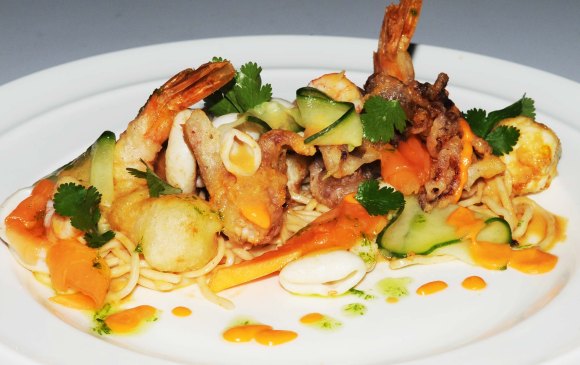
Deep-fried fish, mixed seafood and onion rings


Served on a bed of noodles and cucumber ribbons with a creamy caper mayonnaise dressing
BLOCK HORIZONTAL LINE
Serves 4

The best way to complete a successful deep-fried meal is to prepare all the ingredients in advance and have the salad and dressing ready before cooking the fish and seafood.

DEEP-FRIED FISH AND SEAFOOD PASTA SALAD

The batter:
½ cup/125 ml cream
1 clove garlic, creamed
3 egg yolks
2 tablespoons/30 ml Parmesan cheese, finely grated
1 tablespoon/15 ml plain flour
1 tablespoon/15 ml cornstarch
½ cup/125 ml beer
pinch of salt and freshly ground black pepper

 The fish and seafood:
120 g/4 oz firm white fish, skinned
120 g/4 oz prawns,
120 g/4 oz squid with tentacles
2 large onions, cut into 1 cm/0.4 in rings
flour for dusting
salt and freshly ground black pepper
oil for deep-frying

The caper mayonnaise:
2 hard-boiled eggs
½ teaspoon/3 ml Dijon mustard
salt and freshly ground black pepper
½ cup/125 ml peanut oil
2 teaspoons/10 ml white wine vinegar
1 tablespoon/15 ml capers, drained, rinsed and roughly chopped
2 tablespoons/30 ml gherkins (cornichons), finely chopped
1 tablespoon/15 ml of each of parsley, tarragon, chives and chervil,
finely chopped
paprika for sprinkling

This recipe contains raw eggs and is not suitable for pregnant women, the elderly or very young children.

The noodle salad:
250 g/9 oz noodles
1 tablespoon/15 ml olive oil
1 cucumber

For the batter:  In a large bowl mix cream, garlic, egg yolks, cheese, flour and cornstarch, then add the beer to make a smooth batter (you may not need all the beer).   Season with freshly ground black pepper.  It is important to be aware of the danger of working with hot oil.  See the safety tips for deep-frying.

Heat enough oil to 180° C/356° F in a pan suitable for deep-frying.
Cut the fish into 3 x 3 cm/1 x 1 in pieces, and peel and devein the prawns (reserving the shells for later use).  Remove the tentacles from the squid body (remove the beak from the tentacle), cut the squid open lengthwise, score on the inside.  

Working in batches, dust the fish and seafood with the seasoned flour and  shake off the excess.  Starting with the fish, dip into the batter, coating it all over, letting the excess batter drip off, then deep-fry for 2-3 minutes until golden brown.  Drain on kitchen towel and set aside in a  warm oven with the door ajar.  Repeat with the prawns but cook for 1 minute only.  Repeat with the tentacles, which will need to cook for only about 30 seconds. (Let the oil come back to the right temperature before frying each batch.)

Break the onion rings up and repeat the process for deep-frying, drain and set aside with the seafood.

Heat about ¼ cup/60 ml of oil in another frying pan and quickly fry the squid.  Keep warm.

For the caper mayonnaise: put the yolks of the boiled eggs with the mustard and salt and pepper in a pestle and mortar or blender and mix well until a smooth paste forms.  While mixing, add half the oil, drop by drop, until all the ingredients amalgamated well.  Carry on mixing and add the vinegar, then slowly add the rest of the oil.  Transfer the mixture to a bowl and mix in the rest of the ingredients except the paprika.  Check the seasoning and adjust if necessary. The paprika will be sprinkled over the sauce once it has be spooned onto the serving plates. Keep the sauce refrigerated until ready to serve.

Cook the noodles in salted water, until they still  have a bite to it.  Drain and toss with the olive oil.

On a mandolin, cut the cucumber into ribbons, sprinkle with salt, sugar and rice wine vinegar.  Set aside.

By the time you are ready to deep-fry, everything else must be prepared and ready for use as the crispiness of the batter will spoil if it sits for too long before serving.

To serve:
Serve the seafood and onion rings on a bed of noodles with the drained cucumber ribbons.  Drizzle the mayonnaise around and sprinkle the paprika over the mayonnaise.

Categories
MAIN COURSE

Poached salmon in a seafood broth with fennel and tomato


Serves 4

Salmon

The stock:
1/3 cup/80 ml olive oil
1 onion, roughly chopped
1 leek, roughly chopped
2 celery stalks, thinly sliced
1 tablespoon/15 ml fennel seeds
6 cloves garlic, chopped
1 tablespoon/15 ml orange zest
8 ripe tomatoes, skinned and chopped
1 tablespoon/15 ml tomato paste
1 medium-hot red chili, seeded and chopped
1 teaspoon/5 ml saffron strands, soaked in cold water
1 sprigs of thyme
4 cups/1 liter fish stock, heated

15 g/½ oz butter
2 tablespoons/30 ml olive oil
2 cloves garlic, finely chopped
reserved shells of prawns
¼ cup/60 ml white wine
salt and freshly ground black pepper

The seafood:
4 tablespoons/60 ml olive oil
4 x 250 Norwegian salmon fillets, the skin removed
8 large prawns, shelled and de-veined, reserve shells for stock
3 ripe tomatoes, skinned, seeded and diced chopped
1 teaspoon/5 ml  Pernod
1 tablespoon/15 ml cornstarch, dissolved in 2 tablespoons/15 ml cold water (optional)

The aïoli (garlic mayonnaise):
4 egg yolks
½ teaspoon/3 ml salt
3 cloves garlic (more if you wish)
2 teaspoons/10 ml lemon juice
2 cup/500 ml groundnut oil

The garnish:
2 tablespoons/30 ml fresh coriander, finely chopped
2 tablespoons/30 ml dill, finely chopped
crusty white bread, thinly sliced and lightly toasted

In a large saucepan, heat the oil and sauté the onions, bacon, leeks, celery, fennel seeds and garlic until soft.  Add the orange zest, tomatoes, tomato paste, chili, saffron and soaking liquid, thyme, and fish stock and bring to the boil.  Boil for 15 minutes, then remove from the heat and set aside.
In a separate frying pan, heat the butter and olive oil and sauté the garlic, shells of the prawns until golden and aromatic.  Deglaze the pan with the wine and reduce until half the wine has evaporated.  Add the contents of the pan to the prepared stock and set aside until ready to poach the fish and prawns.
Strain the thoroughly and discard the solids. Add the liquid to the prepared stock.

In a saucepan big enough for the fish, prawns and broth. pour the prepared broth and bring to a gentle simmer.  Add the diced tomatoes and Pernod and, if desired, thicken slightly with the cornstarch. Let it simmer for a few minutes longer until slightly thickened, the add the  salmon to the broth.  Poach for about 4 minutes, then add the prawns and poach 4 minutes more or until you are satisfied that the prawns are cooked.  Check seasoning, then turn off the heat and prepare the serve.
For the aïoli, blend together the egg yolks, salt, garlic and lemon juice in a food processor. Add the oil in a thin steady stream while the machine keeps running.  Continue until all the oil is incorporated. Check the seasoning.
(See the Glossary on the use of excess egg whites.)
This recipe contains raw eggs and is not suitable for pregnant women, the elderly or very young children.

To serve:
Lift the fish from the broth and place into deep pre-heated bowls.  Carefully pour the broth around the salmon, add three prawns to each dish, and sprinkle the fresh coriander and dill over. Serve the crusty bread and small bowls filled with the aïoli on the side.