Categories
SOUPS/SAUCES/CONDIMENTS

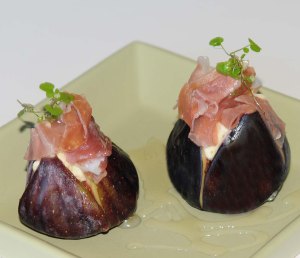
Roast figs with Gorgonzola and Prosciutto


This dish is ideal as an appetizer, as part of an antipasto platter or baked in puff pastry as a dessert.

LINE

Figs are very versatile and are delicious in savory or sweet dishes. They are also seasonal and should be made use of as much as possible while they are available.  See also Roast butternut and figs with pine nuts and goat’s cheese. 

FIGS WITH CHEESE AND HONEY

Serves 2

4 ripe figs, sliced into quarters halfway through
4 tablespoons/60 ml gorgonzola, or to your preference
2 slices prosciutto, each cut into two, lengthways
honey for drizzling
olive oil for drizzling
micro herbs

Preheat the oven grill. Place the four figs on a baking tray and lightly squeeze them to flare open. Push the gorgonzola lightly into the cavity and place under the preheated grill for 5 minutes, or until the gorgonzola is melted to your liking. Crush the strips of prosciutto to fit neatly on top of the cheese. Place back under the grill if you wish, otherwise just drizzle the honey and olive oil over and around the figs. Finally sprinkle the micro herbs over and serve.

Categories
MAIN COURSE

CRISPY PORK BELLY (“SOUS VIDE”-METHOD) WITH DEEPFRIED SWEETBREADS


 Serve with Puy lentils and a grape and cucumber salsa

LINE

CRISPY PORK LOIN WITH DEEPFRIED VEAL SWEETBREADS AND PUY LENTILS

“Sous-vide”-cooking is a method used to cook food sealed in airtight plastic bags in a water bath for longer than normal cooking times, sometimes as long as 72 hours, at a regulated temperature much lower than normally used for cooking. The intention is to cook the item (mostly tough cuts of meat) evenly, preventing the food from overcooking whilst keeping it juicy, succulent and tender.

For the pork belly:
1 stalk lemongrass, hard outside removed, the core finely chopped
1 teaspoon/5 ml white pepper, freshly ground
2 teaspoons/10 ml Chinese five-spice powder (mix your own)
4 cloves garlic, crushed
2 teaspoons/10 ml fresh ginger, peeled and finely chopped
1-2 red chilies, seeds removed, finely chopped
Kosher salt
1 kg/2 lb pork belly, without bone
1⅓  cup/300 ml pork stock
2 tablespoons/30 ml vegetable oil
1 tablespoon/15 ml cornstarch (optional)
2 tablespoons/30 ml cold water
1 tablespoon/15 ml fresh coriander, roughly chopped
1 tablespoon/15 ml fresh chives. finely chopped

For the sweetbreads:
900 g/2 lbs sweetbreads
1 tablespoon/30 ml salt
1 tablespoon/30 ml vinegar
¼ cup/60 ml flour plus extra salt
2 teaspoons/10 ml garlic powder
2 egg, whisked
2 cups/500 ml Panko breadcrumbs
oil for deep-frying

For the Puy lentils:
1½ cup/375 ml Puy lentils
2 cups/500 ml chicken stock
¼ cup/60 ml carrot, finely diced
¼ cup/60 ml celery, finely diced
¼ cup/60 ml shallots, finely diced
2 tablespoons/30 ml sherry vinegar
2 tablespoons/30 ml olive oil
2 tablespoons/30 ml chives, finely sliced
2 tablespoons/30 ml parsley, finely chopped
2 tablespoons/30 ml toasted walnut, roughly chopped
salt and freshly ground pepper to taste

For the salsa garnish:
about 32 green grapes, peeled (you do not have to peel them, but it looks nicer and the skin of some grapes might be a bit tough)
1 cup/250 ml cucumber finely diced
1 tablespoon/15 ml rice wine vinegar
2 teaspoons/10 ml fine sugar
2 tablespoons/30 ml chives finely sliced
salt and freshly ground black pepper to taste
a selection of micro leaves

To make the marinade for the pork belly, mix the lemongrass, five spice, garlic, ginger, salt and chilies and add to the pork stock in a jug. Mix well. Place the pork in a food grade plastic bag and pour in the stock with the marinade mix. Seal the bag in the vacuum sealer and leave in the refrigerator for up to 12 hours.

To make the pouring of the liquid into the bag easier, put the bag (open side up) in a deep container.

Preheat the oven to 120º C/248ºF.

When ready to cook the pork, heat enough water in the ovenproof dish with a lid (to cover the bag) to the same temperature as you have set the oven. Carefully lower the bag with the pork into the hot water, bring the water back to the original temperature (that of the oven), cover the surface of the water with a cartouche and cover with the lid.

A cartouche is a paper lid to, amongst other things, put on top of slow cooking food. The purpose is to keep the food submerged in the liquid. To make your own, take a square piece of parchment paper, slightly larger than the pan. Note the center of  and fold it in half and in half again to form a square with the center of paper now at one corner.  align the edges of the folded paper that diverge from the corner and make a fold.  Keep folding it the same so that you have a narrow sector shape with a wide end and a tip of the center which will become the center of the cartouche.  Measure the length of the folded paper from the center of the pan to the rim.  /cut away any excess at the wide end.  Cut off the tip — about 1½ cm/⅝ in — which will make the hole in the center through which the steam will escape . Open up the folded paper and shape it as necessary to form a circle. Your cartouche is now ready.

Cover the dish with its lid and place in the oven. Cook for 3 hours. When the cooking time has expired, carefully remove the cartouche then the bag from the hot water with tongs and put the bag in a deep dish. Cut the bag open and let the meat and juices slide out of the bag into the dish.  (Do this with great care because the contents will be very hot.) Carefully lift the meat out and place skin side up on a baking tray, put another baking tray on top with some weight to flatten the piece of meat. Chill for at least 2 hours. Just before serving, heat the oil in a frying pan to medium heat and place the pork, skin side down, to crisp up for 10-15 minutes. Put in a warm oven to warm through.

Be careful because quite a lot of spatting will take place.

Meanwhile, strain the sauce into a saucepan and over high heat, reduce to the desired consistency. The sauce will have all the flavors of the marinade as well as the meat. If desired, thicken with some corn starch mixed with some cold water, then strain again. Stir in the coriander and chives.

For the sweetbreads, separate them into about 4 cm/1½ in blocks. In a large saucepan, bring enough water to cover the sweetbreads to a boil and add the salt, vinegar and sweetbreads. Boil the sweetbreads for 5 minutes, remove them from the water with a slotted spoon and place in a bowl of iced water.  Carefully peel off the thin membrane then continue to do the deep-frying.

Personally, I do not think that the membrane causes any problems should you leave them, but to please the purists, I feel I must mention it.

Get three bowls ready: one with the flour, one with the whisked egg and one with the crumbs. In a deep pan heat the oil to 180ºC/356ºF. Coat each piece of sweetbread with the flour then roll it in the egg and finally cover in the breadcrumbs. Carefully place each piece in the hot oil (you might have to do this in batches) and fry until golden brown all round — 3-4 minutes. Remove from the oil and drain on kitchen paper. Keep uncovered in a warm oven until ready to serve.

Meanwhile, in a saucepan and over medium heat, put the lentils, the chicken stock, carrot, celery and shallots and bring to the boil. Boil for 20 minutes without adding salt. Test the lentils for tenderness and strain. Add the rest of the ingredients, mix carefully and keep warm until ready to serve.

For the salsa, drain the cucumber and mix with the grapes and chives.

To serve:
On preheated plates, spoon the Puy lentils, place the pork and sweetbreads at random and carefully pour the sauce around (not over the pork and sweetbreads, it might affect the crispiness of the skin and crumb coating).   Scatter the grape and cucumber salsa around and sprinkle over the micro leaves.  Serve immediately.

Categories
SOUPS/SAUCES/CONDIMENTS

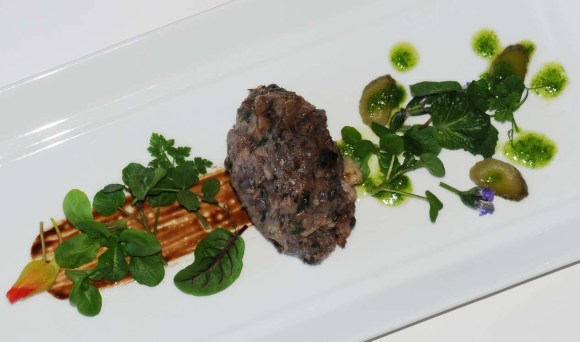
ROAST PIG’S HEAD AND DUCK GIBLET CONFIT PATé


LINEThis is one of the many dishes that can develop out of a roasted pig’s head

PIG'S HEAD PATE 2

For the pig’s head:
½ pig’s head (if you can only buy a whole head, ask you butcher to cut it in half for you and freeze the other half for later use)
1 carrot, roughly chopped
1 medium onion, roughly chopped
1 stick celery, roughly chopped
2 garlic cloves, crushed
4 cloves
salt and pepper
1 liter/2 pts pork stock
½ cup duck fat, hot

For the duck giblets confit:
500g/1 lb duck giblets (excluding the liver)
salt and pepper
1 liter/2 pts duck fat

For the paté:
the cooked pork meat
the cooked duck giblets
a pinch of five-spice powder
1 tablespoon/15 ml rice wine vinegar
2 tablespoons/30 ml spring onions, finely chopped

Remove any hair on the skin, paying special attention to the eyes, ears and snout, by using a blow torch.  Then scrub well in all the crevices using a vegetable brush.  If need be you will have to shave off the stubborn hairs but hopefully the butchery will see to that.  Rub the salt all over into the skin, fold a clean cloth (not plastic) loosely around it and let sit in the refrigerator for at least 24 hours.

Rinse well with cold water and pat dry.  There will be lots of excess fat and it is better to remove as much as possible.  (It can be rendered down for use some other time.)  Place the head on a cake rack in the sink and pour a kettle full of boiling water over.  Leave to cool.

Preheat the oven to 190°C/375°F.

Rub salt and pepper all over the skin and underneath. I suggest that you cover the ears with some foil to stop it from burning.  I did not do it and the ears dried out quite a lot.

Prepare a baking tray big enough for the pig’s head to fit in and add the carrots, onions, celery, garlic and onion with the pork stock.  Place the head on top of the vegetables, then pour the hot duck fat over the head.  Bake in the preheated oven for 1½ hours then lower the heat to 160°C/325°F and bake for an additional 2 hours.  When the head is cooked and browned nicely, remove it from the oven and cool until it is comfortable to handle.  Strain the pan juices and reduce to a syrupy consistency, removing as much of the fat as possible.

Carefully remove the skin so that you have quite a few large pieces and set aside.  Cut away as much as possible and separate the rest from the meat.  Finely slice the meat and moisten it with the reduced pan juices.  At this stage serve with a salad or on bread but if you want to continue with the recipe and add the Duck giblets to it, put it in a sealed container and refrigerate.

When the pork is out of the oven, lower the oven heat to 80°C/175°F.

Clean the duck giblets and cut away all the loose bits of fat and sinew.  Cut off the tough stomach wall and slice everything into small cubes.  In a small ovenproof saucepan, heat the duck fat to 80°C/175°F, season the giblets with salt and pepper and add to the fat.  Place the saucepan in the heated oven and cook for 3 hours.  Remove from the oven and let the giblets cool in the fat.

When ready to assemble the paté, remove the giblets from the fat and drain, trying to get rid of as much of the fat as possible.

Assemble the paté:
Mix all the ingredients together, check the seasoning and add more salt if necessary.  Put everything in a food processor and pulse until you have a rough consistency.

If you want a smooth paté, grind it longer until you are satisfied.

Pack the mixture tightly into ramekins or any other container in which you can serve the paté directly.  Keep in the refrigerator for at least 24 hours to give the flavors a chance develop.

Serve with thin slices of toasted bread, mango chutney and cornichons. Add some salad leaves if you wish.

Categories
GLOSSARY / METHODS

PORK STOCK


5 kg/11 lbs pork bones
2 pig’s trotters, cleaned thoroughly and split in half
50 ml olive oil
2 medium onions, roughly chopped
4 carrots, roughly chopped
1 celery stalk, roughly chopped
1 cup/250 ml white wine
1 garlic bulb, cut in half
a few sprigs of thyme
1 bay leave

Preheat the oven to 200°C/392°F.
Place the pork bones and the trotters on an oven tray and cook in a very hot oven until browned all over.  In a large stockpot, heat the oil and lightly fry the onions, carrots and celery then add the pork bones and trotters. Deglaze with the white wine and as soon as all the wine has evaporator, add the water, and bring to the boil.  Add the garlic, the thyme and bay leave and turn down the heat.  Simmer gently over low-medium heat for 5 hours, regularly skimming the brown foam that forms on the surface. After 5 hours, turn off the heat and cool to room temperature, then strain.  Do not press down on the solids as this will cause the stock to become cloudy.  Cover and refrigerate until cold, then remove the fat from the  surface.  Refrigerate for up to 2 days or frozen in smaller containers for up to 3 months.

Categories
GLOSSARY / METHODS

PORK STOCK


5 kg/11 lbs pork bones
2 pig’s trotters, cleaned thoroughly and split in half
50 ml olive oil
2 medium onions, roughly chopped
4 carrots, roughly chopped
1 celery stalk, roughly chopped
1 cup/250 ml white wine
1 garlic bulb, cut in half
a few sprigs of thyme
1 bay leave

Preheat the oven to 200°C/392°F.
Place the pork bones and the trotters on an oven tray and cook in a very hot oven until browned all over.  In a large stockpot, heat the oil and lightly fry the onions, carrots and celery then add the pork bones and trotters. Deglaze with the white wine and as soon as all the wine has evaporated, add the water, and bring to the boil.  Add the garlic, the thyme and bay leave and turn down the heat.  Simmer gently over low-medium heat for 5 hours, regularly skimming the brown foam that forms on the surface. After 5 hours, turn off the heat and cool to room temperature, then strain.  Do not press down on the solids as this will cause the stock to become cloudy.  Cover and refrigerate until cold, then remove the fat from the  surface.  Refrigerate for up to 2 days or freeze in smaller containers for up to 3 months.  Discard the solids.

Categories
MAIN COURSE

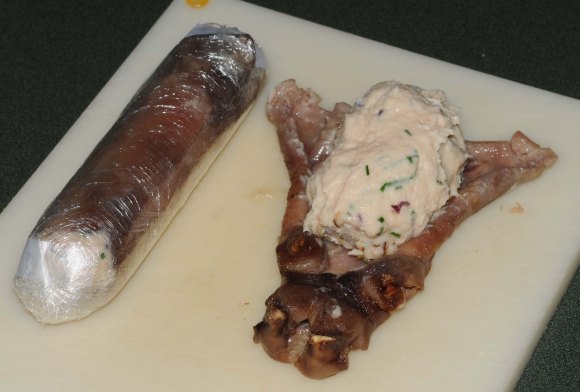
Pork trotter stuffed with chicken and sweetbread mousse


The humble pig’s trotter does not possess much meat, but what it has is flavor, and the cylindrical shape ideal to be stuffed like a sausage.  It’s the intelligent way to approach this part of the nose to tail philosophy, I think.  Its flavor is simple but elegant, earthy but seriously delicious. How to get there is a totally different story.  It is a commitment and a secure few hours of dedication to make the best of it.  My very first time.

PIG'S TROTTERS STUFFED WITH CHICK MOUSSE.jpg


After careful research and You Tube education, and armed with a very sharp knife and chopping board, I started with my most amazing journey — deboning and stuffing pig’s trotters. First the singing with the blow torch to remove any hair that might still be around. Then scrubbing between the toes and singe once more if necessary, and voilá — ready for the deboning action.  Not for the squeamish though…

  • Start with the deboning of the trotters.  You will need 4 trotters.
  • Make an incision down the middle of the underside and carefully ease the skin away from the bone, starting from the open end (the end opposite the toes).
  • At all times try not to cut through the skin because the stuffing will leak out during the cooking process.
  • Peel the skin back as you cut it away from the bone.
  • You will reach the toes and quite a few tough tendons.
  • Cut the tendons and maneuver the knife into the first joint to disconnect the largest bone in the trotter.  (You will need to use some extra force.)
  • Then tackle the next joints which are smaller and easier to remove.
  • The good news is that the bones right inside the toes stay intact to keep them firm.
  • There will still be fat and unidentifiable bits and pieces on the inside of the skin which should be scraped off carefully without tearing the skin.

PIG'S TROTTER DEBONED

Lightly sprinkle the skins with some salt, and spices (I used ground clove and cinnamon) of your choice, and set aside.

The recipe for the whole process:
4 pigs trotters
flour for coating
3 eggs with a dash of water
4 cups/1 liter panko breadcrumbs
oil for deep-frying

2 tablespoons/30 ml oil
2 large carrots, diced
1 large onion, diced
¼ cup/60 ml white wine
1 tablespoon/15 ml Madeira
½ cup/125 ml veal or pork stock
2 teaspoons/10 ml champagne vinegar
herbs such as thyme, sage, tarragon, etc.

For the stuffing:
25 g calf’s sweetbreads
50 g/1.7 oz butter
1 small onion
20 mushrooms of your choice
1 chicken breast (very cold), skinned and diced
1 egg white
200 ml / 7 fl oz double cream, very cold
salt and freshly ground pepper


The chicken meat, egg white and cream must be very cold, otherwise it might split when processed.

  • Heat the oil in an oven-proof pan and lightly brown the chopped vegetables and the bones.
  • Deglaze the pan with the wine and as soon as the wine has evaporated, add the Madeira and the stock and bring back to a boil.
  • Place the trotter skins on top of the bones. Cover the pan tightly and place in the oven at 160°C/325°F for 3 hours.
  • Meanwhile, prepare the stuffing:
CALF'S SWEETBREADS
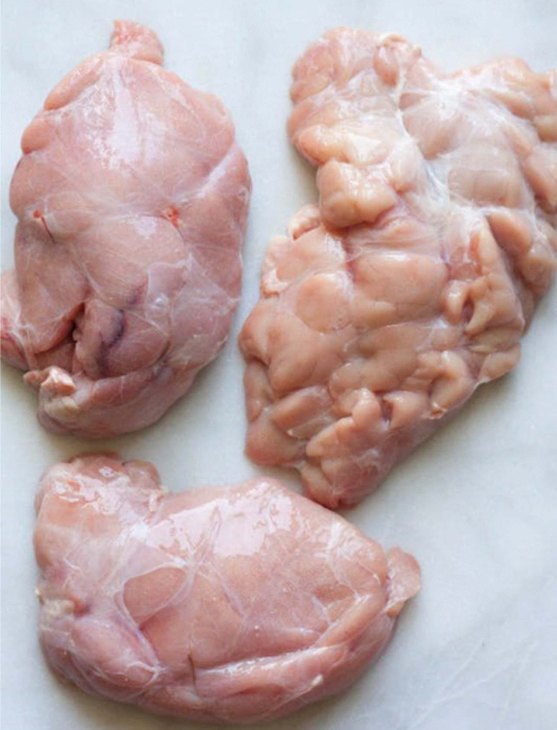
Calf’s sweetbreads
  • Blanch the sweetbreads for 5 minutes, remove with a slotted spoon and plunge in iced water.
  • Drain and carefully remove the skin and membranes around the sweetbreads, then roughly chop them.
  • In a pan heat some butter over medium heat and fry the sweetbreads and chopped onion for 5 minutes then add the mushrooms and cook for a further 5 minutes. Season lightly.  Set aside to cool.
  • To finish the stuffing:  In a processor, puree the chicken breast with the egg white and cream and season with salt and pepper.
  • Stir in the sweetbread mixture and mix well.  Take a small amount of the stuffing and fry it for tasting to adjust the seasoning if necessary.
  • To stuff the trotters:  Place each lukewarm trotter skin (if it gets too cold it loses its elasticity and makes it difficult to roll) on a square of plastic wrap and start filling it, starting at the end of the foot.
  • Pack the stuffing in well but not so much that the trotter loses its shape. The exact amount of mixture will depend on the size of your trotters.
  • Once stuffed, it will take its original shape of the bone-in pig’s foot.
  • Tightly roll up the stuffed trotters in plastic wrap and refrigerate for an hour or two.  (Leftover mousse can be frozen to fill tortellini, etc.)

PORK TROTTERS BEING STUFFED.jpg

  • Meanwhile strain the cooking stock and discard the solids.
  • Reduce the stock to a thick consistency, skimming the fat from the surface of the braising liquid all the time, then whisk in a of champagne vinegar.
  • Add the herbs, adjust the seasoning and keep warm.
  • For the frying of the crumbed trotters, get ready three shallow bowls, one with flour, the other with an egg and water mixture and a third with panko breadcrumbs.
  • Remove the plastic wrap from the trotters.  Cover them with flour, shaking off the excess, then dip into the egg and finally roll in the breadcrumbs, making sure that the crumbs adhere all over.
  • Put back in the refrigerator for 30 minutes.
  • Heat a large pan on medium heat filled with enough vegetable oil to cover the trotters when deep-frying.
  • Once the oil is hot (about 160ºC/325ºF), add the breaded pig’s trotter to the pan and slowly fry it until all sides are golden brown all round.
  • Transfer to a heated pan and place in the oven (160°C/325°F) for 15 minutes.
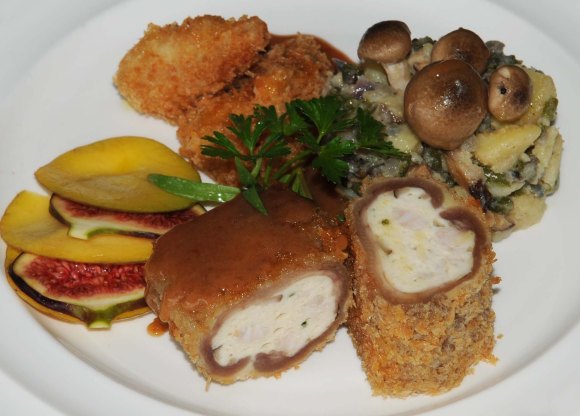
  • When ready to serve, slice the trotter like a sausage and and arrange on the plate with the  sauce and Crushed potatoes, green beans and shiittaki .


Categories
GLOSSARY / METHODS

Spanish chorizo sausage


My chorizo sausage supplier recently closed down and with that came the end of the most delicious chorizo sausages that I have had anywhere in the world. It was not too garlicky, had just the right amount of paprika and herbs and it was not too fatty. I realized that I have to make my own to satisfy my craving from time to time. Now, to make your own, is not that easy because there are as many recipes for Spanish chorizo as there are sausage makers. The only solution was to test various recipes, adjust, increase or eliminate certain ingredients … and I came up with this one. In my opinion, a huge success. Try and let me know.

This recipe makes 2 kg/4 lbs sausages, approximately 24 sausages of 75 g/2.6 oz each

1 kg/2 lbs shoulder of lean pork, trimmed
1 kg/2 lbs pork belly
4-8 garlic cloves, crushed
1-2 teaspoons/5-10 ml dried chili flakes
25 ml/8 fl oz cider vinegar
3-5 teaspoons/15-25 ml Spanish Paprika
5 teaspoons/25 ml salt
1 tablespoon/15 ml oregano
2 teaspoon/10 ml freshly ground pepper
1 tablespoon/15 ml brown sugar
2 m/6.5 in sausage casing

Coarsely mince the pork and pork belly or ask your butcher to do this, then mix all the ingredients together. Pinch off a small amount and fry it in a pan to check the seasoning. Make the necessary adjustments, if any, cover and marinate for 24 hours in a cool place.

Fill your sausage casings using the technique of your choice and twist the sausages into links every 7 cm/4 in.

This recipe is also suitable for a semi dried sausage which can be hung for 2 to 3 weeks. The longer you leave it the more the flavor intensifies but beware that after the drying process it should not be treated as a dried sausage. It still must be cooked thoroughly before eating.
Categories
MAIN COURSE

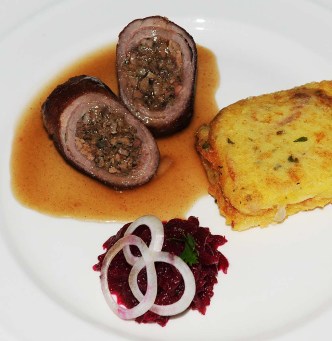
Veal rolls stuffed with chicken liver and prosciuto in a Marsala and white wine sauce


Serve it with polenta cakes and pickled beetroot.

LINE

Serves 4

The rolls can be prepared the previous day and cooked just before serving.VEAL ROLLS

The filling for the veal rolls:
15 ml/1 tablespoon oil
15 ml/1 tablespoon onion, finely chopped
2 rashers of bacon, finely diced
2 free-range chicken livers
5 ml/1 teaspoon rosemary, finely chopped
30 ml/2 tablespoons fresh white breadcrumbs
30 ml/2 tablespoons Parmesan cheese, freshly grated
5 ml/1 teaspoon parsley, finely chopped
1 free-range egg, beaten
pinch nutmeg, freshly grated
5ml/1 teaspoon lemon juice
salt and freshly ground black pepper

The veal:
12 thin slices of veal
12 slices of prosciuto
50 g/1.7 oz butter

The sauce:
30 ml/1 tablespoons olive oil 125ml/½ cup shallots, thinly sliced
5 ml/1 teaspoon garlic, minced
80ml/⅓ cup beef stock
80ml/⅓ cup Marsala wine
salt
10 ml/2 teaspoons fresh rosemary, finely chopped
10 ml/2 teaspoons parsley, finely chopped

If Marsala wine is not available, use port or sherry.

The polenta:
2 liters/4.3 pts milk
300 g/10.5 oz polenta
50 g/1.7 oz Parmesan cheese, grated
50 g/1.7 oz butter
1125 ml/½ cup chopped fresh chives
salt
150 g/5.2 oz butter for frying the mushrooms
500 g/1 lb mixed mushrooms
freshly ground black pepper
60 ml/¼ cup vegetable oil

Heat the oil and fry the onion and bacon until crisp, remove from the pan and drain on paper towel. Add the chicken liver to the same pan and fry for 1 minute, remove and drain, then chop the liver fine and mix well with the bacon and the rest of the filling ingredients. Divide up into twelve portions.

Between two sheets of cling-film, beat the slices of veal flat with a mallet. Put a portion of filling on top of each of the veal slices and carefully roll up the veal with the filling, taking care no to let the filling push out on the sides. Put each roll on top of a slice of prosciuto and roll up again. Secure with toothpicks. Cover and place in the refrigerator for one hour.
In a heavy based saucepan and over medium heat, melt the butter and fry the veal rolls until they are evenly cooked and golden brown – about 3 minutes on each side. Remove from the pan and keep aside in a warm place for 10 minutes.

Add the olive oil to the saucepan in which the veal rolls were cooked, add the shallots and over low heat saute for about 2 minutes, then add the garlic. Turn the heat up and deglaze the pan with the Marsala wine, then add the chicken stock, parsley and rosemary and cook until the liquid is reduced by half. Season to taste and return the veal rolls and any accumulated juices to the pan. Spoon the sauce over the veal rolls and simmer for about 1 minute.

Meanwhile, bring 2 liters/4.3 pts milk to the boil in a large saucepan, add the polenta gradually in a thin, steady stream, stirring all the time. Add salt and cook over low heat for about 45 minutes, stirring frequently.

Remove the polenta from the heat and gently stir in the Parmesan cheese and chives. In a frying pan, heat the butter then fry the mushrooms until cooked and mix in with to the polenta which should be quite soft.  Pour the hot polenta into a square dish about 2 cm/0.7 in thick. Leave to set then slice into squares of about 8 x 8 cm/3 x 3 in.
Heat a frying pan with the oil until quite hot. Gently lower the polenta squares one by one into the hot pan and fry until golden on both sides. Drain on kitchen towel.

Serve the veal rolls sliced at a slant across with the polenta and Pickled beetroot salad. Drizzle the sauce around and serve immediately.

Categories
MAIN COURSE

BOLOGNESE


The difference between this and the traditional Bolognese recipe is that I do not let it cook for very long because I do not use canned tomatoes. I prefer the freshness and lightness the fresh tomatoes give the dish.

BOLOGNESE

To start:
25 g/8 oz butter
25 g/8 oz olive oil
2 cloves garlic, finely chopped
1 carrot, finely chopped
2 celery stalks, finely chopped
2 large mushrooms, finely chopped

The meat:
25 g/8 oz butter
25 g/8 oz olive oil
70 g/2½ oz pancetta, finely sliced
1 onion, finely chopped
300 g/10.6 oz beef, minced
100 g/3.5 oz pork, minced
2 large, fresh tomatoes, peeled, deseeded and finely diced
¾ cup/175 ml white wine
1 cup/250 ml beef stock
¾ cup/175 ml whole milk

The pasta:
spaghetti (for 4 servings)
2 tablespoons/30 ml olive oil
2 tablespoons/30 ml parsley, finely chopped
grated Parmesan cheese, to serve

To start:
Melt the butter and oil in a heavy-based pan over medium heat, then add the garlic, carrot and celery and fry for 2 minutes. Add the mushroom and cook until the mushroom are cooked. Remove the vegetables from the pan with a slotted spoon and add some more butter and oil.

Turn up the heat then add the onion and pancetta and let it cook for a minute or so. Add the minced beef and pork, breaking it up with wooden spoon and leave to brown without stirring. Then stir and let brown some more. Stir in the reserved mushrooms and vegetables and the milk and stir through until the milk is well absorbed. Add the white wine and let it cook down, then add the tomatoes and half the stock. Cook until nearly dry then add the rest of the stock and cook some 15 minutes longer. Season to taste and remove from the heat. Keep it warm.

While the Bolognese is “resting”, cook the pasta until al dente in a deep saucepan with lots of salted water. Drain and pour back into the saucepan and drizzle some olive oil over. Stir through the parsley.

With a pasta serving fork, roll up the pasta and gently slide it onto a warm serving plate. Neatly spoon the meat sauce over the pasta, top it with freshly grated Parmesan cheese and more parsley if preferred.

Make double the meat sauce and use leftovers for making:
Stuffed roast peppers
Stuffed mushrooms
Sausage rolls with puff pastry.

For leftover spaghetti:
Mix with breadcrumbs, herbs and cheese and put it under the grill for a few minutes for a delightful snack or with a salad for lunch.

Categories
MAIN COURSE

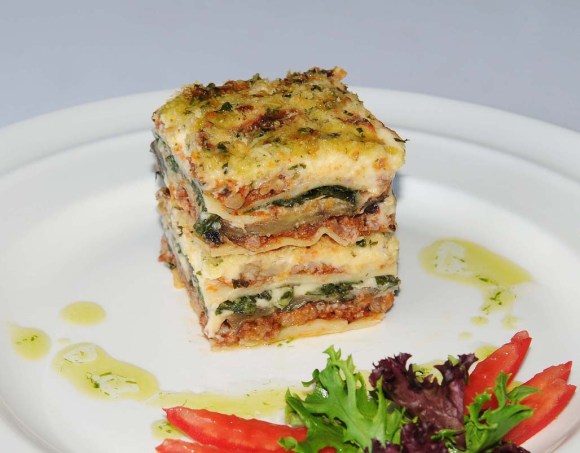
Lamb and aubergine lasagne


Serves 4

To save time, the white sauce may be made up to two days ahead, the surface covered with plastic wrap and stored in the refrigerator until ready to use. Dried lasagne sheets, blanched, can be used in stead of fresh pasta. LASAGNE

Please note that this is not strictly the traditional Lasagne, which I believe comes without aubergine, mushrooms and spinach — contrary to this recipe. So, apologies to all the purists out there.

The vegetables:
2 large aubergines, thinly sliced horizontally
2 tablespoons/30 ml olive oil
1 tablespoon/15 ml butter
16 large field mushrooms, roughly chopped
1 cup/25 ml cooked spinach
salt and freshly ground black pepper

The meat sauce:
2 tablespoons/20 ml olive oil
2 large onions, chopped
3 garlic cloves, minced
3 tablespoons/45 ml bacon, finely chopped
450 g/15.8 oz pork, minced
450 g/15.8 oz lamb, minced
750 g/1½ lb tomatoes, skinned, seeded and chopped
½ teaspoon/3 ml fennel seeds, crushed
2 tablespoons/30 ml tomato paste
½ teaspoon/3 ml cinnamon
pinch allspice, ground
salt and freshly ground pepper

The white sauce:
1 cup prepared Bechamel sauce

The topping:
1 cup/250 ml fresh breadcrumbs
2 tablespoons/30 ml fresh parsley, finely chopped
1 tablespoon/15 ml garlic
250 g/9 oz Parmesan cheese, finely grated

Additional ingredients:
125 g/4.4 oz cheddar cheese, grated
125 g/4.4 oz Buffalo mozzarella cheese, sliced
12 fresh pasta sheets (cut to 14 x 7 cm/5.5 in x 2.7 in)

Preheat the oven to 180°C/356°F.

Sprinkle the aubergines with salt and set aside for 30 minutes, then rinse the aubergines and pat dry.

Heat the olive oil and butter in a large heavy non-stick pan and fry the mushrooms until cooked through. Remove from the pan with a slotted spoon, season and set aside.

Heat some more oil and fry the aubergine slices until golden brown on both sides, then drain on kitchen towel and set aside.

In the same pan, heat the oil and fry the onions, garlic and bacon over moderate heat, until softened. Add the pork and lamb and cook, stirring to break up, until it is crisp and starting to caramelize. Stir in the remaining meat sauce ingredients and salt and pepper to taste. Cook for about 5 minutes more, uncovered.

Mix all the ingredients for the topping and set aside.

Assemble the dish:
Grease an ovenproof dish with a lid, approximately 34 x 24 cm/13 in x 9.5 in. Arrange enough pasta sheets to cover the bottom of the dish. Place the aubergine slices in a single layer over the pasta, then spread half of the meat sauce over the whole surface. Mix the mushroom mixture with the spinach and spread half of this over the meat sauce. Scatter half the mozzarella cheese over and pour half the white sauce over the cheese. Repeat the above steps once more ending with the white sauce. Sprinkle the topping over, drizzle some olive oil over, then cover the dish with the lid and bake in the middle of the oven for 30 minutes.

Remove the lid and bake the Lasagne for 10 minutes longer until the top is bubbling. For extra crispy and golden topping, grill under a preheated grill for about 2 minutes. Let the Lasagne stand for 5-10 minutes before serving. Serve with a simple fresh salad.2