Categories
MAIN COURSE

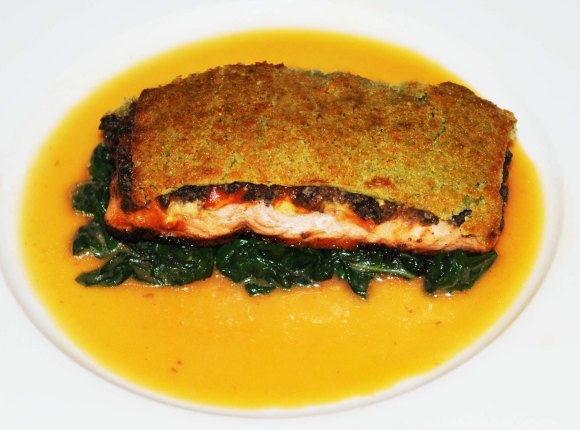
Herb crusted salmon with Swiss chard


This is a very elegant and delicious dish to serve at your next dinner party.  Most of the components can be prepared well in advance.
SALMON WITH HERB CRUST

Serves 4

Preheat the oven to 220ºC/430ºF.

 800 g/1.8 lb salmon, skinned, bones removed
salt and freshly ground white pepper
1 tablespoon mustard
2 tablespoons tomato sauce (recipe follows)
2 tablespoons mushroom duxelle (recipe follows)
200 g soft herb crust (recipe follows)

Cut the salmon in even portions and season with salt and pepper. Lightly spread Dijon mustard on top of each piece of fish,  then a spread of the tomato sauce, then the mushroom duxelle. Place a neat tile (the size of the fish) of the soft herb crust on top of the fish.  Heat an ovenproof pan with a splash of oil and put the salmon in with the crusted side facing up. Cook for 1 minutes then place the pan in the preheated oven for 6-8 minutes.


Keep an eye on it so that the crust does not burn.  Set aside to rest for 5 minutes.

Tomato sauce:
100 ml/3.4 fl oz olive oil
½ shallot, finely chopped
1 clove garlic, minced
6-8 large ripe tomatoes, peeled, seeded and finely diced
1 sprig fresh thyme
¼ bay leaf

Heat the olive oil in a pan and sauté the shallots and garlic for a few minutes without coloring. Add the tomato and thyme and continue cooking very gently until all the moisture of the tomato has evaporated and you are left with a dry tomato paste. Remove the sprig of thyme and bay leaf, and put the mixture in a blender and blend until smooth.

The mushroom duxelles:
2 cups mixed mushrooms, finely chopped
salt and freshly ground white pepper
1 tablespoon cream

Wipe the mushrooms and trim the stalks if necessary. Chop very finely in a processor or by hand, then cook in a dry pan until all their liquid has evaporated and the mushrooms formed a paste.

Add the cream and mix in to bind the mushrooms.


Yoghurt can be used instead of cream, but add it right at the end of cooking the mushrooms and do not bring to a boil.


The herb crust:

175 g/6 oz fresh breadcrumbs
80 g/2.8 oz Gruyère cheese
50 g/1.87 oz mixture of fresh parsley, fresh tarragon, and fresh thyme leaves, finely
chopped
125 g/4.4 oz unsalted butter
salt and freshly ground pepper

Place all the ingredients into a food processor and process until thoroughly mixed. On a tray lined with greaseproof paper, spread the crumb mixture about 2 mm/0.07 in thick on to a tray and freeze uncovered.  Cut the crust big enough to fit nicely on top of each portion of the fish.


There will be some left over.  Cover it tightly and freeze for later us.


The sauce:

500 g/1 lb  butter
1 tablespoon shallots, minced
100 ml/3.4 fl oz white wine
1½ cup fish stock
pinch of kosher salt
pinch of white pepper
lemon juice

Heat 1 tablespoon butter and add the shallots.  Sauté until translucent (do not brown), then add the wine.  Reduce until there are only about 1 tablespoon of the wine left, then add the fish stock and reduce until half.  Set the pan over low heat and whisk 2 knobs of butter into the reduction and continue whisking the rest of the butter, a knob at a time, allowing each piece to dissolve into the sauce before adding more.  When all the butter is used up, remove the pan from the heat and whisk in the lemon juice.  Taste and adjust the seasoning, then strain through a fine sieve into a bowl.  Keep warm.

The Swiss chard:
1 large bunch of Swiss chard, freshly picked
1 small clove garlic, sliced
1 tablespoon/15 ml butter
salt

Rinse out the Swiss chard leaves thoroughly, then remove the tough stalk and cut the leaves into wide strips.

Heat a saucepan on medium heat, add the olive oil and the garlic and sauté for a few seconds, then add the sliced Swiss chard leaves and salt. With tongs lift and stir the leaves constantly to ensure that the bottom ones don’t overcook. (It should not be necessary to add water because the chard releases quite a bit of moisture.) Do this for no longer than 5 minutes. It will become soft and silky and still is bright green.  Taste a piece and add seasoning if necessary.  Set aside until needed. 

To serve:
In the centre of each serving plate, spoon the Swiss chard, place the salmon on top and spoon the sauce around.  Serve immediately.
 

Categories
STARTERS/SIDES

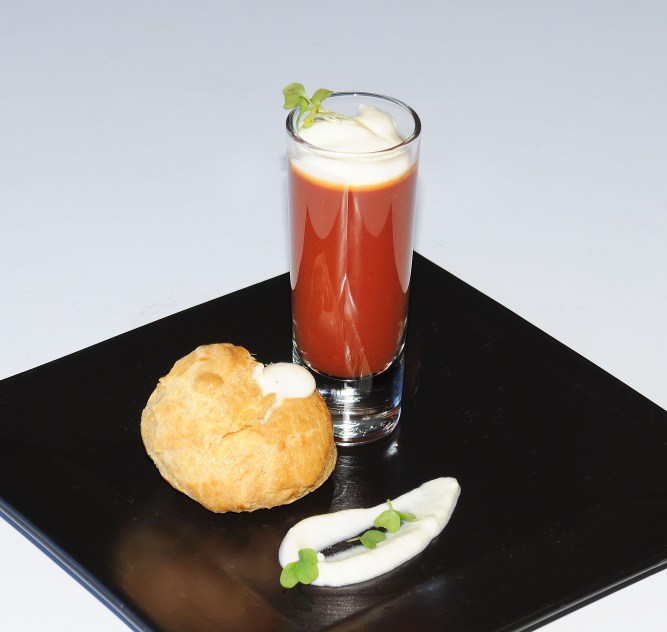
Bloody Mary jellies


Served with savory puffs filled and goat’s cheese cream

This truly delectable and very sophisticated jelly makes a perfect starter. Those who prefer not to use alcohol, use more tomato juice. The savory puffs can be omitted and instead serve with some cheese crackers.

BLOODY MARY JELLYServes 4

The jelly:
1½/ cups/350 ml tomato juice
⅓ cup/80 ml vodka
1 tablespoon/15 ml Worcestershire sauce (for vegetarians use soy sauce)
1 tablespoon/15 ml lemon juice
a few drops Tabasco, or according to taste
½ tablespoon/3 ml horseradish, freshly grated
celery salt to taste
4 teaspoons/20 ml gelatine powder
½ cup/125 ml water

The savory puffs:
½ cup/125 ml milk
115 g/4 oz unsalted butter, cut into tablespoons
large pinch of salt
1 cup/250 ml flour, sifted
4 large eggs
1 cup/250 ml Gruyère cheese, finely grated
freshly ground pepper
freshly grated nutmeg


Use any leftover savory puffs to fill with cream cheese and chives, leftover fish mixed with some mayonnaise, etc..

The filling:
½ cup/125 ml goat’s cheese, crumbled
2 tablespoons/30 ml light cream cheese
2 teaspoons/10 ml olive oil
1 tablespoon/15 ml of water
1 tablespoon/15 ml fresh lemon juice
1 fresh garlic clove, crushed
salt and freshly ground pepper to taste

The garnish:
a few celery leaves
a few sprigs of cress

For the jelly:

  • Mix all of the ingredients together, except the gelatine. Leave to infuse for about 30 minutes, then strain.
  • Heat about ½ cup/125 ml of the liquid and stir in the gelatin powder until dissolved.
  • Add to the rest of the liquid, pour into shot glasses, big enough for one serving each, and place in the refrigerator for at least three hours to set.

For the savory puffs:

  • Preheat the oven to 200°C/400°F and line 2 baking sheets with parchment paper. 
  • In a medium saucepan, bring the water, milk, butter and salt to a boil.
  • Add the flour and stir it with a wooden spoon until a smooth dough forms.
  • Lower the heat and stir until the dough pulls away from the sides, about 2 minutes.
  • Scrape the dough into a bowl and let it cool for 1 minute. Lightly beat the eggs and add to the dough, a little bit at a time, mixing well before adding more egg.
  • Add the cheese, the pepper and the nutmeg.
  • Transfer the dough to a pastry bag fitted with a 1.3 cm/0.5 in round tip and pipe tablespoon-size mounds onto the baking sheets, 5 cm/2 in apart.
  • Sprinkle with cheese and bake for 22 minutes, or until puffed and golden brown.
  • Poke a hole in the base of each puff to let out the steam. Leave to cool until ready to serve

For the savory puff filling:

  • Blend together all the ingredients until creamy, adding an extra tablespoon/15 ml water if necessary.
  • When ready to serve, place a shot glass on each plate and top it with some of the savory puff filling.
  • Pipe the filling into each savory puff and place one on each serving plate with the Bloody Mary jelly.
  • Garnish with a few celery leaves and cress and serve immediately.
Categories
STARTERS/SIDES

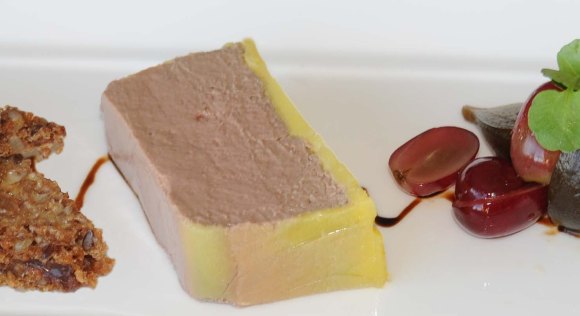
Chicken liver parfait


Serve with figs, grapes and herb salad and whole-wheat bread

Make this silky and rich parfait at least a day in advance if possible so the flavors can fully develop and mature.  Go to the extra trouble with the sieving by pushing the mixture through twice.  This will guarantee the parfait’s smooth and delicate texture.

Chicken liver pave

For the parfait:
1¾ cup milk
400 g/14 oz chicken livers, trimmed
2 tablespoons olive oil
1 medium shallot, finely chopped
1 garlic clove, finely chopped
1 sprig of thyme
3 tablespoons brandy
3 tablespoons port
3 tablespoons of Madeira
50 g/1.8 oz clarified butter*, melted
3 eggs
1 egg yolk
salt and freshly ground black pepper
300 g/10.5 oz butter, melted (to seal the parfait)
balsamic glaze for drizzling


Clarified butter
This is butter that has had the whey and the milk solids removed which allows the butter to be heated to a higher temperature without burning.
To make clarified butter:
Heat the butter in a saucepan over medium heat.  As it melts, the butter will start sizzling as the water evaporates and the butter breaks up in three layers.  A sediment will form in the base of the pan, a froth will form on top and the clear butter in the middle. The sediment on the bottom should not go brown in the process and the froth on top has to be skimmed. Pour the butter through a sieve lined with cheesecloth to trap the milk solids. Store the clarified butter covered in the refrigerator for up to 3 weeks or freeze it for 3 months.
When the recipe calls for foaming butter, do not use clarified butter because the impurities that you remove when clarifying, is in fact, what encourages the foaming.

For the garnish:
4 ripe figs
a few pitted grapes
micro herbs

whole wheat bread, thinly sliced

To make the parfait:

  • Soak the livers in the milk for at least four hours, then drain, rinse and pat dry. Discard the milk.
  • Heat the oven to 120°C/248°F. Grease a terrine mold and line with plastic film.
  • Heat the oil in a frying pan and add the shallot and garlic. Fry until translucent, then add the thyme.
  • Add the brandy and flambé, and when the flames have died down, add the port, Madeira and reduce by two-thirds.
  • Leave to cool slightly, then add the butter, eggs and the cleaned livers and season with salt and pepper.
  • Do not bring to a boil again, this is just to get all the ingredients up to the same temperature.
  • Discard the thyme.
  • Transfer the liver mixture to a food processor and blend until smooth.
  • Pour the blended mixture through a fine sieve, rubbing the mixture with the back of a ladle into a bowl.
  • Discard any solids left behind.
  • Pour the liver mixture into the mold, put a piece of tin foil over the top of the dish (it must not touch the liver mixture) and place the lid on top.
  • Put the dish into a roasting tin, fill it halfway with hot water, place on the middle shelf of the oven and bake for 45 minutes.
  • Test the internal temperature and if it has not reached 65°C/149°F, place it back into the oven for another 10 minutes and check it again.
  • When the parfait is cooked, remove it from the oven and leave to cool in the dish until it has reached room temperature.
  • Spoon the clarified butter over the parfait and decorate with herbs to your liking, pressing them lightly into the butter to adhere.
  • Place the mold in the fridge to set overnight.
  • The next day, place a large enough plate over the parfait and tip the board and plate over to leave the parfait on the plate with the decorated surface facing up.
  • Peel off the plastic film and discard.
  • Return the terrine to the fridge until ready to serve. This will keep for up to 3 days.

The flavors improve tremendously if you leave the parfait to rest for at least 24 hours.

For the garnish:

  • Heat the grill to medium hot.
  • Cut the figs in half and drizzle a few drops of olive oil over the cut side of the fig halves and briefly put under the grill (cut side up). Remove and let cool.
  • Gently toss the micro herbs and grapes with olive oil, a pinch of salt, and a few grinds of pepper.
  • Divide into four servings.

To serve:
Dip a large sharp knife into hot water and carefully slice the parfait to the thickness desired. Plate each slice on suitable serving plates with the fig and grapes and the whole-wheat bread on the side. Drizzle with the balsamic glaze all round.

Categories
SOUPS/SAUCES/CONDIMENTS

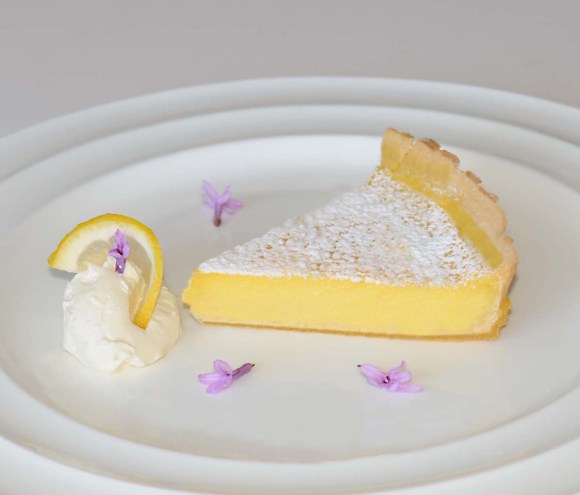
LEMON TART WITH LIMONCELLO CREAM


LEMON TART

The pastry:
125 g/4.5 oz butter, room temperature
90 g/3 oz caster sugar
1 egg
250 g/9 oz cake flour
pinch of salt
ice water

The filling:
2 eggs
4 egg yolks
180 g/6.4 oz caster sugar
1¾ cup/426 ml full cream
5 tablespoons/75 ml lemon juice

The garnish:

icing sugar for sprinkling
1 cup/250 ml fresh cream
1 teaspoon/5 ml Limoncello

Limoncello, and Italian liqueur, mainly produced in the southern parts of Italy, has a strong lemon flavor without the sourness or bitterness of pure lemon juice. Traditionally, it is made from the zest of Sorrento lemons using the zest, or peels without the pith, and is steeped in a neutral spirit until the oil is released. The resulting yellow liquid is then mixed with simple syrup. Varying sugar to water ratio and temperature will affect the clarity, viscosity, and flavor.

Heat the oven to 190°C/374°F and grease a tart pan with a loose bottom of about 20 cm/7.8 in diameter.

In a processor, cream the butter and sugar, then add the egg. Mix well, then add the flour and salt and mix. The dough should be soft and pliable, but if for some reason it feels too dry, add a few drops of ice water. Roll the pastry into a flat disk and roll up in plastic film. Refrigerate for about 30 minutes.

On a lightly floured surface, roll out the pastry to about 4 cm/0.15 in thickness and line the tart pan with it. Cover the pastry with parchment paper and fill it with baking beans, then bake blind for about 15 minutes. Remove the baking beans and paper and bake for 5 minutes longer. The pastry should be a light golden color.

Lower the oven temperature to 140°C/175°F.
Whisk the eggs and sugar until well blended, then add the cream and the lemon juice and stir to mix well. Strain the mixture into a container with a spout. Place the tart on a baking tray and place halfway into the oven. Carefully pour the filling into the tart shell and slowly move the baking tray to the center of the oven. Bake for 50 minutes. The filling should have set but still wobbly. Remove from the oven and cool completely. Carefully remove the cooled tart from the pan. If you prefer, sprinkle icing sugar over the whole tart, otherwise leave it as is.

When cutting the tart, dip the knife into hot water and use soft pressure.

Whip the cream with the Limoncello and put a blob on each plate.


Categories
MAIN COURSE

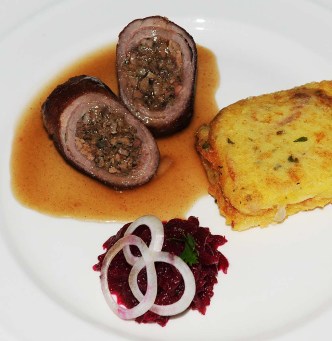
Veal rolls stuffed with chicken liver and prosciuto in a Marsala and white wine sauce


Serve it with polenta cakes and pickled beetroot.

LINE

Serves 4

The rolls can be prepared the previous day and cooked just before serving.VEAL ROLLS

The filling for the veal rolls:
15 ml/1 tablespoon oil
15 ml/1 tablespoon onion, finely chopped
2 rashers of bacon, finely diced
2 free-range chicken livers
5 ml/1 teaspoon rosemary, finely chopped
30 ml/2 tablespoons fresh white breadcrumbs
30 ml/2 tablespoons Parmesan cheese, freshly grated
5 ml/1 teaspoon parsley, finely chopped
1 free-range egg, beaten
pinch nutmeg, freshly grated
5ml/1 teaspoon lemon juice
salt and freshly ground black pepper

The veal:
12 thin slices of veal
12 slices of prosciuto
50 g/1.7 oz butter

The sauce:
30 ml/1 tablespoons olive oil 125ml/½ cup shallots, thinly sliced
5 ml/1 teaspoon garlic, minced
80ml/⅓ cup beef stock
80ml/⅓ cup Marsala wine
salt
10 ml/2 teaspoons fresh rosemary, finely chopped
10 ml/2 teaspoons parsley, finely chopped

If Marsala wine is not available, use port or sherry.

The polenta:
2 liters/4.3 pts milk
300 g/10.5 oz polenta
50 g/1.7 oz Parmesan cheese, grated
50 g/1.7 oz butter
1125 ml/½ cup chopped fresh chives
salt
150 g/5.2 oz butter for frying the mushrooms
500 g/1 lb mixed mushrooms
freshly ground black pepper
60 ml/¼ cup vegetable oil

Heat the oil and fry the onion and bacon until crisp, remove from the pan and drain on paper towel. Add the chicken liver to the same pan and fry for 1 minute, remove and drain, then chop the liver fine and mix well with the bacon and the rest of the filling ingredients. Divide up into twelve portions.

Between two sheets of cling-film, beat the slices of veal flat with a mallet. Put a portion of filling on top of each of the veal slices and carefully roll up the veal with the filling, taking care no to let the filling push out on the sides. Put each roll on top of a slice of prosciuto and roll up again. Secure with toothpicks. Cover and place in the refrigerator for one hour.
In a heavy based saucepan and over medium heat, melt the butter and fry the veal rolls until they are evenly cooked and golden brown – about 3 minutes on each side. Remove from the pan and keep aside in a warm place for 10 minutes.

Add the olive oil to the saucepan in which the veal rolls were cooked, add the shallots and over low heat saute for about 2 minutes, then add the garlic. Turn the heat up and deglaze the pan with the Marsala wine, then add the chicken stock, parsley and rosemary and cook until the liquid is reduced by half. Season to taste and return the veal rolls and any accumulated juices to the pan. Spoon the sauce over the veal rolls and simmer for about 1 minute.

Meanwhile, bring 2 liters/4.3 pts milk to the boil in a large saucepan, add the polenta gradually in a thin, steady stream, stirring all the time. Add salt and cook over low heat for about 45 minutes, stirring frequently.

Remove the polenta from the heat and gently stir in the Parmesan cheese and chives. In a frying pan, heat the butter then fry the mushrooms until cooked and mix in with to the polenta which should be quite soft.  Pour the hot polenta into a square dish about 2 cm/0.7 in thick. Leave to set then slice into squares of about 8 x 8 cm/3 x 3 in.
Heat a frying pan with the oil until quite hot. Gently lower the polenta squares one by one into the hot pan and fry until golden on both sides. Drain on kitchen towel.

Serve the veal rolls sliced at a slant across with the polenta and Pickled beetroot salad. Drizzle the sauce around and serve immediately.

Categories
SOUPS/SAUCES/CONDIMENTS

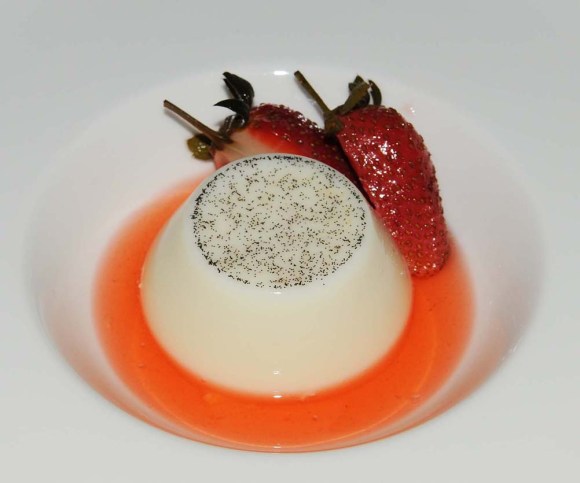
Panna Cotta with strawberries and champagne


Panna Cotta, meaning “cooked cream”, a basic pudding with main ingredients dairy, sugar and gelatin, originated in Italy and its name literally means “cooked cream”. Play with the flavorings.  Use coconut milk, buttermilk or soy milk instead of milk and cream and flavorings, and serve it with sauces such as fruit purees, butterscotch sauce, or chocolate sauce.  This is a very versatile dessert and easy and quick to make.

PANNA COTTA

The Panna Cotta:
1½ sheet leaf gelatin
2 cups/500 ml full cream
70 g/2.5 oz castor sugar
beans from 2 vanilla pods

Once you have scraped the seeds from the vanilla pod, store it in an airtight container filled with sugar. This will provide you with vanilla flavored sugar in just a few days. (See my tip for storing vanilla pods in vodka!)

The strawberries:
½ bottle of champagne
150 g/5.2 oz castor sugar
about 20 strawberries, washed and hulled

Place the gelatin leaves in a bowl of cold water and leave to soak for 5-10 minutes until soft.

Pour the cream into a saucepan and stir in the sugar and the vanilla bean pulp. Bring almost to the boil, remove from the heat and place the pan over a bowl of ice cubes.

Remove the gelatin from the water and squeeze out any excess water with your hands. Stir the gelatin into the boiled cream and continue to stir until it has dissolved. When it has cooled, strain the cream into 4 ramekins. Cover and leave in the fridge for about 4 hours, until set.

Pour the champagne into a saucepan and add the sugar. Bring to the boil then pour over the strawberries in a bowl. Leave to cool.

To serve:
Invert the individual ramekins on each serving plate. Decorate with the strawberries and pour over a little of the juice.

Categories
SOUPS/SAUCES/CONDIMENTS

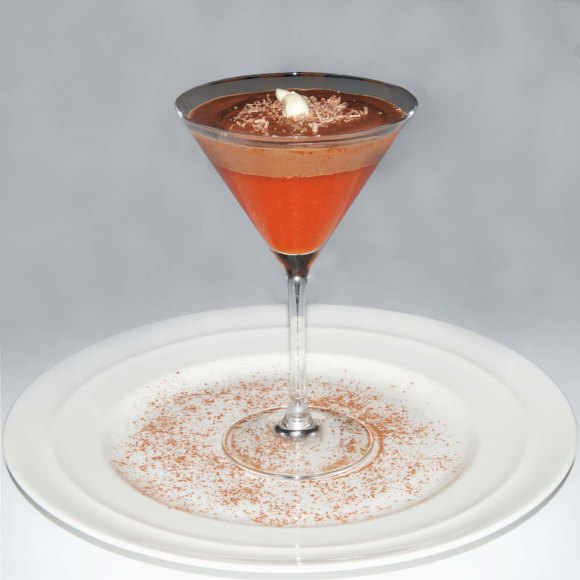
Papaya mousse with chocolate and orange and Cointreau mousse topping


Serve with brandy snaps or wafer rolls.

BLOCK HORIZONTAL LINE

Serves 4

Experiment with mangoes or other soft seasonal fruit such as ripe peaches, melon,etc. Adding lemon juice to prevent them from browning is essential. If orange flavored chocolate is not available, finely grate some orange zest into the melting dark chocolate.

image description

The papaya mousse :
1 small, ripe papaya, seeded and peeled
¼ cup/60 ml caster sugar
2 tablespoons/30 ml fresh lemon juice
2 teaspoons/10 ml peach Scnapps / Cointreau, or orange juice

The chocolate mousse topping:
¼ cup/60 ml whole milk
¼ cup/60 ml double cream
85 g/3 oz orange-flavoured dark chocolate, finely chopped
1 free-range egg

The brandy snaps:
125 g/4.4 oz butter
4 tablespoons/60 ml golden syrup
125 g/4.4 oz dark brown sugar
125 g/4.4 oz plain flour
1 teaspoon/5 ml ground dried ginger

Puree the papaya in a liquidizer. Add the caster sugar, lemon juice and Schnapps / Cointreau (if using) or orange juice. Pour into 4-6 fluted glasses or large cocktail glasses and chill to set.

In a large saucepan and over medium heat, slowly bring the milk and cream to the boil. Put the chopped chocolate into a liquidizer and pour over the hot milk and cream. Leave to stand for two minutes, then blend the mixture for about 30 seconds. Add the egg to the mixture and blend for another 45 seconds. Carefully pour the chocolate over the papaya mousse and refrigerate for about 2 hours or until set.

The recipe for the chocolate mousse contains raw eggs and is not suitable for pregnant women, the elderly or very young children. If you wish to avoid using raw eggs, make the Quick chocolate mousse. The recipe is in the Glossary.

The brandy snaps:
Heat the butter, syrup and sugar over low heat until melted. Sift the flour and ginger together and add to the butter mixture. Mix until smooth, then cool and chill for an hour.

Preheat the oven to 160°C/320°F and lightly grease a baking tray.
Roll teaspoons full of the mixture into balls and flatten them into discs directly onto the baking tray. Leave enough room between each disk for spreading out during baking. Bake in the oven for 7 – 10 minutes or until golden brown. Leave to cool slightly then wrap over the bottom of a glass or around a rolling pin, or simply leave it flat. Leave to cool completely.

To serve:
Place each glass of papaya and chocolate mousse in the center of a serving plate with two brandy snaps each. (One or two wafer rolls can be used instead of the brandy snaps.)

Categories
MAIN COURSE

BOLOGNESE


The difference between this and the traditional Bolognese recipe is that I do not let it cook for very long because I do not use canned tomatoes. I prefer the freshness and lightness the fresh tomatoes give the dish.

BOLOGNESE

To start:
25 g/8 oz butter
25 g/8 oz olive oil
2 cloves garlic, finely chopped
1 carrot, finely chopped
2 celery stalks, finely chopped
2 large mushrooms, finely chopped

The meat:
25 g/8 oz butter
25 g/8 oz olive oil
70 g/2½ oz pancetta, finely sliced
1 onion, finely chopped
300 g/10.6 oz beef, minced
100 g/3.5 oz pork, minced
2 large, fresh tomatoes, peeled, deseeded and finely diced
¾ cup/175 ml white wine
1 cup/250 ml beef stock
¾ cup/175 ml whole milk

The pasta:
spaghetti (for 4 servings)
2 tablespoons/30 ml olive oil
2 tablespoons/30 ml parsley, finely chopped
grated Parmesan cheese, to serve

To start:
Melt the butter and oil in a heavy-based pan over medium heat, then add the garlic, carrot and celery and fry for 2 minutes. Add the mushroom and cook until the mushroom are cooked. Remove the vegetables from the pan with a slotted spoon and add some more butter and oil.

Turn up the heat then add the onion and pancetta and let it cook for a minute or so. Add the minced beef and pork, breaking it up with wooden spoon and leave to brown without stirring. Then stir and let brown some more. Stir in the reserved mushrooms and vegetables and the milk and stir through until the milk is well absorbed. Add the white wine and let it cook down, then add the tomatoes and half the stock. Cook until nearly dry then add the rest of the stock and cook some 15 minutes longer. Season to taste and remove from the heat. Keep it warm.

While the Bolognese is “resting”, cook the pasta until al dente in a deep saucepan with lots of salted water. Drain and pour back into the saucepan and drizzle some olive oil over. Stir through the parsley.

With a pasta serving fork, roll up the pasta and gently slide it onto a warm serving plate. Neatly spoon the meat sauce over the pasta, top it with freshly grated Parmesan cheese and more parsley if preferred.

Make double the meat sauce and use leftovers for making:
Stuffed roast peppers
Stuffed mushrooms
Sausage rolls with puff pastry.

For leftover spaghetti:
Mix with breadcrumbs, herbs and cheese and put it under the grill for a few minutes for a delightful snack or with a salad for lunch.

Categories
SOUPS/SAUCES/CONDIMENTS

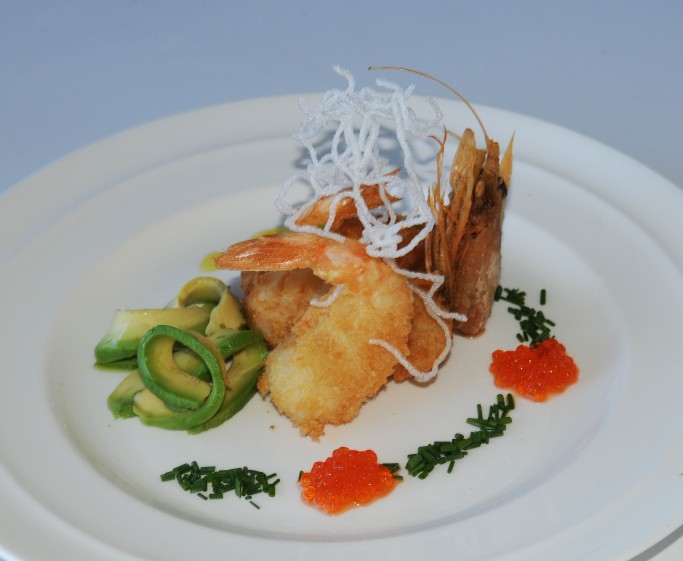
Fish and prawn tempura with an Oriental dipping sauce


The tempura prawns can also be served on a potato cake, toast or rice cake; serve also with salmon roe, chopped chives and/or avocado.

SEAFOOD TEMPURAServes 4

The fish:

320 g /11 oz firm white fish, skin removed
8 tiger prawns, shelled and de-veined (always reserve and freeze prawn shells for later use to make seafood stock. )
flour for dusting
salt and freshly ground black pepper
oil for deep-frying

The tempura batter:
1 cup/250 ml self-raising flour
1 tablespoon/15 ml cornstarch
1 cup/250 ml soda water
a few blocks of ice

The dressing:
3 tablespoons/45 ml hot water
1 teaspoon/5 ml dashi granules
1-2 teaspoons/5-10 ml mirin
2 tablespoon/30 l soy sauce

The garnish:
fresh coriander leaves for serving
salmon roe or caviar


See the Glossary for safety tips on deep-frying.

  • Heat the oil in a deep frying pan to about 180°C/356°F.
  • Cut the fish in strips of 3 x 8 cm/1 x 3 in and butterfly the prawns.
  • For the dipping sauce, dissolve the dashi granules in the hot water and let it cool.
  • Add the mirin and soy sauce and mix well.

The mirin is quite sweet but after tasting the sauce you can decide whether you want to add more.

  • In a large bowl, mix the two flours with the or soda water until just combined, but still quite lumpy. Add the blocks of ice to keep the mixture cold.
  • Dust the pieces of fish and prawns lightly with flour and season well.
  • Dip the fish in the batter, gently shake off the excess and place in the hot oil (not more than four pieces at a time).
  • Deep-fry in batches until golden and drain on paper towel.
  • Before adding the next batch, make sure the oil is back to the correct temperature.
  • Keep the cooked fish uncovered in a low oven until you are ready to serve.
  • Serve immediately.

To serve:
Serve the fish tempura pieces stacked on each plate with garnishes of your choice, and the dipping sauce in a small bowl for each serving.

Categories
METHODS

Lamb stock


5 kg/11 lbs lamb bones
2 pig’s trotters, cleaned thoroughly and split in half (ask your butcher to do it for you)
50 ml olive oil
2 medium onions, roughly chopped
4 carrots, roughly chopped
1 celery stalk, roughly chopped
6 liters/12.5 pts/ cold water
5 medium size ripe tomatoes, cut in quarters

Preheat the oven to 200°C/400°F.
Place the lamb bones and the trotters on an oven tray and cook in the preheated oven until browned all over.  In a large stockpot, heat the oil and lightly fry the onions, carrots and celery, then add the lamb bones and trotters. Add the water, and bring to the boil.  Turn down the heat and simmer gently over low-medium heat, regularly skimming the brown foam that forms on the surface.  Simmer for 5 hours, then remove from the heat. Cool to room temperature, then strain, do not press down on the solids as this will cause the stock to become cloudy.  Cover and refrigerate until cold, then remove the fat from the  surface.  Refrigerate for up to 2 days or frozen in smaller containers for up to 3 months.  Discard the solids.