Categories
SOUPS/SAUCES/CONDIMENTS

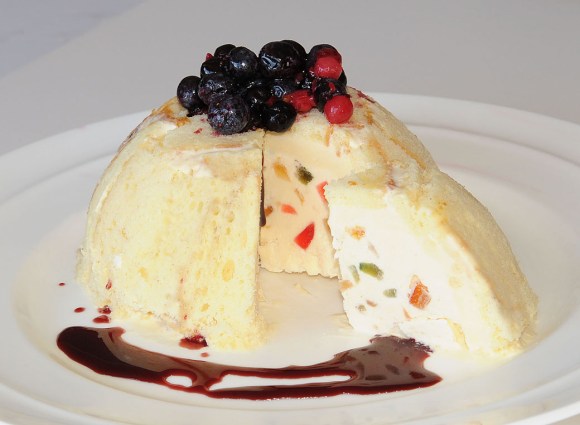
CASSATA (Glazed fruit ice-cream cake with a fresh strawberry compote)


This dessert definitely has the wow factor and can be prepared well in advanced, therefore ideal for entertaining.
CASSATA

The sponge cake:
225 g/8 oz self-raising flour
½ level teaspoon baking powder
225 g/8 oz caster sugar
225 g/8 oz unsalted butter (melted and cooled)
½ cup/125 ml milk and water mixed
1 large egg
zest of 1 lemon
pinch of salt

The candied fruit:
4 tablespoons/60 ml candied fruit
4 tablespoons/60 ml rum

The vanilla ice-cream: 

As a time saver, use a good quality bought vanilla ice-cream.

150 g/5 oz sugar
6 free-range eggs
1 cup/250 ml milk
1 cup/250 ml full cream
beans of 1 vanilla pod
grated peel of 1 lemon

The cream:
2 free-range egg whites
75 g (2.6 oz) sugar
the soaked and drained candied fruit
¼ cup/60 ml crème fraîche, stirred until smooth

Any left over egg whites can be frozen and thawed for future use. Freeze each egg white in an ice-cube tray and then transfer to either a freezer bag or a container. Once thawed, whites will beat to a better volume if allowed to sit at room temperature for about 30 minutes.

The strawberry compote:
1 cup/250 ml sugar syrup
½ cup/125 ml fresh orange juice
1 cup/250 ml fresh strawberries, hulled and roughly chopped

The garnish:
a selection of red berries (optional)

Preheat the oven to 180ºC/356°F. Grease a cake pan with a loose bottom, about 22 cm/8.6 in diameter, then dredge the inside with a mixture of flour and caster sugar.

Into a mixing bowl, sieve the flour, baking powder, salt and sugar. Whisk together the egg, butter, milk and water and mix into the flour until it forms a smooth batter.  Pour into the prepared cake tin and bake in the preheated oven for 30-35 minutes, until well risen and golden. Remove from the oven and leave for 5 minutes. Remove the cake from the cake tin and leave to cool totally.

Cut the cake into strips of 2 cm/0.7 in thick each. Line 1 ℓ/1 qrt bowl with cling wrap, then line with the strips of the sponge cake.

Soak the candied fruit in the rum for about 4 hours or overnight.

Whisk the sugar and egg yolks in a bowl until pale. Bring the milk and cream with the vanilla beans to the boil and pour half of it onto the sugar and egg mixture.

The ice-cream recipe contains raw eggs and is not suitable for pregnant women, the elderly or very young children.

Whisk well, then pour the mixture back into the saucepan with the remaining milk and return to very low heat. Stir continuously with a wooden spoon until the mixture thickens enough to coat the back of the spoon. Remove from the heat and pass through a sieve into a clean bowl placed over a bowl of ice cubes and water to cool the mixture as quickly as possible. Pour into an ice-cream machine and churn, otherwise you can still-freeze it.

Fill the cake lined bowl with the ice-cream, leaving an ample hollow space to fill later with the candied fruit cream. Put back into the freezer for about 1 hour or until frozen.

Beat the egg whites and sugar until stiff. Drain the candied fruits and add to the egg whites. Gently stir in the crème fraîche until the whole mixture becomes well blended. Fill the bowl (lined with the cake and frozen ice-cream) with this mixture and smooth with a knife. Cover and freeze overnight.

Bring the syrup and orange juice to the boil and pour over the strawberries. Leave to cool then refrigerate until ready to use.

To serve:
Turn the mold out onto a plate, slice it to reveal the center and pour the strawberry compote on the side. Garnish with a selection of the red fruits.

 

Categories
SOUPS/SAUCES/CONDIMENTS

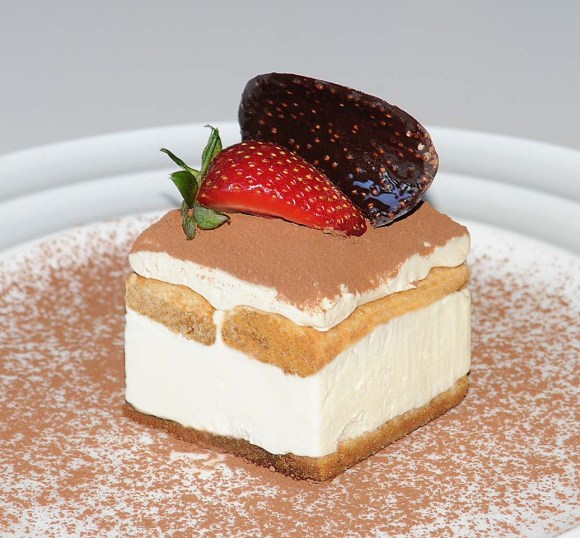
Tiramisú


This is a popular coffee-flavored Italian dessert with many different versions.  Although this is a most delightful dessert, there is unfortunately no recipes for Tiramisú with ingredient substitutes for the weight conscious.
BLOCK HORIZONTAL LINEServes 4

TIRAMISÙ

3 very fresh eggs, separated
¼ cup/60 ml sugar
1 cup/250 ml Mascarpone (make your own)
1 cup/250 ml cold, strong black coffee
80 ml/⅛ cup Noilly Prat / Marsala / Tia Maria
200 g/7 oz sponge fingers

Mascarpone is a thick, double or triple cream, soft cream cheese with a very high fat content. The texture is that of thickened cream that is on its way to becoming butter. Making your own mascarpone at home is simple, cheaper than the shop bought ones and utterly delicious. It can be used for both sweet and savory dishes and enhances the flavor of the dish without overwhelming the original taste. Mascarpone can be served alone with fruit or fruit syrup;  it makes charming canopies, topped with anchovies, tomato, smoked salmon, etc in fact, any topping you would normally put on top of a cream cheese snack. Mascarpone needs to be consumed within a few days.

The garnish:
unsweetened cocoa powder to finish

Over a double boiler, beat the egg yolks and sugar until the mixture becomes thick and creamy. Remove from the heat and allow to cool for a few minutes. Fold the mascarpone into the egg mixture, a spoonful at a time. Beat the whites separately until stiff, and fold into the mascarpone mixture.

Mix the coffee with the liqueur in a shallow bowl, then briefly dip half the sponge fingers in the liquid, soaking one side only and arrange in a single layer on the bottom of a shallow serving dish the dry side of the biscuit facing down.

Do not soak the sponge fingers for longer than 3 seconds as it falls apart easily when wet. Other liqueurs can be used but if you prefer without alcohol, the coffee should be enough.

Pour half the mascarpone mixture over the sponge fingers. Dip the remaining sponge fingers in the coffee and liqueur mixture and arrange on top of the mascarpone cream. Finally, pour over the rest of the mascarpone cream, and smooth the surface. Cover, and chill in the refrigerator for at least 2 hours.

This recipe contains raw eggs and is not suitable for pregnant women, the elderly or very young children.

To serve:
Before serving, sprinkle generously with cocoa powder. (Using a small sieve makes this easier).

Categories
SOUPS/SAUCES/CONDIMENTS

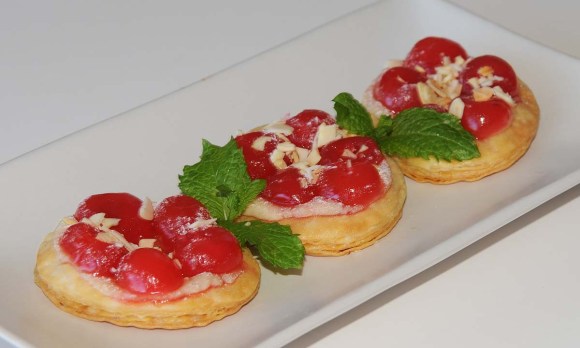
Marachino cherries and marzipan tarts


If this recipe yields too many tarts for one sitting, it is better to half the recipe as they are at their best when still slightly warm. But it should be no problem. They are delicious and small enough to have more than one, two, three ….

Makes 30

CHERRY MARZIPAN

45 pitted Marachino cherries, drained thoroughly on kitchen paper (it is available in jars at any supermarket)
150 g/ 5 oz marzipan (make your own)
2 sheets puff pastry (use bought pastry but see recipe to make your own)
½ cup/125 ml almonds, finely chopped
icing sugar for dusting

Preheat the oven to 180°C/350°F.

Line two baking trays with parchment paper. Roll out the puff pastry to 5 mm/0.2 in thick. Use a 5 cm/2½ in pastry cutter and punch 30 rounds from the rolled pastry. Carefully place each round on the two prepared baking trays and prick each one all over with a fork. Cover them with another sheet of parchment paper, then two more baking trays on top of each baking tray. (If you don’t have enough baking trays, do this in two sessions.) This is to weigh the pastry down preventing them from rising during the cooking. Bake for 10 minutes then remove from the oven. Lift off the extra trays and parchment paper and leave the pastry to cool.  

Roll out the marzipan to about 2 mm/0.7 in and punch 30 rounds with pastry cutters slightly smaller than 5 mm/0.2 in and place on top of the cooled pastry discs. Cut each cherry in half and place 5 halves on top of each marzipan disc. Put the trays back in the oven and bake for another 10 minutes. Remove from the oven and when they have cooled down slightly, sprinkle over the icing sugar and the chopped almonds.


Categories
SOUPS/SAUCES/CONDIMENTS

Roast butternut and figs with pine nuts and goat’s cheese


1 small butternut
75ml olive oil
salt and freshly ground black pepper
12 spring onions
1 teaspoon/5 ml chili powder (or more if you want it stronger)
8 fresh, ripe figs, halved
40 ml balsamic vinegar
20g caster sugar
2 tablespoons/30 ml pine nuts, toasted
½ cup/125 ml soft goat’s cheese, crumbled

Heat the oven to 220°C/425°F. Peel the butternut , cut in half lengthways, then cut into smaller wedges and pack loosely in a baking tray. Pour three tablespoons/45 ml of the olive oil over and season well with the salt and freshly ground black pepper. Roast for 25 minutes until soft, then remove from the oven and set aside. Heat the rest of the olive oil in a frying and add the spring onions. Fry until tender and sprinkle over the chili powder. Remove from the pan and set aside. Then add the figs cut side down to the same pan and fry until lightly caramelized.

Meanwhile, make the dressing. Put the balsamic vinegar and sugar in a small saucepan, bring to a boil, then reduce the heat and simmer for two to four minutes, until it thickens but is still runny. Remove from the heat.

Arrange the butternut on a serving plate and add the figs and spring onions. Sprinkle over the pine nuts and scatter the cheese crumbs all round. This dish can be served hot or at room temperature.

Categories
SOUPS/SAUCES/CONDIMENTS

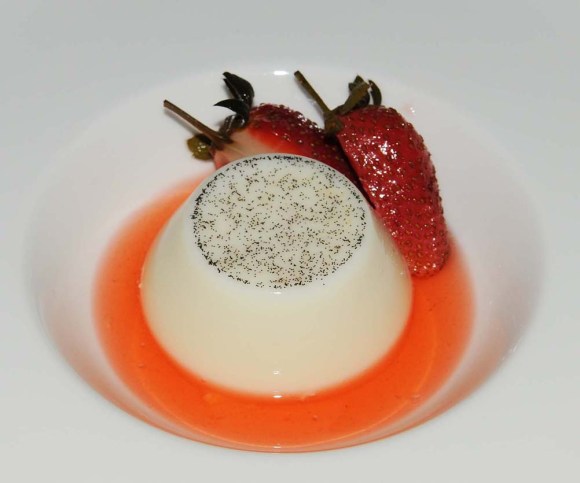
Panna Cotta with strawberries and champagne


Panna Cotta, meaning “cooked cream”, a basic pudding with main ingredients dairy, sugar and gelatin, originated in Italy and its name literally means “cooked cream”. Play with the flavorings.  Use coconut milk, buttermilk or soy milk instead of milk and cream and flavorings, and serve it with sauces such as fruit purees, butterscotch sauce, or chocolate sauce.  This is a very versatile dessert and easy and quick to make.

PANNA COTTA

The Panna Cotta:
1½ sheet leaf gelatin
2 cups/500 ml full cream
70 g/2.5 oz castor sugar
beans from 2 vanilla pods

Once you have scraped the seeds from the vanilla pod, store it in an airtight container filled with sugar. This will provide you with vanilla flavored sugar in just a few days. (See my tip for storing vanilla pods in vodka!)

The strawberries:
½ bottle of champagne
150 g/5.2 oz castor sugar
about 20 strawberries, washed and hulled

Place the gelatin leaves in a bowl of cold water and leave to soak for 5-10 minutes until soft.

Pour the cream into a saucepan and stir in the sugar and the vanilla bean pulp. Bring almost to the boil, remove from the heat and place the pan over a bowl of ice cubes.

Remove the gelatin from the water and squeeze out any excess water with your hands. Stir the gelatin into the boiled cream and continue to stir until it has dissolved. When it has cooled, strain the cream into 4 ramekins. Cover and leave in the fridge for about 4 hours, until set.

Pour the champagne into a saucepan and add the sugar. Bring to the boil then pour over the strawberries in a bowl. Leave to cool.

To serve:
Invert the individual ramekins on each serving plate. Decorate with the strawberries and pour over a little of the juice.

Categories
SOUPS/SAUCES/CONDIMENTS

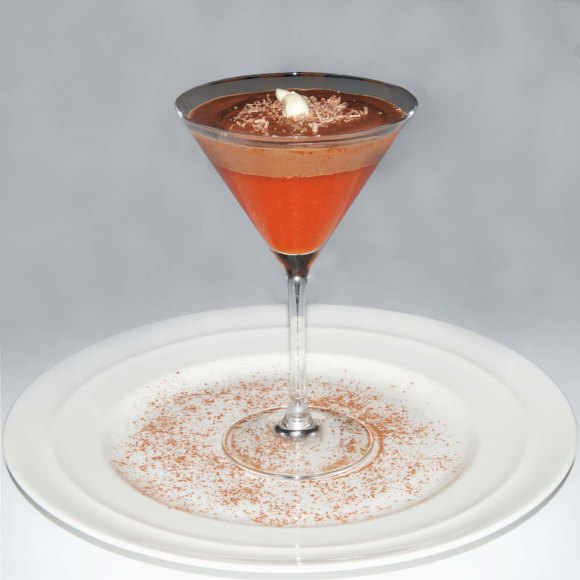
Papaya mousse with chocolate and orange and Cointreau mousse topping


Serve with brandy snaps or wafer rolls.

BLOCK HORIZONTAL LINE

Serves 4

Experiment with mangoes or other soft seasonal fruit such as ripe peaches, melon,etc. Adding lemon juice to prevent them from browning is essential. If orange flavored chocolate is not available, finely grate some orange zest into the melting dark chocolate.

image description

The papaya mousse :
1 small, ripe papaya, seeded and peeled
¼ cup/60 ml caster sugar
2 tablespoons/30 ml fresh lemon juice
2 teaspoons/10 ml peach Scnapps / Cointreau, or orange juice

The chocolate mousse topping:
¼ cup/60 ml whole milk
¼ cup/60 ml double cream
85 g/3 oz orange-flavoured dark chocolate, finely chopped
1 free-range egg

The brandy snaps:
125 g/4.4 oz butter
4 tablespoons/60 ml golden syrup
125 g/4.4 oz dark brown sugar
125 g/4.4 oz plain flour
1 teaspoon/5 ml ground dried ginger

Puree the papaya in a liquidizer. Add the caster sugar, lemon juice and Schnapps / Cointreau (if using) or orange juice. Pour into 4-6 fluted glasses or large cocktail glasses and chill to set.

In a large saucepan and over medium heat, slowly bring the milk and cream to the boil. Put the chopped chocolate into a liquidizer and pour over the hot milk and cream. Leave to stand for two minutes, then blend the mixture for about 30 seconds. Add the egg to the mixture and blend for another 45 seconds. Carefully pour the chocolate over the papaya mousse and refrigerate for about 2 hours or until set.

The recipe for the chocolate mousse contains raw eggs and is not suitable for pregnant women, the elderly or very young children. If you wish to avoid using raw eggs, make the Quick chocolate mousse. The recipe is in the Glossary.

The brandy snaps:
Heat the butter, syrup and sugar over low heat until melted. Sift the flour and ginger together and add to the butter mixture. Mix until smooth, then cool and chill for an hour.

Preheat the oven to 160°C/320°F and lightly grease a baking tray.
Roll teaspoons full of the mixture into balls and flatten them into discs directly onto the baking tray. Leave enough room between each disk for spreading out during baking. Bake in the oven for 7 – 10 minutes or until golden brown. Leave to cool slightly then wrap over the bottom of a glass or around a rolling pin, or simply leave it flat. Leave to cool completely.

To serve:
Place each glass of papaya and chocolate mousse in the center of a serving plate with two brandy snaps each. (One or two wafer rolls can be used instead of the brandy snaps.)

Categories
MAIN COURSE

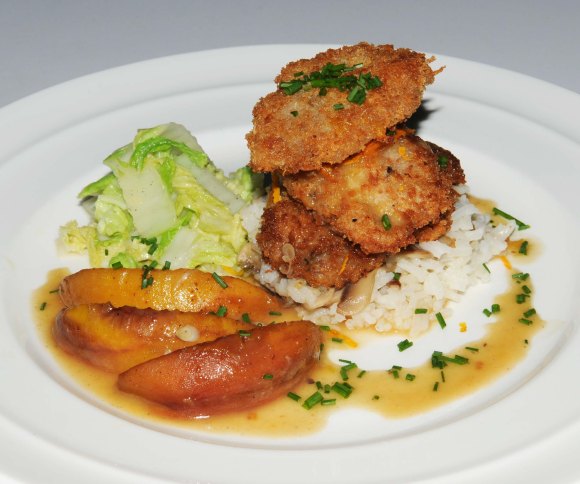
Duck breast fritters with Basmati rice and roast peaches


If you wish to serve another vegetable,  cabbage, lightly poached in butter and seasoned with nutmeg, goes very well with this dish.

Serves 4

DUCK BREAST FRITTERS

The duck:
4 free-range duck breasts
2 tablespoons/30 ml shoa xing rice wine (available at Asian supermarkets)
1 tablespoon/15 ml szechuan pepper, ground (available at Asian supermarkets)
1 clove garlic, minced
salt
flour for sprinkling
2 free-range eggs, whisked
Japanese breadcrumbs (Panko breadcrumbs)
oil for deep-frying

The peaches:
1 tablespoon/15 ml sugar
1 tablespoon/15 ml butter
4 ripe peaches, stoned and quartered (use canned peaches if fresh ones are unavailable but cut down on the sugar)
2 cloves, ground
2 tablespoons/30 ml Peach Schnapps

The rice:
450 g/15.8 oz Basmati rice
4 cups/1 liter chicken stock
75 g/2.6 oz butter
salt

The garnish:
2 tablespoons/30 ml orange zest, grated
2 tablespoons/30 ml fresh chives, chopped

Score the breasts on the fat side with 2 cm/0.8 in space between each cut. Mix the rice wine, pepper, garlic and salt and rub onto the breasts on both sides. Set aside in the refrigerator for at least 2 hours.

When ready to cook, wipe most of the marinade of the breasts, heat a non-stick pan and sear the breasts on the fat side only, until crispy (about 3 minutes). Remove the breasts from the pan and set aside to cool. Store the rendered fat in a container for another time to fry potatoes, etc.

When the meat has rested for at least ½ hour (it will be quite raw still), slice the meat into 4 thick slices across. Place each slice of breast between two pieces of cling film and with a mallet, flatten the meat until about 15 mm/1 in) thick.

Sprinkle each slice with flour, then dip it in the egg and finally coat with the breadcrumbs. Heat the oil in a large saucepan,  fry the crumbed slices in the hot oil until crispy — not longer than 30 seconds on each side. Remove from the pan and let drain on kitchen paper.

Meanwhile, in a saucepan, melt the sugar and butter and saute the peach quarters in it for about 1 minute on each side, de-glaze with the schnapps, sprinkle over the ground cloves and let simmer for another 2 minutes or until just tender.

Add the rice, salt and chicken stock to a medium saucepan. Bring to the boil, lower the heat, then cover with a tightly-fitting lid. Cook for 15-20 minutes then turn off the heat and leave the rice to stand, still covered, until about 5 minutes before serving. When ready to serve,add the butter and fluff up the rice with a fork.

To serve:
On each heated serving plate, spoon some rice and stack four duck breast fritters on top.  Divide the peaches and place around the rice and drizzle some of the peach juices over.

Categories
SOUPS/SAUCES/CONDIMENTS

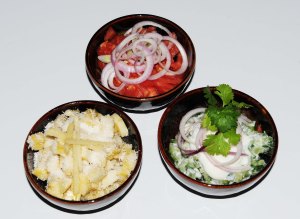
SAMBALS TO SERVE WITH INDIAN FOOD


SAMBALS

SAMBAL 1:
Papaya and banana coated with coconut
Makes about 2 cups/500 ml
1 small papaya, cut into 2 cm/0.7 in pieces
1 banana, cut into 2 cm/0.7 in pieces
4 tablespoons/60 ml cup lemon juice
desiccated coconut

Sprinkle the lemon juice over the banana and papaya and toss in enough desiccated coconut to coat each piece. Serve immediately at room temperature.

SAMBAL 2:
Tomato and onion salsa
Makes about 2 cups/500 ml
4 ripe tomatoes, unpeeled, seeded and cut into 1 cm/0.4 in pieces
1 red onion, finely chopped
3 tablespoons/45 ml coriander leaves, finely chopped
1-2/15-30 ml tablespoons lime juice
1 teaspoon/5 ml soft brown sugar
salt and freshly ground black pepper

Combine all the ingredients and gently mix together.  Cover with plastic wrap and refrigerate for 15 minutes.

Chef’s note: The reason for not peeling the tomato, is simply to keep the tomato pieces intact and not losing too much juice.

 SAMBAL 3:
Cucumber and yogurt mix (Raita)
Makes about 2 cups
1 teaspoon/5 ml each of ground cumin  and mustard seeds, toasted
1 cucumber, seeded and diced
1 cup/250 ml plain yoghurt
½ teaspoon/3 ml ginger, freshly grated
3 sprigs of mint, finely chopped
salt and freshly ground black pepper

Fry spices in a dry pan for 1 minute until fragrant and set aside.  In a separate bowl, put the cut cucumber and sprinkle salt over.  Set aside to draw out all the water.   Just before serving the meal, drain the cucumber and mix with the cucumber and yogurt and add the toasted spices, ginger and mint.  Mix gently to combine well.  Serve chilled.

Categories
MAIN COURSE

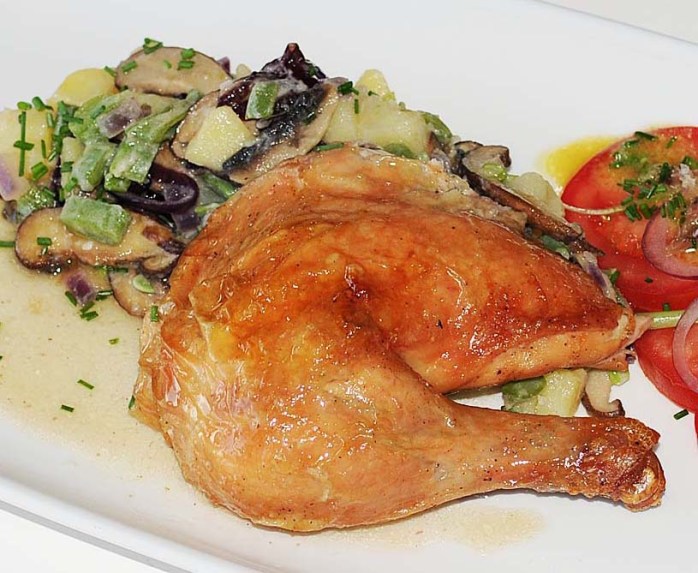
Thyme smoked chicken (Done on a Weber)


Served with a creamy white wine and thyme sauce, served rice and any vegetables. 


To smoke food, means to slowly cook over indirect heat and a low fire with smoldering flavorings such as herbs or special wood. For this recipe however it is a combination of smoking and roasting. Here we serve the chicken with a Bulgur wheat salad with fennel, egg, grapes and sun-dried tomatoes and a Roast potato with rosemary.

THYME SMOKED CHICKEN

Serves 4

The chicken:
1 large free-range chicken, washed inside and out, and dried
3 tablespoons/45 ml olive oil
salt and freshly ground black pepper
juice of ½ lemon
20 sprigs of fresh thyme, tied in two bundles
2 cups/500 ml chicken stock

The sauce:
1 teaspoon garlic, minced
1 shallot, finely chopped
1 cup/250 ml chicken stock
the pan drippings
1cup/250 ml fresh cream (optional)
salt and freshly ground black pepper

The bulgur wheat salad:
250 g/9 oz bulgur wheat
4 small free-range eggs (small hen’s eggs or quail eggs)
1 fennel bulb, halved and finely sliced
1 bunch spring onions, chopped
25 g/0.8 oz sun-dried tomatoes in oil, drained and sliced
a handful of green seedless grapes, cut in half
3 tablespoons/45 ml chopped fresh parsley
2 tablespoons/30 ml chopped fresh mint
75 g (2.6 oz) black olives, stoned
¼ cup/60 ml olive oil
1 small garlic clove, minced
2 tablespoons/30 ml lemon juice
salt and ground black pepper


For the smoking, we strongly recommend using the indirect cooking method in a kettle barbecue. Set up your grill for indirect heat by building a 2 zone fire, one on each side – drip pan goes in the middle under the meat. Make a charcoal fire and let burn until the coals are coated lightly with white ash.

  • Rub the oil over the skin of the chicken and season inside and out with salt and pepper.
  • Prepare the fire with two side fires and a central position for a drip try.
  • Generously rub with olive oil all over, then place the chicken, breasts up, on top of the wire racks of the barbeque, over the hot coals (with the dripping tray directly underneath), then position the sprigs of thyme on each side of the chicken.
  • Place the lid firmly on but keep the grill vents open, and cook for about 20 minutes. Then remove and discard the burnt thyme.
  • Tip the carcass to let the juice in the cavity run into the dripping tray (do this every 10 minutes from now on), pour the chicken stock in the dripping tray, and place the chicken back on the grid with the breasts facing down.
  • Replace the lid firmly again and continue cooking for another 20 minutes.
  • Then make a small incision in the inside of each leg. If the juices run clear it is cooked, otherwise leave it for 5-10 minutes longer.
  • Another way of seeing whether the chicken is cooked, tip it again to see whether the juices in the cavity is clear. If you are satisfied that the juices are clear, remove the chicken from the grill and leave to rest in a warm place, breasts side down, for at least 25 minutes.
  • While the chicken is cooking, heat the oil in a saucepan and gently fry the garlic and shallot until golden.
  • Turn up the heat then add the chicken stock and reduce until syrupy. Put aside until the chicken is cooked.
  • When the chicken is cooked and while resting it, remove the dripping tray from the barbeque and drain off the excess oil.
  • Pour the contents of the dripping through a strainer (scraping off all the bits that are stuck to the tray) into the reduced chicken stock and over medium heat, bring to the boil then add the cream (if using).
  • Pour through a fine sift again into a clean pan and simmer gently until the sauce has thickened, stirring continuously. Check the seasoning.

To serve:

  • Joint the chicken and place a serving of joints on warm serving plates.
  • Spoon the sauce around and garnish with a sprig of fresh thyme.
  • Serve with the rice and other side dishes of your choice.
  • If you wish, cut the chicken in easy serving pieces the Chinese way. A description of this method is in the Glossary.
Categories
SOUPS/SAUCES/CONDIMENTS

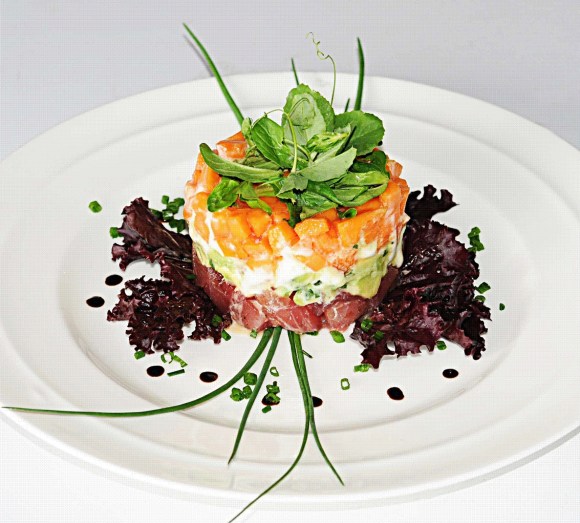
Marinated tuna salad with avocado pear, yogurt cream and mint papaya


Served with avocado pear,yogurt cream and mint papaya.

BLOCK HORIZONTAL LINE

Serves 4

The preparations for this dish should only be done just before serving to ensure utter freshness.The tuna can be replaced with fresh salmon or any other sashimi fresh fish.

MARINATED TUNA SALAD

The tuna:
2 cups/500 ml very fresh raw tuna, cut into small dice
1 tablespoon/15 ml olive oil
½ teaspoon/3 ml balsamic vinegar
salt and freshly ground pepper

The avocado:
2 cups/500 ml avocado pear, cut into small dice
½ teaspoon/3 ml lemon juice
salt and freshly ground black pepper

The yogurt cream:
1 tablespoon fresh/15 ml cream
1 tablespoons/15 ml plain yogurt
1 tablespoon/15 ml chives, finely chopped

The papaya:
2 cups/250 ml papaya, cut into small dice
2 mint leaves, finely chopped
½ teaspoon/3 ml lemon juice
½ teaspoon/3 ml fine sugar

The dressing:
2 tablespoons/30 ml Japanese mayonnaise, mixed with rice wine vinegar and a pinch sugar
extra chives, finely dice

The garnish:
a selection of fine herbs
chive oil
balsamic vinegar syrup

For the tuna, gently mix the tuna with the olive oil, balsamic vinegar and salt and pepper. Cover and set aside.

For the avocado, sprinkle the lemon juice and salt and pepper over the avocado and set aside.

For the yogurt cream, whisk the cream until thick, then mix in the yogurt, chives and salt and pepper.   Gently mix the yogurt cream into the avocado, cover and set aside.

For the papaya, mix all the ingredients, cover and set aside.
For the dressing,  mix all the ingredients, cover and set aside.

To serve:
On each serving plate, place a ring mold and divide the tuna into four. Spoon the tuna into the ring mold and gently press down, then repeat with the avocado mixture, then papaya.  Slowly lift the ring mold whilst pressing the contents down with your other hand. Drizzle some of the mayonnaise over each tower and top with a sprinkle of chives. Scatter the lettuce leaves all round and serve immediately.