Categories
MAIN COURSE

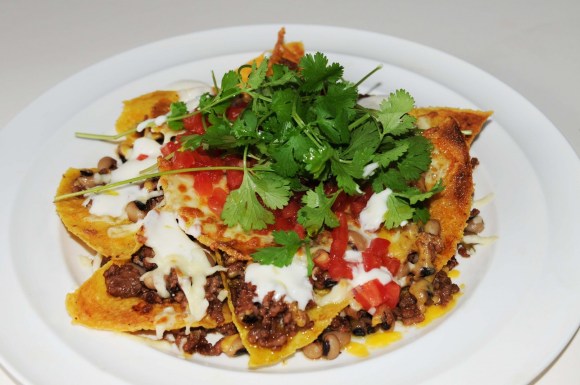
Nachos with tomato salsa, quacomole and sour cream


Nachos (believed to have originated in Mexico) is regarded as a snack and generally consists of fried tortilla chips topped with a layer of refried beans, various meats, jalapeño and a layer of shredded cheese.  There are many variations and this recipe is my own variation.  I hope you enjoy it.
LINE

Serves 4 Nachos

The beans:
1 cup/250 ml black eye beans, soaked in water overnight

The meat:
125 g/4.5 oz bacon, finely diced
500 g/1 lb ground lamb
2 garlic cloves
1 large onion, finely sliced
1 tablespoons/15 ml cumin, ground
2 cups/500 ml lamb stock (or chicken stock), heated
4 pickled jalapeno, seeds removed and finely sliced salt and freshly ground black pepper

The tomato salsa:
1 large onion, finely chopped
2 tomatoes, peeled, seeds removed, and chopped
1 cup/250 ml spring onions, finely sliced
1 tablespoon/15 ml olive oil
1 teaspoon/5 ml lemon juice
pinch of sugar
salt and freshly ground black pepper

The sour cream:
1 cup/250 ml cream
2 cups/500 ml natural yoghurt
2 tablespoons/30 ml lemon juice
salt and freshly ground black pepper

The quacomole:
2 ripe avocados, roughly mashed with a fork
1 pickled jalapeño, seeds removed if required, finely chopped
3 tablespoons/45 ml onion, finely chopped
1 tablespoon/15 ml tomato, peeled, seeded and finely chopped
1 tablespoon/15 ml cilantro
½ tablespoon/7 ml lime juice
a few drops of Tobasco sauce
salt and freshly ground black pepper

The toppings:
1 small bunch cilantro
24 corn tortillas
250 g/½ lb cheddar cheese, grated
250 g/½ lb hard mozzarella cheese, grated

In a saucepan, cover the soaked and drained black eye beans with cold water and bring to the boil.  Boil until tender (about 40 minutes), drain and add salt to taste.   Cover the saucepan and keep warm.

In a large frying pan, heat the olive oil until very hot.  Add the bacon and cook for a minute or so, then add the mince and stir to break up the lumps.  Fry until it started to get a good caramelized color, then add the garlic, onion, cumin, salt and freshly ground black pepper.  Cook for about 5 minutes, then add the hot lamb stock and cook until the sauce starts to thicken. Stir through the jalapeño and the black eye beans, cover the pan and turn off the heat.

For the tomato salsa, mix all the ingredients in a bowl, cover and refrigerate until needed.

For the sour cream, whisk the cream until slightly thickened, then add the rest of the ingredients and mix well.  Cover and refrigerate until needed.

For the quacomole, mix all the ingredients just before serving, cover and refrigerate until needed.

Heat the oven to very hot and arrange the corn tortillas on a big baking plate. Heat until the color changes slightly, then remove from the oven, cool slightly and break up in the required sizes.  Alternatively, if available, use good quality bought corn chips.

To serve: Use a big shallow baking dish and spread half the lamb mixture on the bottom, followed by a layer of chips.  Scatter half the cheddar and mozzarella around and half the cilantro.  Repeat the layer and finish with the cheese.  Do not add the rest of the cilantro now.  Place the baking dish under the grill and leave until the cheese is melted and bubbling.  Remove from the oven and sprinkle the rest of the cilantro over.  Serve with the tomato salsa scattered over and a generous drizzle of the sour cream.  Serve the quacomole on the side as well as the rest of the sour cream for guests to add as they wish.  Extra tortilla chips will certainly be appreciated.
Categories
SOUPS/SAUCES/CONDIMENTS

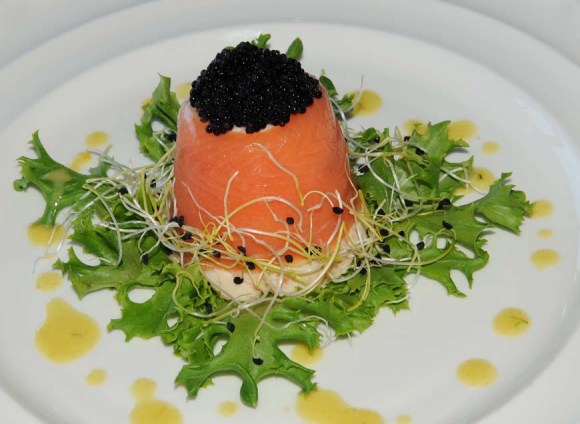
Smoked trout mousse


Served with horseradish and micro salad leaves

SMOKED TROUT MOUSSEServes 4

The mousse:
4-8 ribbons of smoked trout (to line the ramekins)
2 smoked trout fillets
½ cup/125 ml full cream, chilled
1 tablespoon/30 ml butter at room temperature
Tobasco sauce, a few drops
2 tablespoons/30 ml fresh lemon juice
salt
1 sheet gelatin
1 tablespoon/15 ml water
1½ cup/750 ml chilled full cream
4 tablespoons/60 ml caviar (if caviar is not available, finely chopped chives will do)

The horseradish cream:
3 tablespoons/45 ml fresh horseradish, grated
1 tablespoon/15 ml white wine vinegar or lemon juice
1 teaspoon/5 ml sugar
1 tablespoon/30 ml fresh dill, finely chopped
1 cup/250 ml fresh full cream
salt and freshly ground black pepper


This horseradish cream also goes well with  beef, beets, chicken, eggs, fish, pork, salmon, sausages, shellfish, smoked fish, etc. Covered, the sauce will keep for 2 to 3 days in a refrigerator.

The garnish:
micro salad leaves and sprouts
horseradish cream
dill sprigs
small wedges of lemon

  • Have ready four ramekins lined with cling wrap with excess all round to cover the mousse, then line the inside of each ramekin with the trout ribbons, leaving the bottom open.
  • In a food processor, blend the trout, cream, butter and lemon juice and add salt to taste.
  • Soak the sheets of gelatin in a bowl of cold water and after 5 minutes, drain and squeeze out the excess water.
  • Heat a small saucepan on low heat and add the gelatin with one tablespoon of water.
  • Let the gelatin dissolve thoroughly, then remove from the heat and add to the trout puree.
  • Whisk the cream until stiff and fold into the trout puree. Taste for seasoning.
  • Fill the ramekins with the mousse, then cover with the overhanging cling wrap and chill the mousse for at least 8 hours or overnight.
  • For the horseradish cream, blend the horseradish, vinegar and lemon juice, sugar and dill in a food processor.
  • In a separate bowl, whisk the cream until stiff then fold in the horseradish mixture.
  • Season to taste, then strain if you prefer a smooth texture and refrigerate for 4 – 8 hours.

To serve:
Arrange the salad leaves and sprouts in the center of each serving plate and turn the mousse out onto the greens. Carefully peal off the cling wrap then spoon some caviar (or chives, if using) on top and drizzle the horseradish cream around the mousse. Decorate with a few sprigs of dill and the wedges of lemon and serve immediately.

Categories
MAIN COURSE

Marinated belly pork “sous vide”


“Sous-vide”-cooking is a method used to cook food sealed in airtight plastic bags in a water bath for longer than normal cooking times, sometimes as long as 72 hours, at a regulated temperature much lower than normally used for cooking. The intention is to cook the item (mostly tough cuts of meat) evenly, preventing the food from overcooking whilst keeping it juicy, succulent and tender.

PORK BELLY

For the pork:
1 kg/2 lb pork belly, without bone
300 ml pork stock
2 tablespoons/30 ml vegetable oil

The marinade:
1 stalk lemongrass, hard outside removed, the core finely chopped
1 teaspoon/5 ml white pepper, freshly ground
2 teaspoons/10 ml Chinese five-spice powder (mix your own)
4 cloves garlic, crushed
2 teaspoons/10 ml fresh ginger, peeled and finely chopped
Kosher salt
1-2 red chilies, seeds removed, finely chopped

  • For the marinade, mix the lemongrass, spices, garlic, ginger, salt and red chilies together in a small bowl, then rub the marinade into the pork belly all round.  Cover with cling film and marinate for at least two hours, or up to 12 hours, in the fridge.
  • Preheat the oven to 100ºC/212ºF.
  • Place the marinated pork in a food grade plastic bag and pour in the stock.
  • Seal the bag in the vacuum packing machine.
  • Meanwhile heat water in the ovenproof  basking dish to the same temperature as you have set the oven.
  • Carefully lower the sealed bag into the hot water and make sure the bag is totally covered with the water.

A good idea is to put a circle of greaseproof paper with a small hole in the middle, on top of the meat before you secure the lid on.

  • Place the baking dish in the oven and set your timer for 3 hours.
  • When the cooking time is up, carefully remove the bag from the hot water with tongs and place in a deep dish.
  • Cut the bag open and let the meat and juices slide out of the bag into the dish.
  • Pour out the sauce in a saucepan.
  • Press the meat between two baking trays with a weight on top to flatten the skin and place in the fridge to chill for 1-2 hours.
  • Just before serving set the oven to grill and place the pork belly, skin side up, about 30 cm/12 in from the grill.

Keep an eye on the skin as it can burn in an instant.


The sauce will have all the flavors of the marinade as well as the meat. 


Categories
SOUPS/SAUCES/CONDIMENTS

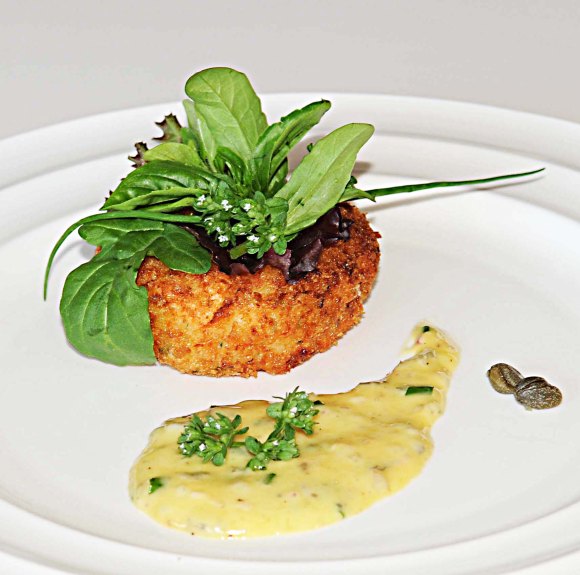
Seafood cakes with a caper sauce and mixed herbs


The fishcakes can be made with any leftover fish from a previous meal.

Serves 4
SEAFOOD CAKES

The mashed potatoes:
300 g/0.5 oz potatoes, peeled
2 tablespoons/30 ml créme fraîsche (make your own)
2 tablespoons/30 ml milk, heated
salt and freshly ground white pepper

The seafood:
1 tablespoon/15 ml olive oil
8 medium prawns, shelled, deveined
200 g/7 oz firm white fish OR 100 g/3.5 oz  salmon and 100 g/3.5 oz
firm white fish
100 g/3.5 oz smoked salmon
1 medium shallot, finely chopped
1 small mild red chili, finely chopped
1 tablespoon/15 ml lemon juice
1 egg lightly beaten
1 tablespoon/15 ml parsley, finely chopped
1 tablespoon fresh coriander, finely chopped
salt and fresh ground black pepper
Japanese breadcrumbs (Panko)
oil for deep-frying

The sauce:
2 hard-boiled egg
½ teaspoon/3 ml Dijon mustard
salt and freshly ground black pepper
½ cup/125 ml peanut oil
2 teaspoons/10 ml white wine vinegar
1 tablespoon/15 ml capers, drained, rinsed and roughly chopped
2 tablespoons/30 ml gherkins (cornichons), finely chopped
1 tablespoon/15 ml of each of parsley, tarragon, chives and chervil, finely chopped

The garnish:
a mixture of fresh herb leaves
paprika for sprinkling

Cut the potatoes into even chunks and boil in salted water until tender (about 15 minutes). Drain and return to the pan and over gentle heat, reheat the potatoes until any excess moisture has evaporated.  Push the potato chunks through a potato ricer.  In the meantime, slowly add the heated milk to the potatoes whilst whisking it with a fork. Mix in the créme fraîsche, salt and pepper to taste, then cover and set aside in a warm place.

To get the potato mash even smoother, push it through a drum sieve.

In a frying pan, heat the oil and lightly fry the prawns for 1 minute.  Remove with a slotted spoon and drain on kitchen towel.  Then fry the fish until just cooked – about 2 minutes.  Remove with a slotted spoon and drain on kitchen towel.  When the prawns and fish have cooled completely, roughly chop all of it and put in a bowl.  Cut the smoked salmon into small pieces and add to the fish and prawns.  Add the rest of the ingredients and the mashed potatoes, except the crumbs and oil, and mix well.  Put in the refrigerator for about 15 minutes to set, then remove and form the cakes.  Divide the mixture into 8 equal sized cakes.  (If you find that the cakes are too big, make smaller ones to get 12 cakes.)

To make sure that all the cakes are the same size, weigh them!

Heat the oil to about 170°C/335°F. (See safety tips for deep frying.)

Roll each cake in the crumbs, making sure the crumbs stick well, then fry in the oil – about 1-2 minutes on each side until they are golden brown.  Drain on kitchen towel and keep warm until ready to serve.

Put the yolks of the boiled eggs with the mustard and salt and pepper in a blender and blend well until a smooth paste forms.  While mixing, add half the oil, drop for drop, until all the ingredients amalgamated well.  Carry on mixing and add the vinegar, then slowly add the rest of the oil.  Transfer the mixture to a bowl and mix in the rest of the ingredients except the paprika.  Check the seasoning and adjust if necessary.  The paprika will be sprinkled over the sauce once it has be spooned onto the serving plates. Keep the sauce refrigerated until ready to serve.

To serve:
Place two or three fishcakes in the center of each serving plate, then put a posy of herb leaves on top or next to the cakes, and drizzle the sauce around.  Lightly sprinkle some paprika onto the sauce.

Categories
MAIN COURSE

Lamb shanks poached in a spicy broth


Served with harissa yogurt,  couscous and roast vegetables and spicy aubergine and shiitaki mushrooms

BLOCK HORIZONTAL LINE
Serves 4

LAMB SHANKS WITH HARISSA

The shanks:
olive oil
4 lamb shanks
1 carrot, diced
1 leek, diced
1 celery stick, diced
4 garlic cloves
1 bay leaf
1 rosemary sprig
1 star anise
4 cardamom pods
1½ cup/375 ml dry white wine
7 cups/1¾ liter lamb stock, heated
sea salt and freshly ground black pepper

The couscous:
2 tablespoons/30 ml butter
3 spring onions, thinly sliced
½ cup/250 ml raisins
cinnamon stick
salt and freshly ground black pepper
3 cups/740 ml chicken stock
2 cups/250 ml couscous
¼ cup/60 ml almonds, slithered
¼ cup/60 ml fresh mint, chopped

The aubergines:
olive oil
4 medium aubergines, sliced in thin sliced
12 shiittaki mushrooms, sliced
salt and freshly ground black pepper
½ teaspoon/3 ml sesame oil
½ teaspoon/3 ml oyster sauce
½ tablespoon/7 ml balsamic vinegar
½ tablespoon/7 ml lemon juice
1 tablespoon.15 ml soy sauce
2 teaspoons/10 ml mirin

The yoghurt and harissa sauce:
2 tablespoons/30 ml fresh cream
4 tablespoons/60 ml plain yoghurt
2 teaspoons/20 ml lemon juice
salt and pepper to taste
harissa paste

Preheat the oven to 120°C/250ºF.
Heat a little olive oil in a large ovenproof pan and brown the shanks all over. Remove and set aside. Add some more olive oil to the same pan, then saute the carrot, leek, celery and garlic until light golden. Add the herbs and spices, pour in the wine and cook until the alcohol has evaporated.
Place the lamb shanks back into the pan with the vegetables, then pour in the stock. Season well, then cover and put in the preheated oven. Cook for about 3 hours, then remove from the oven and leave in the liquid for 30 minutes. Remove the meat and keep in a warm place. Strain the liquid, discard the solids, then skim of the fat that rises to the top. Reduce the liquid over high heat until thick and glossy. Check the seasoning and add more salt and pepper if necessary.

In a saucepan, melt the butter then add the spring onions, raisins, cinnamon stick, salt and pepper and stir until everything is well coated with the butter. Add the stock and bring to a boil. Put the couscous in a heatproof bowl and pour the spiced stock over. Cover and allow to sit for 5-10 minutes. Uncover, fluff the couscous with a fork, and stir in the almonds. Serve warm at room temperature with the mint sprinkled over.

Preheat the oven to 180°C/356°F.
Sprinkle the aubergines with salt and set aside for 30 minutes, then rinse the aubergines and pat dry. Heat some oil and fry the aubergine slices until golden brown on both sides. Drain on kitchen towel and set aside.

In the same pan heat some more oil and fry the mushrooms until tender. Remove from the pan and drain on kitchen towel. Set aside.
Mix together the rest of the ingredients for the dressing and season to taste. Mix the dressing with the fried mushrooms and aubergines and gently stir through to coat all the vegetables. Set aside until ready to serve warm at room temperature.

Whisk the cream until stiff, then fold in the yoghurt, lemon juice and salt and pepper. Taste and adjust the seasoning to your liking. Set aside until ready to use.
Just before serving, add some of the harissa paste to the yoghurt and mix through. Taste and add more paste if you wish.

Categories
METHODS

HARISSA


1 preserved lemon, finely chopped OR 1 tablespoon lemon zest
1 bunch fresh coriander, including stalks, chopped
2 small hot green chilies (or more if you like it stronger)
1 teaspoon/5 ml salt
2-3 garlic cloves
½ cup/125 ml fresh mint leaves
1 tablespoon/15 ml coriander seed, toasted and ground
1 cup/250 ml olive oil.

In a pestle and mortar grind the lemon, coriander and chilies, then add the rest of the ingredients, pouring the oil in in a steady stream. Once you have reached the desired consistency, set aside for for an hour or two to allow the flavors to develop.

Categories
MAIN COURSE

Seafood pie with a golden potato crust


Served with a fennel, carrot and apple salsa and an apple juice and maple syrup dressing or pickled beetroot.

Serves 4

FISH PIE


This dish is even more tasty the next day, just reheat it in a very hot oven for 8 minutes.  If there is any leftover pie, be adventurous and convert it into a soup by liquidizing it and adding more fish- or chicken stock and cream.

The seafood:
300 g/10.5 oz three different types of firm white fish, cut into bite-size pieces

100 g/3.5 oz prawns, shelled, shells reserved for the stock
100 g/3.5 oz king crab legs, shelled, shells reserved for the stock
juice of ½ lemon
salt and freshly ground black pepper

The stock:
25 g/0.8 oz butter
2 garlic cloves, crushed
reserved prawn and crab shells
1 cup fish stock

The onion and mushroom mix:
6 cippolini onions, quartered (if cippolini onions are not available, use
shallots)
10 small button mushrooms
juice of 1 lemon
salt and freshly ground black pepper
1 tablespoons Noili Prat
dash of Tabasco (pepper sauce)

The potatoes:
300 g/10.5 oz potatoes, peeled and sliced with a mandolin to 2 mm thick slices
25 g/0.8 oz clarified butter
salt and freshly ground black pepper

The white sauce:
1 medium sized onion, studded with 10 whole cloves
¾ cup milk
¾ cup full cream
25 g butter
20 g flour
2 tablespoons spring onions, chopped
1 tablespoon parsley, chopped

  • Preheat the oven to 200°C/392°F.
  • For the stock, in a saucepan over medium heat, melt the butter and add the garlic. Fry for about 1 minute, taking care not to burn the garlic.
  • Add the reserved prawn and crab shells and cook gently whilst stirring – for about 5 minutes.
  • Add the fish stock and bring to the boil. Boil for 5 minutes then turn off the heat and let the stock infuse for about half an hour. Strain and discard the solids.

  • For the onion and mushroom mix, bring the strained stock back to a boil, add the onions, mushrooms and lemon juice and season to taste.
  • When the mushrooms are tender, remove from the heat and add the Noily Prat and Tabasco. Put aside to cool.

  • For the white sauce, bring the milk and cream to the boil in a saucepan and add the onion studded with cloves. Pour it in a bowl and leave to infuse.
  • In the same saucepan, melt the butter then stir in the flour and over low heat cook whilst stirring for about 5 minutes.
  • Strain the infused milk, discard the onion and cloves, and slowly pour the hot milk into the butter and flour mixture, whisking constantly until it reaches the desired consistency.
  • Add seasoning to taste and cook for a further 5 minutes. Strain the sauce, then add the chopped spring onions and parsley and put to one side.
  • Dot the surface with flakes of butter to prevent a skin from forming.

The onion can be reused (without the cloves) to make a sauce for another dish or for soup.

  • For the potatoes, blanch the potato slices in salted boiling water for about 5 minutes. Drain, plunge in iced water and set aside.

Assemble the dish:

  • Season the fish, prawns and crab meat and gently mix with the onion/mushroom mixture and the white sauce.
  • Spoon into a buttered ovenproof dish and smooth out with a spatula.
  • Carefully place the blanched potato slices like scales over the top and brush with the clarified butter.
  • Bake for 25-30 minutes in the preheated oven. If the potatoes are not golden brown at the end of the cooking time, turn on the grill and brown them directly.
  • When the dish is cooked, remove from the oven and let it rest for 15-20 minutes in a warm place before serving.
  • Serve with the Salad of fennel, apple and carrot salad (recipe follows).

Beetroot is also delicious with Seafood pie.  See Pickled beetroot salad with onions.

For the salad:
3 small heads of fennel, jullienned
2 Granny Smith apples, cored and jullienned
2 carrots, jullienned
½ red onion, finely diced
½ cup toasted slithered almonds, and 2 cups mixed baby salad leaves. 

For the dressing:

  • Bring ¼ cup apple juice, 1 tablespoon maple syrup and 1 teaspoonl balsamic vinegar to a boil in a saucepan and reduce down to about half.
  • Remove from the heat and add the salt and pepper. Leave to cool, then whisk in 1 cup avocado oil.
  • Just before serving, gently mix all the salad ingredients and drizzle the dressing.
  • Serve immediately with the Fish pie.
Categories
SOUPS/SAUCES/CONDIMENTS

Deep-fried brie on toast


Serve with fresh figs, crispy glass noodles and a Port vinaigrette

BLOCK HORIZONTAL LINEServes 4


Timing is of the essence when deep-frying the cheese. The result needs to be crispy on the outside and soft and creamy in the inside. The crispiness help with sealing in the creaminess, so when you cut into it, the creamy center will deliciously ooze out.

Chickpea flour chips:
100 g/3,5 oz chickpea flour
2 teaspoons/10 ml olive oil oil for deep-frying (if making the deep-fried brie for the same dish, use the same oil)

The cheese:
75 g/2.6 oz Camembert cheese, chilled
1 free-range egg
35 g/1.2 oz white breadcrumbs (Japanese breadcrumbs [Panko] are
very good)
125 g/4.4 oz flour
½ teaspoon/3 ml cayene pepper
oil for deep-frying (See Safety and practical tips for deep frying)
4 bundles of glass noodles

The port vinaigrette:
½ cup/125 ml vegetable oil
2 teaspoons/10 ml rice wine vinegar
½ teaspoon/3 ml Dijon mustard
1⅓ cup/330 ml port

The garnish:
four slices of bread, trimmed to the size of each wedge (lightly
toasted)
4 fresh figs (preserved figs, each cut in half will do when fresh ones are not available)
1 cup/250 l fresh mixed herb leaves

Chickpea flour has a high proportion of carbohydrates but no gluten and can be used to replace eggs in vegan cooking. It has a distinct flavor and chips are a delicious way of getting extra subtle flavor on the plate.

For the chickpea flour chips, bring 1 cup/250 ml of water to a boil and add salt.  Mix the chickpea flour with half a cup/125 ml of cold water, strain and whisk into the boiling water.  Lower the heat and cook for about 20 minutes.  Transfer to a food processor, add the olive oil and whisk until smooth.  Spread the dough about 8 mm (⅓ in) thick on a baking tray and cover with plastic wrap.  Let it cool and refrigerate for at least 4 hours but preferably overnight.  When ready to serve, remove from the refrigerator and cut into 8 x 2 cm/3 x ¾ in chips.  Sprinkle each chip lightly with flour, then fry until they are crisp and golden. Remove with a slotted spoon and drain on paper towel.  Keep warm until ready to serve.

Cut the chilled cheese into 4 wedges.  Whisk the egg in a bowl, and in another bowl put the breadcrumbs.  In a third bowl put the flour mixed with a pinch of cayenne pepper.  Dust each cheese wedge with the flour, then dip into the egg and finally roll it in the breadcrumbs.
Cover and refrigerate for 15 minutes, then repeat the process.  Cover again and refrigerate until ready to cook.

To deep-fry the glass noodles, heat the oil you will be frying the cheese in to 190°C/374°F. Drop the bundles of glass noodles into the hot oil for 2 seconds (they will puff up immediately), remove from the oil and drain.

For the vinaigrette, whisk together the oil, vinegar and mustard and season to taste.  In a small saucepan bring the port to a boil and reduce until half the quantity remains.  Let it cool and then whisk into the vinaigrette.

To serve:
For the figs:  make two crossing cuts in the stem and cut halfway to the bottom.  Gently squeeze the figs to open up slightly.

Garnish four plates with the toasted bread, figs and basil leaves.  In a large frying pan heat enough oil to cover the cheese.

With a slotted spoon, lower the crumbed cheese into the hot oil.  It will fry very quickly to a golden brown — less than a minute.  Carefully remove from the oil and briefly drain on paper towels, then transfer to each plate and place on top of the bread.  Place the herb leaves and the glass noodles on top, drizzle the port vinaigrette over and serve immediately with the chickpea flour chips.