Categories
SOUPS/SAUCES/CONDIMENTS

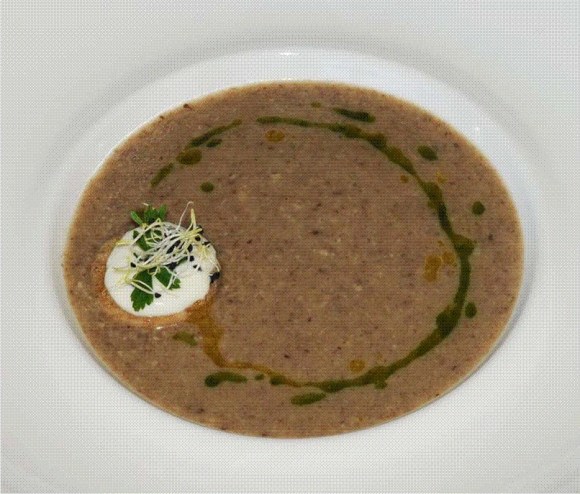
Mixed mushroom soup with cream, chives and truffle oil


If you are fortunate enough to have fresh truffle or preserved truffle, add a teaspoon or two to the soup after it has been cooked.  If you cannot get hold of any form of truffle, do not deprive yourself from having this soup.  It is delicious!
BLOCK HORIZONTAL LINE

Serves 4

MUSHROOM SOUP

The soup:
40 g/1½ oz butter
1 medium shallot, chopped
2 garlic cloves, finely chopped
2 tablespoons/30 ml bacon, finely chopped (ignore if you want to keep it vegetarian)
400 g/14 oz mixed fresh mushrooms, roughly chopped
1 tablespoon/15 ml porcini powder
4 cups/500 ml chicken stock, heated (or vegetable stock)
4 cups/500 ml mushroom stock, heated
1 tablespoon/15 ml Za’atar
salt and freshly ground black pepper
1 tablespoon/15 ml lemon juice

The garnish:
1 tablespoon/15 ml chives, finely chopped
1 tablespoon/15 ml chive oil
1 tablespoon/15 ml truffle oil
⅔ cup/160 ml yogurt cream

In a deep saucepan, heat the butter and sauté the bacon until soft. Remove with a slotted spoon and set aside.  In the same saucepan, add the shallot and garlic and sauté until soft.  Add the mushrooms and cook until most of the juices have evaporated. Add the chicken stock and mushroom stock and bring back to the boil, then lower to a simmer for 10 minutes.  Remove from the heat and set aside to cool slightly.

Pour into a liquidizer, add the fried bacon and lemon and blend until smooth.  Pass through a sieve if you wish, otherwise leave as is with a bit of a texture.  Check the seasoning.

To serve:
Ladle into four soup plates, sprinkle the chives or drizzle lightly with chive oil, then drizzle the truffle oil around,  and lastly place a dollop of the yogurt cream on top.  Serve immediately.

Categories
SOUPS/SAUCES/CONDIMENTS

Current tart served with Creme de Casis syrup


This is a tribute to my mother for “inventing” this very special dessert  which became a big  favorite with family and friends, young and old.

BLOCK HORIZONTAL LINE

CURRENT TART


Preheat the oven to 180ºC (356°F).

The base:
225 g (8 oz) self-raising flour
½ level teaspoon baking powder
225 g (8 oz) caster sugar
225 g (8 oz) unsalted butter (melted and cooled)
½ cup milk and water mixed
1 large free-range egg
zest of 1 lemon
pinch of salt

The topping:
1½ cup black currents
1 tablespoon sugar
2 egg yolks
2 tablespoons Creme de Cassis
1 cup fresh cream, whipped until it forms stiff peaks

If you do not have Creme de Casis or prefer not to use alcohol, black currant syrup (similar flavor, non-alcoholic) is a good substitute, otherwise raspberry liqueur is also good.

The syrup:
½ cup sugar
juice of half a lemon
¼ cup Creme de Cassis
½ cup water

Grease a cake pan of about 22 cm (8.6 in) in diameter with a loose bottom, and then dredge all over inside with a mixture of flour and caster sugar.
Into a mixing bowl, sieve the flour, baking powder, salt and sugar.  Mix in the egg, butter, milk and water and whisk together until the mixture forms a smooth batter.
Pour into the prepared cake tin and bake in the preheated oven for 30-35 minutes, until well risen and golden.  Remove from the oven and leave for 5 minutes.  Remove the cake from the cake tin and leave to cool totally.
In a small saucepan bring the currents and enough water to cover it, add the sugar and bring to a boil.  Cook until the currents are nice and swollen and the sauce is syrupy (you should have about  ¾ cup/175 ml of syrup – if it is not enough, add a little bit more water), then remove from the heat and immediately add the egg yolks whilst stirring vigorously to avoid the yolks from scrambling.  It should be a creamy consistency.  Add the liqueur, reserve 4 tablespoons of the sauce, and set aside to cool completely.
In a small saucepan and over very low heat, heat all the ingredients until it becomes syrupy.  Remove from the heat and set aside to cool right down to room temperature.

To assemble:
Spoon the cooked currents on top of the cake with enough syrup to soak in, then top with the whipped cream and pour the Creme de Cassis syrup around.  Cut the cake to the desired size for serving.

Categories
SOUPS/SAUCES/CONDIMENTS

Deep-fried brie on toast


Serve with fresh figs, crispy glass noodles and a Port vinaigrette

BLOCK HORIZONTAL LINEServes 4


Timing is of the essence when deep-frying the cheese. The result needs to be crispy on the outside and soft and creamy in the inside. The crispiness help with sealing in the creaminess, so when you cut into it, the creamy center will deliciously ooze out.

Chickpea flour chips:
100 g/3,5 oz chickpea flour
2 teaspoons/10 ml olive oil oil for deep-frying (if making the deep-fried brie for the same dish, use the same oil)

The cheese:
75 g/2.6 oz Camembert cheese, chilled
1 free-range egg
35 g/1.2 oz white breadcrumbs (Japanese breadcrumbs [Panko] are
very good)
125 g/4.4 oz flour
½ teaspoon/3 ml cayene pepper
oil for deep-frying (See Safety and practical tips for deep frying)
4 bundles of glass noodles

The port vinaigrette:
½ cup/125 ml vegetable oil
2 teaspoons/10 ml rice wine vinegar
½ teaspoon/3 ml Dijon mustard
1⅓ cup/330 ml port

The garnish:
four slices of bread, trimmed to the size of each wedge (lightly
toasted)
4 fresh figs (preserved figs, each cut in half will do when fresh ones are not available)
1 cup/250 l fresh mixed herb leaves

Chickpea flour has a high proportion of carbohydrates but no gluten and can be used to replace eggs in vegan cooking. It has a distinct flavor and chips are a delicious way of getting extra subtle flavor on the plate.

For the chickpea flour chips, bring 1 cup/250 ml of water to a boil and add salt.  Mix the chickpea flour with half a cup/125 ml of cold water, strain and whisk into the boiling water.  Lower the heat and cook for about 20 minutes.  Transfer to a food processor, add the olive oil and whisk until smooth.  Spread the dough about 8 mm (⅓ in) thick on a baking tray and cover with plastic wrap.  Let it cool and refrigerate for at least 4 hours but preferably overnight.  When ready to serve, remove from the refrigerator and cut into 8 x 2 cm/3 x ¾ in chips.  Sprinkle each chip lightly with flour, then fry until they are crisp and golden. Remove with a slotted spoon and drain on paper towel.  Keep warm until ready to serve.

Cut the chilled cheese into 4 wedges.  Whisk the egg in a bowl, and in another bowl put the breadcrumbs.  In a third bowl put the flour mixed with a pinch of cayenne pepper.  Dust each cheese wedge with the flour, then dip into the egg and finally roll it in the breadcrumbs.
Cover and refrigerate for 15 minutes, then repeat the process.  Cover again and refrigerate until ready to cook.

To deep-fry the glass noodles, heat the oil you will be frying the cheese in to 190°C/374°F. Drop the bundles of glass noodles into the hot oil for 2 seconds (they will puff up immediately), remove from the oil and drain.

For the vinaigrette, whisk together the oil, vinegar and mustard and season to taste.  In a small saucepan bring the port to a boil and reduce until half the quantity remains.  Let it cool and then whisk into the vinaigrette.

To serve:
For the figs:  make two crossing cuts in the stem and cut halfway to the bottom.  Gently squeeze the figs to open up slightly.

Garnish four plates with the toasted bread, figs and basil leaves.  In a large frying pan heat enough oil to cover the cheese.

With a slotted spoon, lower the crumbed cheese into the hot oil.  It will fry very quickly to a golden brown — less than a minute.  Carefully remove from the oil and briefly drain on paper towels, then transfer to each plate and place on top of the bread.  Place the herb leaves and the glass noodles on top, drizzle the port vinaigrette over and serve immediately with the chickpea flour chips.