Categories
SOUPS/SAUCES/CONDIMENTS

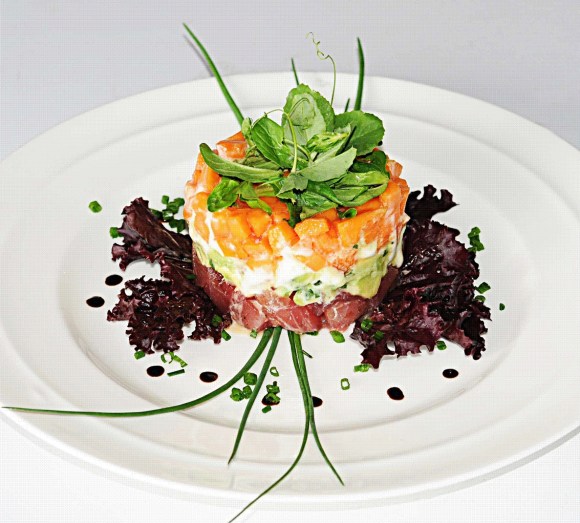
Marinated tuna salad with avocado pear, yogurt cream and mint papaya


Served with avocado pear,yogurt cream and mint papaya.

BLOCK HORIZONTAL LINE

Serves 4

The preparations for this dish should only be done just before serving to ensure utter freshness.The tuna can be replaced with fresh salmon or any other sashimi fresh fish.
MARINATED TUNA SALAD

The tuna:
2 cups/500 ml very fresh raw tuna, cut into small dice
1 tablespoon/15 ml olive oil
½ teaspoon/3 ml balsamic vinegar
salt and freshly ground pepper

The avocado:
2 cups/500 ml avocado pear, cut into small dice
½ teaspoon/3 ml lemon juice
salt and freshly ground black pepper

The yogurt cream:
1 tablespoon fresh/15 ml cream
1 tablespoons/15 ml plain yogurt
1 tablespoon/15 ml chives, finely chopped

The papaya:
2 cups/250 ml papaya, cut into small dice
2 mint leaves, finely chopped
½ teaspoon/3 ml lemon juice
½ teaspoon/3 ml fine sugar

The dressing:
2 tablespoons/30 ml Japanese mayonnaise, mixed with rice wine vinegar and a pinch sugar
extra chives, finely dice

The garnish:
a selection of fine herbs
chive oil
balsamic vinegar syrup

For the tuna, gently mix the tuna with the olive oil, balsamic vinegar and salt and pepper. Cover and set aside.

For the avocado, sprinkle the lemon juice and salt and pepper over the avocado and set aside.

For the yogurt cream, whisk the cream until thick, then mix in the yogurt, chives and salt and pepper.   Gently mix the yogurt cream into the avocado, cover and set aside.

For the papaya, mix all the ingredients, cover and set aside.
For the dressing,  mix all the ingredients, cover and set aside.

To serve:
On each serving plate, place a ring mold and divide the tuna into four. Spoon the tuna into the ring mold and gently press down, then repeat with the avocado mixture, then papaya.  Slowly lift the ring mold whilst pressing the contents down with your other hand. Drizzle some of the mayonnaise over each tower and top with a sprinkle of chives. Scatter the lettuce leaves all round and serve immediately.

Categories
METHODS

Chive oil


CHIVE OILFill a bowl with ice cubes and water. Blanch a bunch of chives in boiling water for 30 seconds, then drain immediately and put in the ice water. Drain, then with paper towels squeeze out the excess water. Chop the chives (about a cup full) and add to a processor with one cup of extra virgin olive oil, peanut oil or sunflower oil.
Blend for 2 minutes and let infuse for a few hours, then strain through a fine sieve. Transfer the oil to a plastic squeeze bottle if you like. The oil can be refrigerated for up to a month.  Bring to room temperature before using.

Categories
MAIN COURSE

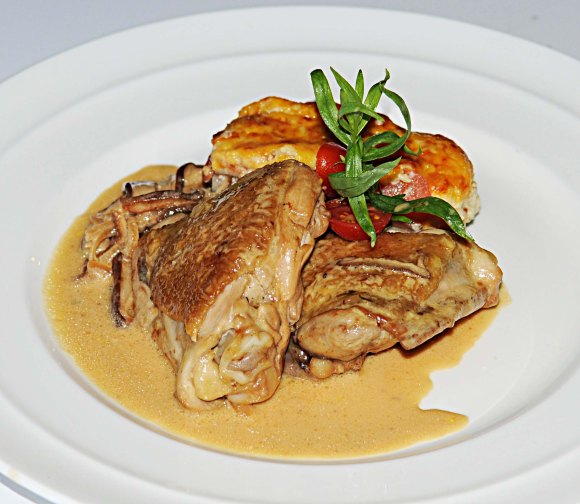
Chicken and mushroom casserole with a creamy champagne and tarragon sauce


Served with  Peccorino Swiss chard, and Macaroni and cheese

CHICKEN CASSEROLEServes 4

The casserole:
2 tablespoons olive oil
12 free-range chicken thighs, deboned (reserve the bones)
1 shallot, finely chopped
12 fresh tarragon leaves
salt and freshly ground black pepper
½ cup brut Champagne
½ cup fresh cream
1 teaspoon Dijon mustard
500 g/1 lb fresh mushrooms, stems removed and sliced
fresh tarragon leaves


Fresh shiitake mushrooms can be replaced with dried ones, but use about half the quantity.

The Peccorino Swiss chard:
1 kg/2 lbs Swiss chard
2 tablespoons butter
2 tablespoons olive oil
1 tablespoon garlic, minced
½ small red onion, diced
2 tablespoons Parmesan cheese
2 tablespoons Peccorino cheese
10 cherry tomatoes, skinned
salt and freshly ground black pepper

The macaroni and cheese:
4 cups milk
40 g butter
50 g/1.7 oz flour, sifted
½ cup Fontina
½ cup mature cheddar cheese
1 teaspoon mustard
400 g/14 oz Riggatoni pasta
15 g/0.5 oz butter
4 large tomatoes, skinned and sliced in 3 mm/0.2 thick slices
1 tablespoon red onion, finely sliced
1 cup Gruyère cheese, freshly grated
½ cup Parmesan


Any leftover Macaroni and cheese is ideal for a light lunch with salad the next day. It will keep, covered and refrigerated, for up to four days, but well wrapped, it also freezes well.

The salsa:
2 ripe pears, julienned
2 teaspoons, finely chopped
1 tablespoon pickled ginger, finely sliced
1½ tablespoon chive oil
1 teaspoon Dijon mustard
2 teaspoons lemon juice
pinch of sugar

The chicken:

  • Heat the oil in a saucepan and lightly sauté the chicken and bones until golden brown all over. Add the shallot and sauté until translucent, then add the tarragon and season with salt and pepper.
  • Add the Champagne and bring to a boil over medium heat. Cover and cook for ±20 minutes, remove the bones, then add the mushrooms and cook for another 15 minutes.
  • Mix the cream and mustard and pour over the chicken. Stir and bring to the boil, then cover and cook for 10 more minutes over low heat, stirring often. Serve immediately.

If you prefer to use reduced fat cream and to avoid it curdling, turn the heat right down at the end of the cooking time and only then pour the cream and mustard over the chicken. Stir gently to heat through, not longer than 15 seconds, then remove from the heat. Do not let it boil again – it will curdle.

  • Serve with some fresh tarragon leaves scattered over.

The Swiss chard:

  • Separate the ribs and leaves. Finely chop the ribs and shred the leaves, keeping them separate as the ribs take longer to cook.
  • Heat the butter and olive oil together in a large saucepan over medium-high heat.
  • Stir in the garlic and onion, and cook for 30 seconds. Remove with a slotted spoon and set aside.
  • Add the ribs and cook for about 5 minutes then add the chard leaves and cook until the leaves are wilted. Drain and squeeze out as much liquid as possible.
  • Put the chard, fried garlic and onions in a processor and pulse until it looks like large breadcrumbs.
  • Remove from the processor to a bowl, add the freshly grated Parmesan cheese and Peccorino. Mix well and tomatoes. Season to taste and keep warm.

The macaroni and cheese:

  • Preheat the oven to 200°C/392°F.
  • For the cheese sauce, bring the milk to a boil in a small saucepan, then remove from the heat.
  • Meanwhile, in a separate saucepan and over a medium heat, melt the butter. Stir in the flour and cook for 3-4 minutes, then gradually stir in the milk and cook gently, stirring constantly, until the sauce is smooth.
  • Reduce the heat and simmer for 3-4 minutes or until thickened. Remove from the heat and add the freshly grated Fontina and cheddar cheese and mustard, then season to taste with salt and freshly ground black pepper.
  • For the macaroni, cook the Riggatoni until tender, drain and set aside.
  • In a large ovenproof dish, start the layering: First a layer of a third of the pasta, followed by a layer of a third of the tomatoes and onions.
  • Spoon over a third of the sauce and sprinkle over a third of the freshly gated Gruyère cheese, then repeat with the rest of the ingredients.
  • Finally sprinkle over the freshly grated Parmesan. Bake in the oven for 20 minutes or until the top is golden brown. Remove from the oven and let it rest for at least 15 minutes before serving.

The pear salsa:

  • Gently mix the pear, chives and pickled ginger in a bowl.
  • Whisk together the chive oil, mustard, lemon and sugar and just before serving, pour over the salsa.

To serve:
Spoon the sauce over the chicken and scatter the tarragon leaves over. Serve with the Swiss chard, Macaroni and cheese and the Pear, chive and pickled ginger salsa.

Categories
METHODS

Clarifying stock for clear soups or aspic


As used in Quail egg and prawn set in aspic molds

Clarified stock is used for clear soups and savory jellies. During the clarifying process a certain amount of flavor will be lost.  To avoid this, add additional finely chopped aromatic vegetables (vegetables, celery, leek, parsley, etc) together with the specified amount of gelatin to the stock.   Then add lightly whisked egg white (2 or 3 depending on the volume of the stock) and bring the stock up to the boil.  The egg white will start to form a crust on top to which all the impurities (that make the liquid cloudy) in the stock get trapped.  Do not stir the stock at all. This process will take about ten minutes after boiling started, then turn the heat of and carefully remove the crust.  Through a sieve lined with double cheesecloth and over a large bowl, slowly ladle the stock through. Do not squeeze the cheesecloth or force the liquid through. The stock is now clarified.  Seasoning are added then to flavor the aspic according to the recipe of the dish you are preparing.

Categories
METHODS

Tomato sauce


TOMATO OIL

4 ripe tomatoes, roughly chopped
1 small clove of garlic, roughly chopped
1 sprig of thyme
4 tablespoons/60 ml extra virgin olive oil
a pinch of sugar, optional

Preparation method
In a food processor, blend the tomatoes and garlic and strain into a small pan. Bring to the boil and add the thyme. Turn the heat down and simmer until the liquid is reduced to half. Remove from the heat, strain the juice again and leave to cool.

Whisk the olive oil, season and add a pinch of sugar if necessary.

Categories
METHODS

TOMATO WATER


Tomato water is an extremely interesting ingredient with its unexpected intense tomato flavor that can be used in a variety of ways.  It is also a great way to use excess quantities of ripe tomatoes and is very easy to make.

Take 2 kg/4.4 lbs very ripe tomatoes, chop roughly and scrape into a food processor.  Add 1 tablespoon coarse salt and blend thoroughly.  Line a sieve with a double layer of cheesecloth and let it rest over a deep bowl.  Ladle the processed tomatoes into the cheesecloth and let it sit overnight in the refrigerator.  You might be tempted to push the tomato to force the juice through, but don’t!  Their own weight will be sufficient to extract the water.

Without squeezing the cloth, discard the contents.  Tomato water keeps, covered and chilled for 4 days, otherwise freeze for later use in small containers for up to 3 months.

Categories
GLOSSARY / METHODS METHODS

CHICKEN STOCK


¼ cup/60 ml olive oil
4 celery sticks, coarsely chopped
2 leeks, coarsely chopped
3 large onions, quartered
3 large carrots, coarsely chopped
½ whole head garlic, unpeeled
3 kg/6.6 lbs raw free range chicken carcasses
5 liters/10.5 pts cold water
6 black peppercorns
6 coriander seeds

Bouquet garni:
1 large leek
1 celery stick
1 large sprig thyme
1 small bunch of parsley
1 bay leaf
Tie the leeks, celery, thyme, parsley stalks and bay leaf together with
kitchen string.

In a large stock pot, heat the olive oil and lightly fry the celery, leeks, onions and carrots.  Add  the raw chicken carcasses and cover with the water. Add the peppercorns and coriander seeds, and bring to a gentle simmer, frequently skimming the brown foam that forms on the surface.

Add the bouquet garni to the pot, return to a gentle simmer for about 4½ hours, still skimming frequently but do not stir the stock.  Remove from the heat and let it cool to room temperature, then strain it by ladling the contents of the pan through a muslin-lined colander set over a large bowl. Try not to disturb the solids at the bottom, it will make the stock cloudy.  Cool the strained stock, remove all traces of fat, then chill or freeze in smaller containers until needed.  Discard the solids.

For a brown chicken stock simply brown the chicken carcasses or joints in the oven at 200°C/400°F for about 15-20 minutes, before adding to the stock pot.

Categories
GLOSSARY / METHODS METHODS

FISH STOCK


½ cup/125 ml olive oil
1 small leek, finely chopped
1 small onion, finely chopped
1 celery stick, finely chopped
1 small bulb fennel, finely chopped
2 cloves garlic
1 bay leaf
½ teaspoon/3 ml dried fennel seeds
2 kg/4.6 lbs fish bones, thoroughly rinsed and roughly chopped
1½ cups/375 ml dry white wine
¼ cup/60 ml  Noilly Prat
8 cups/2 liters cold water
2 sprigs each of parsley, thyme and tarragon
½ lemon, unpeeled
1 teaspoon/5 ml white peppercorns

In a large pot, lightly saute the leek, onion, celery, fennel and garlic in the oil.  Add the fish bones, wine, Noilly Prat and the dried herbs, and cook until the wine  has evaporated.  Add the water and bring to the boil.  Skim the surface frequently. Add the fresh herbs, lemon and peppercorns, and cook gently for 20 minutes.  Remove from the heat and let the stock cool.  Strain through a muslin lined colander, but take care not to disturb the solids at the bottom.  Leave to cool, then chill or freeze in smaller containers until needed. Discard the solids.

Categories
SOUPS/SAUCES/CONDIMENTS

NOILLY PRAT


Noilly Prat is a special French vermouth excellent for cooking and can be used in most ways that wine, brandy or sherry can be used. It gives a unique flavor to fish and chicken and can be used in a wide range of cocktails. Also add it to sauces, stews, risottos and fruit dishes.
Noilly Prat is infused with a long list of herbs ie camomile, coriander, bitter orange peel, nutmeg, etc. but the full list remains secret. Each of the plants and herbs used is prepared in the traditional manner and only plants that have been dried slowly are accepted, resulting in flavoring qualities unique to Noilly Prat…

Categories
SOUPS/SAUCES/CONDIMENTS

Crème Fraîche


To make your own crème fraîche:
Take 1 cup/250 ml double cream and add 1 teaspoon/5 ml cultured buttermilk. Stir together in a saucepan and heat gently to 85°C/185°F. Pour into a container, partially covered and leave at warm room temperature for 6-8 hours, or until thickened.  When thick, stir the cream, cover and refrigerate. The flavor intensifies and the cream thickens the longer it stands.  Makes 1 cup/250 ml.