Categories
METHODS

GARAM MASALA


GARAM MASALAGaram masala is a blend of ground spices common in Indian cuisine. Chef’s that specialize in Indian cuisine, all have their own blends.  This is my version:

Add all the following spices to a medium hot pan and roast until fragrant.  Do not let it burn, though.  Then transfer to a coffee grinder, grind until fine and store in a sealed jar in the freezer.
4 x 2.5 cm/1 in cinnamon sticks
3 cloves
3 black peppercorns
2 black cardamom pods, crushed to release the seeds, husks removed
2 teaspoons/10 ml cumin seeds

Categories
GLOSSARY / METHODS

Dashi granules


Dashi is Japan’s fundamental stock and seasoning, much used in Japanese cooking, particularly in Japanese soups and dipping sauces for tempura, stews and salad dressings. It is made from dried flakes of bonito (dried, smoked and cured bonito, a type of tuna, which has a strong aroma but a smoky, mellow flavor), kelp and shiitake mushrooms and are available in granule form in Asian supermarkets.

Categories
GLOSSARY / METHODS

Mirin


Mirin, is a low-alcohol sweet Japanese cooking wine, made of a mixture of medium grain rice, glutinous rice and distilled rice spirit, then matured for two months.  It adds a lovely glaze to grilled foods and a mild sweetness in cooking. Mirin is sold in well stocked supermarkets. It can be substituted with dry sherry to which sugar is added but will not have the same results in flavor.

Categories
SOUPS/SAUCES/CONDIMENTS

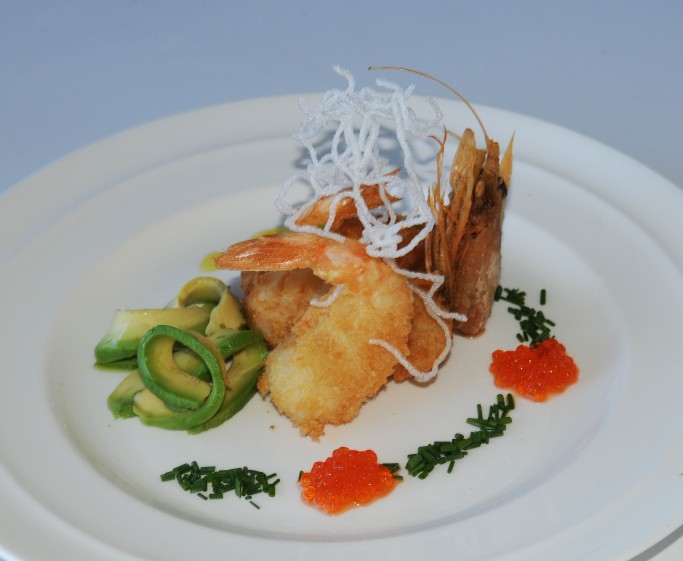
Fish and prawn tempura with an Oriental dipping sauce


The tempura prawns can also be served on a potato cake, toast or rice cake; serve also with salmon roe, chopped chives and/or avocado.

SEAFOOD TEMPURAServes 4

The fish:

320 g /11 oz firm white fish, skin removed
8 tiger prawns, shelled and de-veined (always reserve and freeze prawn shells for later use to make seafood stock. )
flour for dusting
salt and freshly ground black pepper
oil for deep-frying

The tempura batter:
1 cup/250 ml self-raising flour
1 tablespoon/15 ml cornstarch
1 cup/250 ml soda water
a few blocks of ice

The dressing:
3 tablespoons/45 ml hot water
1 teaspoon/5 ml dashi granules
1-2 teaspoons/5-10 ml mirin
2 tablespoon/30 l soy sauce

The garnish:
fresh coriander leaves for serving
salmon roe or caviar


See the Glossary for safety tips on deep-frying.

  • Heat the oil in a deep frying pan to about 180°C/356°F.
  • Cut the fish in strips of 3 x 8 cm/1 x 3 in and butterfly the prawns.
  • For the dipping sauce, dissolve the dashi granules in the hot water and let it cool.
  • Add the mirin and soy sauce and mix well.

The mirin is quite sweet but after tasting the sauce you can decide whether you want to add more.

  • In a large bowl, mix the two flours with the or soda water until just combined, but still quite lumpy. Add the blocks of ice to keep the mixture cold.
  • Dust the pieces of fish and prawns lightly with flour and season well.
  • Dip the fish in the batter, gently shake off the excess and place in the hot oil (not more than four pieces at a time).
  • Deep-fry in batches until golden and drain on paper towel.
  • Before adding the next batch, make sure the oil is back to the correct temperature.
  • Keep the cooked fish uncovered in a low oven until you are ready to serve.
  • Serve immediately.

To serve:
Serve the fish tempura pieces stacked on each plate with garnishes of your choice, and the dipping sauce in a small bowl for each serving.

Categories
METHODS

Puff pastry


You can, of course, buy ready-made puff pastry, but the pride and satisfaction of having made a successful puff pastry — watching it rising to a golden crispy crust in the oven — is worth a million dollars. Needless to say, the flavor of the all butter pastry is phenomenal.   See Puff pastry apple and sultana parcels with Calvados butter sauce or Stuffed beef fillet rolled in pastry

500 g/17.6 lbs flour, sifted
500 g/17.6 lbs butter, chilled and cut into small dice
1 teaspoon/5 ml white wine vinegar
1¾ cup/425 ml ice water
pinch of salt

In a food processor, measure 25 g/0.8 oz of the flour and 450 g/15.8 oz of the butter and mix well.  Spoon the mixture out onto a large piece of plastic film and shape into a neat rectangle of approximately 14 x 20 cm/5.5 x 7.8 in.  Put in the refrigerator.

Mix the rest of the flour (450 g/15.8 oz), the balance of the butter (25 g/0.8 oz), the vinegar and salt and process, adding the iced water little by little until the dough comes together nicely.  Lift it out onto a floured surface and knead until smooth.  Roll out and shape into a neat rectangle of about 25 x 35 cm/9.8  x 13.7 in with the edges as straight as possible.  Wrap in plastic film and place in the refrigerator for 20 minutes.    Unwrap the dough and place the butter mixture diagonally over the center of the pastry.  Pull up the far ends of the dough to cover the butter mixture and press the seams down gently to seal them. Press down the sides to seal in the butter.

Roll out the dough carefully (the butter must not break out) in one direction only until it is about three times as long as it is wide and the corners square – gently easing them out with your fingertips if necessary.

Fold the top part a third of the way down, then fold the bottom part over that to make 3 layers.  With the rolling pin, press the seams gently together.  Turn the dough 90° to the right and roll out once more in a rectangle 3 times as long as it is wide.  Repeat the folds and press the edges with the rolling pin.  Turn 90° again.  Wrap in plastic film and store in the refrigerator for 30 minutes.

Repeat the rolling and folding and turning of 90° four times (every time in the same direction), placing the pastry in the refrigerator after each time.

The pastry is now ready to be used.  If you are not going to use all of it immediately, divide up in size portions you will require and wrap each one individually in plastic film.  It will freeze very well and should be taken out of the freezer about 1 hour to defrost at room temperature.  It is better to defrost it in the refrigerator overnight.

Categories
GLOSSARY / METHODS

SICHUAN PEPPERCORNS


Sichuan peppercorns is not strictly speaking pepper but berries of a shrub called prickly ash.  Sichuan pepper, unlike ordinary pepper, has a pungent flavor and the aftertaste, rather than being hot as is in the case of pepper, is numbing.  The “peppercorns” should be crushed and dry-roasted to bring out their full flavor.

Categories
METHODS

Chicken cut into pieces the Chinese way


Cutting the chicken this way, makes it much easier to serve when entertaining a large group of people.

  • Use a cleaver or a large sharp knife and with the chicken breast facing upwards, cut right through the chicken against the side of the backbone into two halves.
  • Cut each chicken half diagonally across to give you two pieces each of a breast and a wing, and two pieces of a leg and a thigh.
  • Find the joint between each breast and wing and cut right through to separate the breast from the wing. Do the same with the leg and thigh.  You will now have eight pieces.
  • Cut each wing into two pieces on the joint, and chop each leg into three pieces.  (If you wish, you can then put the tips of the wing and the leg aside to make stock later on.)
  • Cut each breast into three pieces diagonally, and do the same with the thighs.
    You should now have 20 pieces if you do not discard the tips of the wings and legs.
Categories
MAIN COURSE

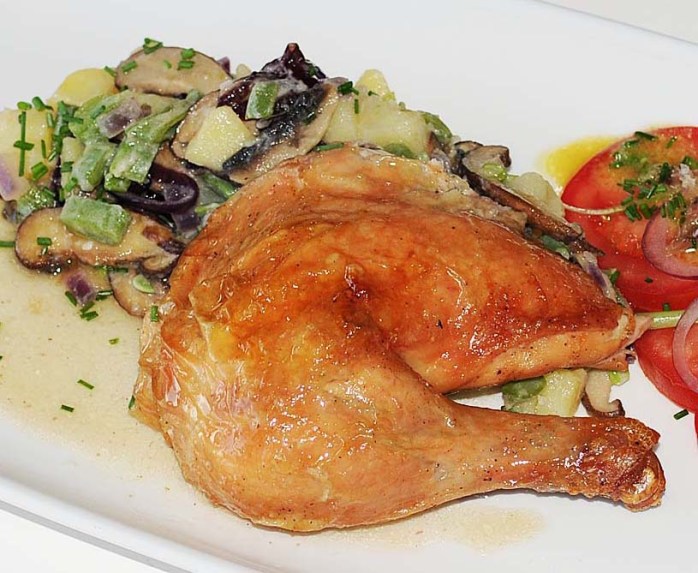
Thyme smoked chicken (Done on a Weber)


Served with a creamy white wine and thyme sauce, served rice and any vegetables. 


To smoke food, means to slowly cook over indirect heat and a low fire with smoldering flavorings such as herbs or special wood. For this recipe however it is a combination of smoking and roasting. Here we serve the chicken with a Bulgur wheat salad with fennel, egg, grapes and sun-dried tomatoes and a Roast potato with rosemary.

THYME SMOKED CHICKEN

Serves 4

The chicken:
1 large free-range chicken, washed inside and out, and dried
3 tablespoons/45 ml olive oil
salt and freshly ground black pepper
juice of ½ lemon
20 sprigs of fresh thyme, tied in two bundles
2 cups/500 ml chicken stock

The sauce:
1 teaspoon garlic, minced
1 shallot, finely chopped
1 cup/250 ml chicken stock
the pan drippings
1cup/250 ml fresh cream (optional)
salt and freshly ground black pepper

The bulgur wheat salad:
250 g/9 oz bulgur wheat
4 small free-range eggs (small hen’s eggs or quail eggs)
1 fennel bulb, halved and finely sliced
1 bunch spring onions, chopped
25 g/0.8 oz sun-dried tomatoes in oil, drained and sliced
a handful of green seedless grapes, cut in half
3 tablespoons/45 ml chopped fresh parsley
2 tablespoons/30 ml chopped fresh mint
75 g (2.6 oz) black olives, stoned
¼ cup/60 ml olive oil
1 small garlic clove, minced
2 tablespoons/30 ml lemon juice
salt and ground black pepper


For the smoking, we strongly recommend using the indirect cooking method in a kettle barbecue. Set up your grill for indirect heat by building a 2 zone fire, one on each side – drip pan goes in the middle under the meat. Make a charcoal fire and let burn until the coals are coated lightly with white ash.

  • Rub the oil over the skin of the chicken and season inside and out with salt and pepper.
  • Prepare the fire with two side fires and a central position for a drip try.
  • Generously rub with olive oil all over, then place the chicken, breasts up, on top of the wire racks of the barbeque, over the hot coals (with the dripping tray directly underneath), then position the sprigs of thyme on each side of the chicken.
  • Place the lid firmly on but keep the grill vents open, and cook for about 20 minutes. Then remove and discard the burnt thyme.
  • Tip the carcass to let the juice in the cavity run into the dripping tray (do this every 10 minutes from now on), pour the chicken stock in the dripping tray, and place the chicken back on the grid with the breasts facing down.
  • Replace the lid firmly again and continue cooking for another 20 minutes.
  • Then make a small incision in the inside of each leg. If the juices run clear it is cooked, otherwise leave it for 5-10 minutes longer.
  • Another way of seeing whether the chicken is cooked, tip it again to see whether the juices in the cavity is clear. If you are satisfied that the juices are clear, remove the chicken from the grill and leave to rest in a warm place, breasts side down, for at least 25 minutes.
  • While the chicken is cooking, heat the oil in a saucepan and gently fry the garlic and shallot until golden.
  • Turn up the heat then add the chicken stock and reduce until syrupy. Put aside until the chicken is cooked.
  • When the chicken is cooked and while resting it, remove the dripping tray from the barbeque and drain off the excess oil.
  • Pour the contents of the dripping through a strainer (scraping off all the bits that are stuck to the tray) into the reduced chicken stock and over medium heat, bring to the boil then add the cream (if using).
  • Pour through a fine sift again into a clean pan and simmer gently until the sauce has thickened, stirring continuously. Check the seasoning.

To serve:

  • Joint the chicken and place a serving of joints on warm serving plates.
  • Spoon the sauce around and garnish with a sprig of fresh thyme.
  • Serve with the rice and other side dishes of your choice.
  • If you wish, cut the chicken in easy serving pieces the Chinese way. A description of this method is in the Glossary.
Categories
SOUPS/SAUCES/CONDIMENTS

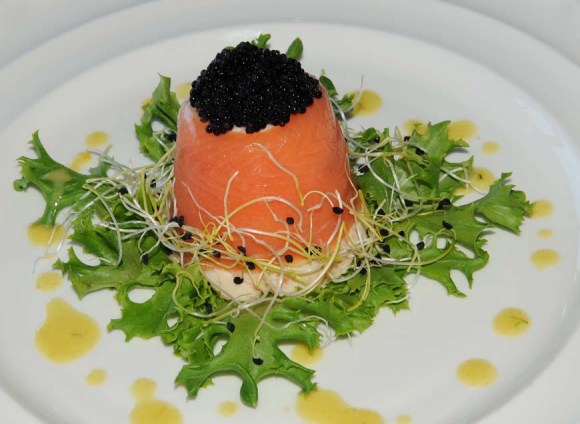
Smoked trout mousse


Served with horseradish and micro salad leaves

SMOKED TROUT MOUSSEServes 4

The mousse:
4-8 ribbons of smoked trout (to line the ramekins)
2 smoked trout fillets
½ cup/125 ml full cream, chilled
1 tablespoon/30 ml butter at room temperature
Tobasco sauce, a few drops
2 tablespoons/30 ml fresh lemon juice
salt
1 sheet gelatin
1 tablespoon/15 ml water
1½ cup/750 ml chilled full cream
4 tablespoons/60 ml caviar (if caviar is not available, finely chopped chives will do)

The horseradish cream:
3 tablespoons/45 ml fresh horseradish, grated
1 tablespoon/15 ml white wine vinegar or lemon juice
1 teaspoon/5 ml sugar
1 tablespoon/30 ml fresh dill, finely chopped
1 cup/250 ml fresh full cream
salt and freshly ground black pepper


This horseradish cream also goes well with  beef, beets, chicken, eggs, fish, pork, salmon, sausages, shellfish, smoked fish, etc. Covered, the sauce will keep for 2 to 3 days in a refrigerator.

The garnish:
micro salad leaves and sprouts
horseradish cream
dill sprigs
small wedges of lemon

  • Have ready four ramekins lined with cling wrap with excess all round to cover the mousse, then line the inside of each ramekin with the trout ribbons, leaving the bottom open.
  • In a food processor, blend the trout, cream, butter and lemon juice and add salt to taste.
  • Soak the sheets of gelatin in a bowl of cold water and after 5 minutes, drain and squeeze out the excess water.
  • Heat a small saucepan on low heat and add the gelatin with one tablespoon of water.
  • Let the gelatin dissolve thoroughly, then remove from the heat and add to the trout puree.
  • Whisk the cream until stiff and fold into the trout puree. Taste for seasoning.
  • Fill the ramekins with the mousse, then cover with the overhanging cling wrap and chill the mousse for at least 8 hours or overnight.
  • For the horseradish cream, blend the horseradish, vinegar and lemon juice, sugar and dill in a food processor.
  • In a separate bowl, whisk the cream until stiff then fold in the horseradish mixture.
  • Season to taste, then strain if you prefer a smooth texture and refrigerate for 4 – 8 hours.

To serve:
Arrange the salad leaves and sprouts in the center of each serving plate and turn the mousse out onto the greens. Carefully peal off the cling wrap then spoon some caviar (or chives, if using) on top and drizzle the horseradish cream around the mousse. Decorate with a few sprigs of dill and the wedges of lemon and serve immediately.

Categories
METHODS

STILL-FREEZING


Place the empty shallow container in which you wish to freeze the ice cream in the freezer for about 30 minutes before pouring the cream mixture into it.  Ice crystals form in the inside of the container as the mixture freezes and it needs to be broken down and mixed into the rest.  Do this after 30 minutes by whisking (or processing with the pulse setting) the mixture until it is smooth again.  Return to the freezer and repeat every half hour for about 3 hours or until it become more solid and smooth.  Take care not to overwork the mixture as it might become grainy.