Categories
STARTERS/SIDES

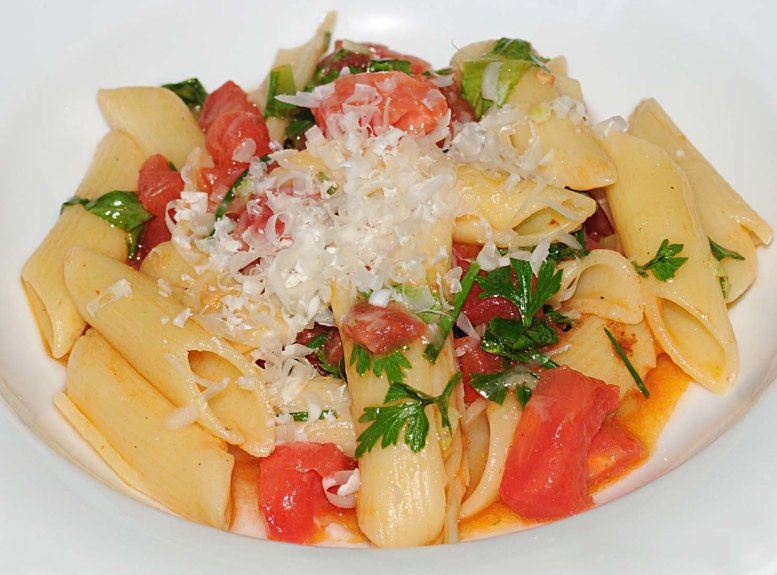
Pasta with a fresh tomato and brie sauce


This is a delightfully light and fresh tasting starter or light summer lunch. Served with some fresh crusty bread and a crispy white wine, guarantees total satisfaction.

PASTA WITH TOMATO AND BRIE SAUCEServes 4

olive oil
4 shallots, finely sliced
3 garlic cloves, finely chopped
8 rashers of bacon, finely chopped (omit if for vegetarians)
375 g penne pasta
250 g/8.8 oz good quality brie, roughly chopped
8 tomatoes, skinned and roughly chopped
salt and fresh ground pepper
2 tablespoons fresh parsley, finely chopped
2 cups Parmesan cheese
1 cup fresh basil, finely sliced


For every 100 g/3.5 oz of pasta, you’ll need 5 cups water and 2 teaspoons salt in a large saucepan. It is important to use lots of water when cooking pasta to enable the pasta to move around while cooking. Bring the water to the boil and add salt before you add the pasta. The best way to judge whether the pasta is cooked, is to taste it.

  • Heat 2 tablespoons olive oil in a frying pan and fry the shallots, garlic and bacon for about 4 minutes, until lightly caramelized. Remove from the heat.
  • Meanwhile, cook the pasta until tender but still have a bite to it. Drain but reserve one cup of the cooking liquid.
  • Place the saucepan with the pasta back onto low heat and mix in 2 tablespoons olive oil.
  • Reheat the pan with the fried onion mix and deglaze with the reserved liquid.
  • Add this mixture to the pasta, stir in the brie and let it melt slightly, then add the tomatoes, salt and pepper to taste, parsley and half of the Parmesan cheese.
  • Let simmer for about 2 minutes, then remove from the heat.
  • Dish up immediately with the basil and the rest of the Parmesan sprinkled over.
Categories
METHODS

NAAN BREAD


500 g/1 lb flour
1 packet/10 g/0.3 oz dried yeast or 30 g fresh yeast

If you prefer to use fresh yeast and the recipe requires dried yeast, simply multiply the dry yeast quantity by 3, i.e. 7 g/0.25 oz dried yeast becomes 21 g/0.7 oz fresh yeast.
Another way to remember:
10 g/0.35 g fresh yeast = 1 teaspoon/5 ml dry yeast.

60 ml/¼  cup plain yogurt
2 tablespoons/30 ml melted butter
1 teaspoon/5 ml salt
1 teaspoon/5 ml sugar
¾ cup/180 ml warm milk
olive oil for coating the dough
garlic, finely chopped to sprinkle over the bread

You can add seeds of your choice, aniseed, poppy-seed, etc to give it a distinct flavor or brush with oil and garlic.

Dissolve the sugar in the warm water to activate the yeast., add the yeast and wait for it to froth.

Meanwhile, sift the flour and salt together in a separate bowl and make a well in the center. Add the melted butter, yoghurt and yeast, mix well, then knead it well until a dough forms. It should be quite elastic and may need a little extra flour, in which case, sprinkle over a little flour and knead again.  (This can be done in a food processor with dough hook attachment.)

Place the dough in a clean bowl that you have greased lightly with oil, also coat the dough with a little oil.  Cover with a tea towel and set aside in a warm place to rise for about 2 hours or until the dough has doubled in size.

Preheat your oven to 220°C/392°F.  Brush a baking sheet with oil.

Remove the dough, separate into 6-8 pieces and roll out into rounds or oval shapes, about 5 mm thick.  Place on a baking sheet, brush with olive oil and garlic (your choice) and place in the oven for 10 minutes.  Remove from the oven and serve warm.

Categories
SOUPS/SAUCES/CONDIMENTS

Fruit, spice and nut rice


450 g/16 oz Basmati rice
75 g/2.6 oz unsalted butter
1 tablespoon/15 ml corn oil
1 bay leaf
3 black peppercorns, crushed
4 green cardamom pods, crushed and husks removed
1 teaspoon/5 ml salt
75 g/2.6 oz sultanas
50 g almonds, flaked (slivered)
4 cups/1 liter water

Wash the rice twice, drain in a colander and set aside. Heat the butter and oil in a medium saucepan, over low heat, and add the bay leaf, peppercorns and cardamoms, and fry for about 30 seconds. Add the rice, salt, sultanas and flaked almonds, and stir-fry for about 1 minute, then pour in the water. Bring to the boil, lower the heat, then cover with a tightly-fitting lid. Cook for 15-20 minutes then turn off the heat and leave the rice to stand, still covered, for about 5 minutes before serving.  When ready to serve, remove the bay leaf, and fluff up the rice with a fork.

Categories
MAIN COURSE

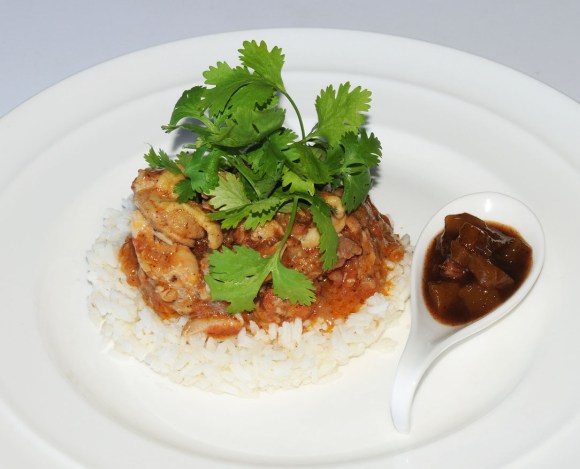
An Indian chicken dish delicately flavored with a selection of spices


Serve with Basmati rice, Poppadoms and a variety of sambals

BLOCK HORIZONTAL LINE

Serves 4

This is a wonderful dish to make a day ahead as the flavor becomes more intense overnight, therefore making it ideal for entertaining. 

INDIAN CHICKEN DISH

The chicken:
6 free-range chicken thighs
6 free-range drumsticks
3 tablespoons/45 ml oil
1 ℓ/4 cups chicken stock
4 tablespoons/60 ml plain yogurt
¼ cup/60 ml lemon juice
4 fresh green chilies, ribs and seeds removed, finely sliced
1 tablespoon/15 ml garam masala

 The spicy onion and tomato and mixture:
2.5 cm/1 in cinnamon stick
seeds of 2 large cardamom pods
8 black peppercorns
1 teaspoon/5 ml black cumin seeds, ground
1 teaspoon/5 ml chili powder
2 tablespoons/30 ml oil
3 medium onions, finely chopped
1 tablespoon/15 ml fresh ginger, finely chopped
3 garlic cloves, finely chopped
6 medium tomatoes, peeled, seeded and chopped
salt to taste
250 ml/1 cup chicken stock

The rice:
(Adding the spices are optional.  Use plain Basmati rice if you wish otherwise make the Fruit, spice and nut rice)
450 g/16 oz Basmati rice
75 g/2.6 oz unsalted butter
1 tablespoon/15 ml corn oil
1 bay leaf
3 black peppercorns, crushed
4 green cardamom pods, crushed and husks removed
1 teaspoon/5 ml salt
75 g/2.6 oz sultanas
50 g almonds, flaked (slivered)
4 cups/1 liter water

The garnish:
2 tablespoons/30 ml fresh coriander, chopped
2 fresh green chilies, chopped (optional)

In a heavy-based saucepan, heat the oil and fry the chicken pieces until golden brown. Add the chicken stock and salt to taste, bring to the boil then  turn the heat down, cover and let it simmer gently for 30 minutes.

Meanwhile prepare the onion and tomato mixture.
In a coffee grinder or pestle and mortar, grind the cinnamon, cardamom seeds, peppercorns, cumin seeds and chili powder.
In a saucepan heat the oil and over low heat fry the onions, ginger and garlic gently until golden brown.  Add the ground spices and fry a little longer,  then add the tomatoes and cook slowly until the tomatoes break up and a thick sauce is formed.  Keep on cooking whilst stirring regularly. When all is thoroughly coated (take care that it does not stick to the bottom of the pan), season to taste.  If it becomes too thick before the tomatoes are cooked, add the chicken stock.  

Add the cooked onion and tomato spice mixture (recipe above) to the chicken, mix through and let it simmer, covered, over low heat for another 15 minutes.  Check constantly that it does not cook dry.  Add a little boiling hot water if necessary.   When cooked,  check the seasoning and remove the pan from the heat.  Add the yogurt, lemon, fresh chilies and garam masala to the chicken and gently mix to heat through.  Do not cook again.

Meanwhile, wash the rice twice, drain in a colander and set aside.  If making the spicy rice, heat the butter and oil in a medium saucepan, over low heat, and add the bay leaf, peppercorns and cardamoms, and fry for about 30 seconds. Add the rice, salt, sultanas and flaked almonds, and stir-fry for about 1 minute, then pour in the water. Bring to the boil, lower the heat, then cover with a tightly-fitting lid. Cook for 15-20 minutes then turn off the heat and leave the rice to stand, still covered, for about 5 minutes before serving.  When ready to serve, remove the bay leaf and fluff up the rice with a fork.

To serve:
Place a 10 cm (2 in) diameter pastry ring on the plate and fill it with the Fruit, spice and nut rice.  Arrange the chicken pieces around it with a generous helping of the sauce.  Lift the pastry rings off the rice and place some coriander and whole chili on top of the rice.  Serve the Sambals in small individual bowls for each guest and Naan bread and /or Poppadoms (available at upmarket super markets) on the side.

Categories
SOUPS/SAUCES/CONDIMENTS

STELLA


STELLA AVATOR

I have had no formal chef’s training. Classical piano was my parents’ choice, and that took care of the first 20 years of my life. Journalism and radio followed (my own choices, this time), and these opened many doors for me into different countries, people, cultures — and, of course, foods. During a (felt like endless but enjoyable) series on radio, which I used as a platform for my love for food, I shared lots of interesting recipes and food news with listeners.  The creation of this blog feels like and extension of my radio experience and makes me deeply happy.

My earliest memories of food come from the family kitchen at home; I can still remember the wonderful smells of the dishes my mother prepared. I became aware of the flavors of her creations at an early age. Some I enjoyed and preferred, while others depressed me with their lack of interesting flavors. My mother was a good cook, but not a gourmet, and sadly this often showed. What I did appreciate was that she always involved me in the preparation, sharing her knowledge of nutrition, flavor, color, and the harmonies of each plate she dished up. She was also a genius with leftovers and quick meals when unexpected guests arrived. This is one of the things that stands out in my mind, and it inspired me to create wonderful dishes from leftover foods myself.

I carried on with the tradition of carefully planning meals with the same principles, while at the same time offering a variety and elegant presentation. In the process, I also developed a passion for seeking out the best available products, adhering to each season’s offerings, and treating it with the respect it deserves, which eventually became part of my daily culinary life and travels. I did these things not because I wanted to become a chef, but to satisfy myself, family and friends with creations of gorgeous food and exciting flavors. All of which, I hope, is reflected in this blog.

Categories
SOUPS/SAUCES/CONDIMENTS

Baked aubergine and mushroom stacks with tomato and balsamic vinegar


Serves 4

BAKED AUBERGINE AND MUSHROOM STACKS

The aubergine stacks:
2 tablespoons/30 ml olive oil
2-3 large aubergines, sliced across in 2 cm/0.8 in wide slices (you
should have 16 slices)
8 large black mushrooms, wiped clean
salt and freshly ground black pepper
4 tablespoons/60 ml soft goat’s cheese
4 slices of brie, medium flavored
8 basil leaves

The tomato sauce
1 tablespoon/15 ml olive oil
1 medium onion, finely chopped
1 garlic clove, finely chopped
3 large very ripe tomatoes, skinned and deseeded, roughly chopped
3 sprigs fresh rosemary, finely chopped
few sprigs of fresh thyme, leaves picked
salt and freshly ground black pepper
vegetable stock (optional), if needed

The dressing:
3 tablespoons/45 ml balsamic vinegar (not an expensive grade)
2 tablespoons/30 ml caster sugar
2 tablespoons/30 l water
zest of one lemon, finely chopped
2 tablespoons/30 ml chives, finely sliced

Heat the olive oil in a large frying pan and fry the aubergine slices until golden brown on both sides. Remove with a slotted spoon and drain on kitchen paper. In the same pan, fry the mushrooms, until they have released all their moisture. Remove from the heat and set aside.

For the tomatoes, heat the olive oil and over medium heat, fry the onion and garlic for about 1 minute. Turn up the heat, add the tomato and cook for about 10 minutes – nothing more. It must still retain the freshness. Add the herbs and season well. Reserve about 1 cup/250 ml for drizzling at the end.

For the dressing, bring the balsamic vinegar and sugar to the boil and remove from the heat immediately. (By the time you need to use the balsamic vinegar it might have turned too sticky to use. Just add a little water and reheat, stirring well.) Add the lemon zest and set aside.

Preheat the oven to 220°C/422°F.

To assemble:
In a heatproof dish make four “towers” starting at the bottom with one layer of aubergine, followed by a mushroom, a spoon full of tomato sauce and a layer of the soft goat’s cheese crumbled. Repeat this procedure until all the vegetables have been used, finishing with tomato. Put a slice of brie on top, scatter the crumb mixture over and drizzle a little bit of olive oil over. Put in the oven for about 10 minutes or until the brie starts bubbling. Remove from the oven and put a ”tower” on each plate. Drizzle the reserved tomato sauce around and a swirl of the balsamic vinegar glaze. Sprinkle the chopped chives and spring onions around, and serve immediately. If you have sufficient size ovenproof dishes, each “tower” can be baked and served individually.

Categories
MAIN COURSE

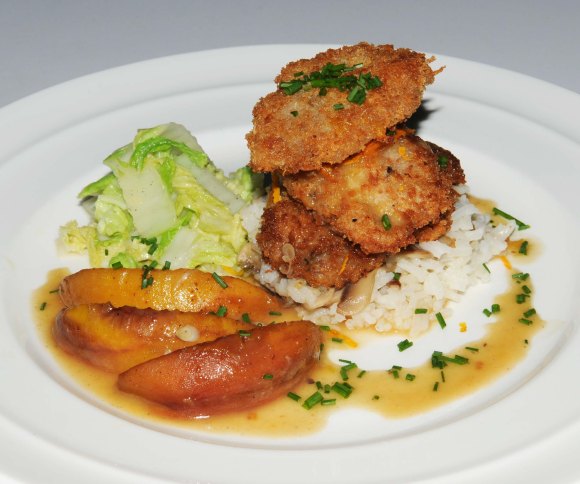
Duck breast fritters with Basmati rice and roast peaches


If you wish to serve another vegetable,  cabbage, lightly poached in butter and seasoned with nutmeg, goes very well with this dish.

Serves 4

DUCK BREAST FRITTERS

The duck:
4 free-range duck breasts
2 tablespoons/30 ml shoa xing rice wine (available at Asian supermarkets)
1 tablespoon/15 ml szechuan pepper, ground (available at Asian supermarkets)
1 clove garlic, minced
salt
flour for sprinkling
2 free-range eggs, whisked
Japanese breadcrumbs (Panko breadcrumbs)
oil for deep-frying

The peaches:
1 tablespoon/15 ml sugar
1 tablespoon/15 ml butter
4 ripe peaches, stoned and quartered (use canned peaches if fresh ones are unavailable but cut down on the sugar)
2 cloves, ground
2 tablespoons/30 ml Peach Schnapps

The rice:
450 g/15.8 oz Basmati rice
4 cups/1 liter chicken stock
75 g/2.6 oz butter
salt

The garnish:
2 tablespoons/30 ml orange zest, grated
2 tablespoons/30 ml fresh chives, chopped

Score the breasts on the fat side with 2 cm/0.8 in space between each cut. Mix the rice wine, pepper, garlic and salt and rub onto the breasts on both sides. Set aside in the refrigerator for at least 2 hours.

When ready to cook, wipe most of the marinade of the breasts, heat a non-stick pan and sear the breasts on the fat side only, until crispy (about 3 minutes). Remove the breasts from the pan and set aside to cool. Store the rendered fat in a container for another time to fry potatoes, etc.

When the meat has rested for at least ½ hour (it will be quite raw still), slice the meat into 4 thick slices across. Place each slice of breast between two pieces of cling film and with a mallet, flatten the meat until about 15 mm/1 in) thick.

Sprinkle each slice with flour, then dip it in the egg and finally coat with the breadcrumbs. Heat the oil in a large saucepan,  fry the crumbed slices in the hot oil until crispy — not longer than 30 seconds on each side. Remove from the pan and let drain on kitchen paper.

Meanwhile, in a saucepan, melt the sugar and butter and saute the peach quarters in it for about 1 minute on each side, de-glaze with the schnapps, sprinkle over the ground cloves and let simmer for another 2 minutes or until just tender.

Add the rice, salt and chicken stock to a medium saucepan. Bring to the boil, lower the heat, then cover with a tightly-fitting lid. Cook for 15-20 minutes then turn off the heat and leave the rice to stand, still covered, until about 5 minutes before serving. When ready to serve,add the butter and fluff up the rice with a fork.

To serve:
On each heated serving plate, spoon some rice and stack four duck breast fritters on top.  Divide the peaches and place around the rice and drizzle some of the peach juices over.

Categories
MAIN COURSE

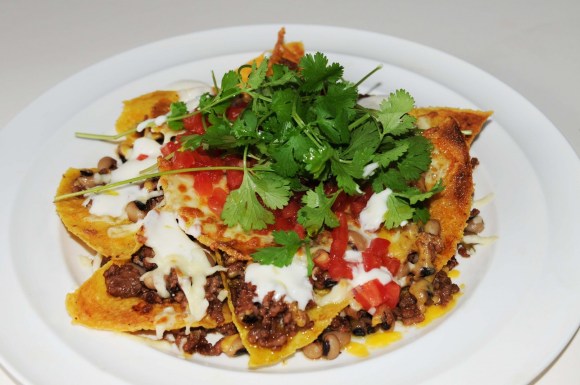
Nachos with tomato salsa, quacomole and sour cream


Nachos (believed to have originated in Mexico) is regarded as a snack and generally consists of fried tortilla chips topped with a layer of refried beans, various meats, jalapeño and a layer of shredded cheese.  There are many variations and this recipe is my own variation.  I hope you enjoy it.
LINE

Serves 4 Nachos

The beans:
1 cup/250 ml black eye beans, soaked in water overnight

The meat:
125 g/4.5 oz bacon, finely diced
500 g/1 lb ground lamb
2 garlic cloves
1 large onion, finely sliced
1 tablespoons/15 ml cumin, ground
2 cups/500 ml lamb stock (or chicken stock), heated
4 pickled jalapeno, seeds removed and finely sliced salt and freshly ground black pepper

The tomato salsa:
1 large onion, finely chopped
2 tomatoes, peeled, seeds removed, and chopped
1 cup/250 ml spring onions, finely sliced
1 tablespoon/15 ml olive oil
1 teaspoon/5 ml lemon juice
pinch of sugar
salt and freshly ground black pepper

The sour cream:
1 cup/250 ml cream
2 cups/500 ml natural yoghurt
2 tablespoons/30 ml lemon juice
salt and freshly ground black pepper

The quacomole:
2 ripe avocados, roughly mashed with a fork
1 pickled jalapeño, seeds removed if required, finely chopped
3 tablespoons/45 ml onion, finely chopped
1 tablespoon/15 ml tomato, peeled, seeded and finely chopped
1 tablespoon/15 ml cilantro
½ tablespoon/7 ml lime juice
a few drops of Tobasco sauce
salt and freshly ground black pepper

The toppings:
1 small bunch cilantro
24 corn tortillas
250 g/½ lb cheddar cheese, grated
250 g/½ lb hard mozzarella cheese, grated

In a saucepan, cover the soaked and drained black eye beans with cold water and bring to the boil.  Boil until tender (about 40 minutes), drain and add salt to taste.   Cover the saucepan and keep warm.

In a large frying pan, heat the olive oil until very hot.  Add the bacon and cook for a minute or so, then add the mince and stir to break up the lumps.  Fry until it started to get a good caramelized color, then add the garlic, onion, cumin, salt and freshly ground black pepper.  Cook for about 5 minutes, then add the hot lamb stock and cook until the sauce starts to thicken. Stir through the jalapeño and the black eye beans, cover the pan and turn off the heat.

For the tomato salsa, mix all the ingredients in a bowl, cover and refrigerate until needed.

For the sour cream, whisk the cream until slightly thickened, then add the rest of the ingredients and mix well.  Cover and refrigerate until needed.

For the quacomole, mix all the ingredients just before serving, cover and refrigerate until needed.

Heat the oven to very hot and arrange the corn tortillas on a big baking plate. Heat until the color changes slightly, then remove from the oven, cool slightly and break up in the required sizes.  Alternatively, if available, use good quality bought corn chips.

To serve: Use a big shallow baking dish and spread half the lamb mixture on the bottom, followed by a layer of chips.  Scatter half the cheddar and mozzarella around and half the cilantro.  Repeat the layer and finish with the cheese.  Do not add the rest of the cilantro now.  Place the baking dish under the grill and leave until the cheese is melted and bubbling.  Remove from the oven and sprinkle the rest of the cilantro over.  Serve with the tomato salsa scattered over and a generous drizzle of the sour cream.  Serve the quacomole on the side as well as the rest of the sour cream for guests to add as they wish.  Extra tortilla chips will certainly be appreciated.
Categories
METHODS

The “sous-vide” (waterbath) method of cooking


The “Sous-Vide” way of cooking, as described in the recipe for Slow poached marinated pork belly (”sous vide”- style) with Mushroom Basmati rice, is a method in which you seal raw and marinated food in a food grade plastic bag and then cook it at a low temperature in a water bath.  The food, and I am referring mainly to meat, i.e. tough cuts of meat, comes out beautifully succulent and incredibly tender after a few hours.  If, as a home cook, you want to experiment with this method of cooking, remember it is not really necessary to invest in expensive equipment.  You need a reliable oven, a good quality ovenproof dish with a lid (I use a cast iron saucepan) that is big enough to hold the whole piece of meat instead of a temperature controlled water bath, a vacuum packing machine and patience.  Compared to other cooking methods, the food cannot dry out and the flavor intensifies because all the seasoning and juices stay in and around the food.

 The basic steps I follow i.e. for cooking pork belly, is to neatly trim the meat, then marinate it in a mixture of spices and stock or wine for a few hours, preferably overnight.  When ready, transfer the marinated meat with the marinade to a food grade plastic bag that will withstand the heat, and seal it in a vacuum packing machine.  If you do not possess a vacuum packing machine, do not despair.  Try to get all the air out of the pouch after you have added the meat,  then tie a secure knot. Simple!  Preheat the oven to the temperature according to the recipe — usually relatively low, then heat water in the ovenproof dish to the same temperature as you have set the oven.  Carefully lower the sealed bag into the hot water and make sure the bag is totally covered with the water.  A good idea is to put a heatproof plate on top before you secure the lid on.  Place the dish in the oven and set your timer for the desired time.  When the cooking time is up, carefully remove the bag from the hot water with tongs and place in a deep dish.  Cut the bag open and let the meat and juices slide out of the bag into the dish.  If the juice is too thin, pour it off into a saucepan and over high heat, reduce to the desired consistency.  The sauce will have all the flavors of the marinade as well as the meat.  And as a bonus you have gorgeous tender and succulent meat!

 Here is my Pork belly recipe that I cook in this way…

Categories
SOUPS/SAUCES/CONDIMENTS

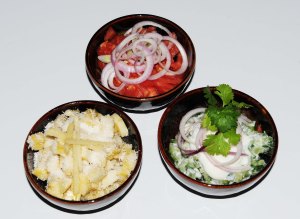
SAMBALS TO SERVE WITH INDIAN FOOD


SAMBALS

SAMBAL 1:
Papaya and banana coated with coconut
Makes about 2 cups/500 ml
1 small papaya, cut into 2 cm/0.7 in pieces
1 banana, cut into 2 cm/0.7 in pieces
4 tablespoons/60 ml cup lemon juice
desiccated coconut

Sprinkle the lemon juice over the banana and papaya and toss in enough desiccated coconut to coat each piece. Serve immediately at room temperature.

SAMBAL 2:
Tomato and onion salsa
Makes about 2 cups/500 ml
4 ripe tomatoes, unpeeled, seeded and cut into 1 cm/0.4 in pieces
1 red onion, finely chopped
3 tablespoons/45 ml coriander leaves, finely chopped
1-2/15-30 ml tablespoons lime juice
1 teaspoon/5 ml soft brown sugar
salt and freshly ground black pepper

Combine all the ingredients and gently mix together.  Cover with plastic wrap and refrigerate for 15 minutes.

Chef’s note: The reason for not peeling the tomato, is simply to keep the tomato pieces intact and not losing too much juice.

 SAMBAL 3:
Cucumber and yogurt mix (Raita)
Makes about 2 cups
1 teaspoon/5 ml each of ground cumin  and mustard seeds, toasted
1 cucumber, seeded and diced
1 cup/250 ml plain yoghurt
½ teaspoon/3 ml ginger, freshly grated
3 sprigs of mint, finely chopped
salt and freshly ground black pepper

Fry spices in a dry pan for 1 minute until fragrant and set aside.  In a separate bowl, put the cut cucumber and sprinkle salt over.  Set aside to draw out all the water.   Just before serving the meal, drain the cucumber and mix with the cucumber and yogurt and add the toasted spices, ginger and mint.  Mix gently to combine well.  Serve chilled.